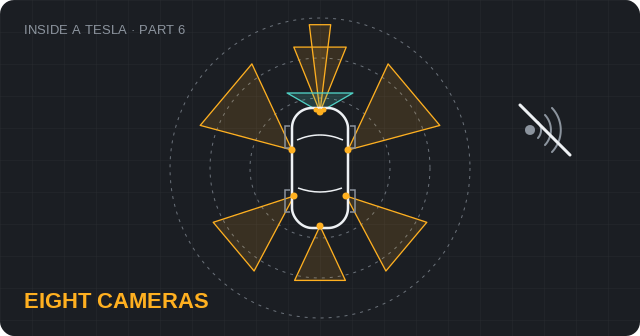
Part 6 of 12: Inside a Tesla Previous: Fewer Wires, One Valve: Tesla's Electrical and Thermal Design Next: The Chip in the Glovebox: Tesla's FSD Computer (HW3, HW4, AI5)
All 12 parts
- Inside a Tesla: A Computer That Happens to Have Wheels
- One Casting Instead of 70 Parts: Tesla's Giga Press
- Building a Car in Pieces: Tesla's Unboxed Process
- The Battery Is the Floor: Cells, Chemistry and the Structural Pack
- Fewer Wires, One Valve: Tesla's Electrical and Thermal Design
- Eight Cameras, No Radar: How a Tesla Sees
- The Chip in the Glovebox: Tesla's FSD Computer (HW3, HW4, AI5)
- Tesla HydraNet and Bird's-Eye View: From Eight Cameras to One Map
- Tesla Occupancy Network: Seeing Things It Has No Name For
- From Hand-Written Rules to One Network: How FSD Plans
- The Data Engine: How Tesla Teaches the Car
- Robotaxi: A Car With Nobody in the Driver's Seat
You park outside on a cold, wet night. In the morning the touchscreen shows an alert: a camera is blocked, and some driver-assist features are limited until the view clears. Nothing is broken. Tesla’s fix is warm air.
The alert comes straight from Tesla’s owner’s manual. It says that “condensation can form inside the camera enclosures, especially if you park your vehicle outside in cold or wet conditions”, and tells you to warm the cabin, run the windshield defroster and point the front vents at the door pillars (Model 3 manual, 2025 copy). A foggy lens matters this much because the camera is no longer one sensor among several. Radar left Tesla’s cars from 2021. The ultrasonic parking sensors went in 2022. This part is about what is left.
Part 6 of Inside a Tesla. I like the car and the tech, so I researched it to feed my own curiosity; not affiliated with Tesla, not investment advice.
Short version:
- A current Tesla sees through seven or eight cameras and nothing else. Tesla’s manuals say where they sit, and Tesla’s own 2021 page gave their reach: 250 m for the narrow forward camera down to 50 m for the rear one.
- Tesla took out forward radar from May 2021 and the 12 ultrasonic sensors from October 2022. A radar or lidar measures distance. A camera does not, so a neural network has to estimate it.
- The trade-offs are public. Tesla says vision is enough. Regulators are studying how FSD copes with glare, fog and dust. Rivals keep radar and lidar. I show both sides, labelled by who said what.
Every claim below says who made it: Tesla says (its pages, manuals, patents and talks), regulator (NHTSA), or outside analysis (press, teardowns, academics). Tesla’s site blocks automated fetchers, so I read archived copies of its pages, and the links point to those.
The eight cameras
Count them on an older car and you get eight. Tesla’s manual puts one above the rear license plate, one in each door pillar, one in each front fender, and three behind the windshield above the rear view mirror (Model Y manual, 2023 copy). A separate cabin camera above the mirror watches the driver. It is not one of the eight.
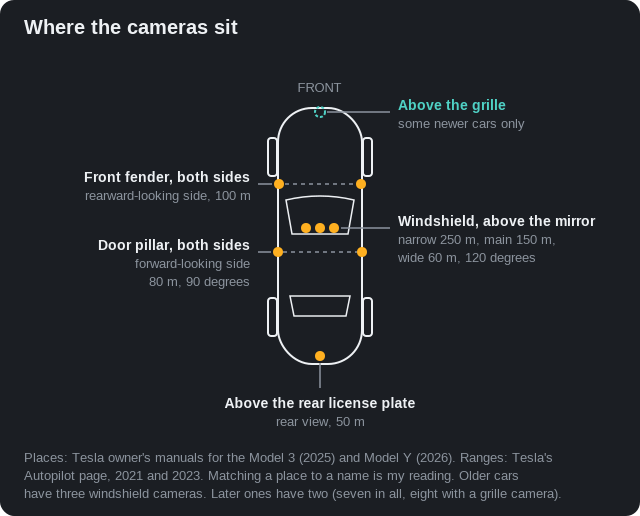
The mix has moved on. Tesla’s 2025 Model 3 manual lists two cameras behind the windshield (copy). That list has seven cameras and no grille camera. Its Model Y manual, in an April 2026 copy, lists two there plus “A camera is mounted above the grille on the front bumper.”, so that car totals eight (copy).
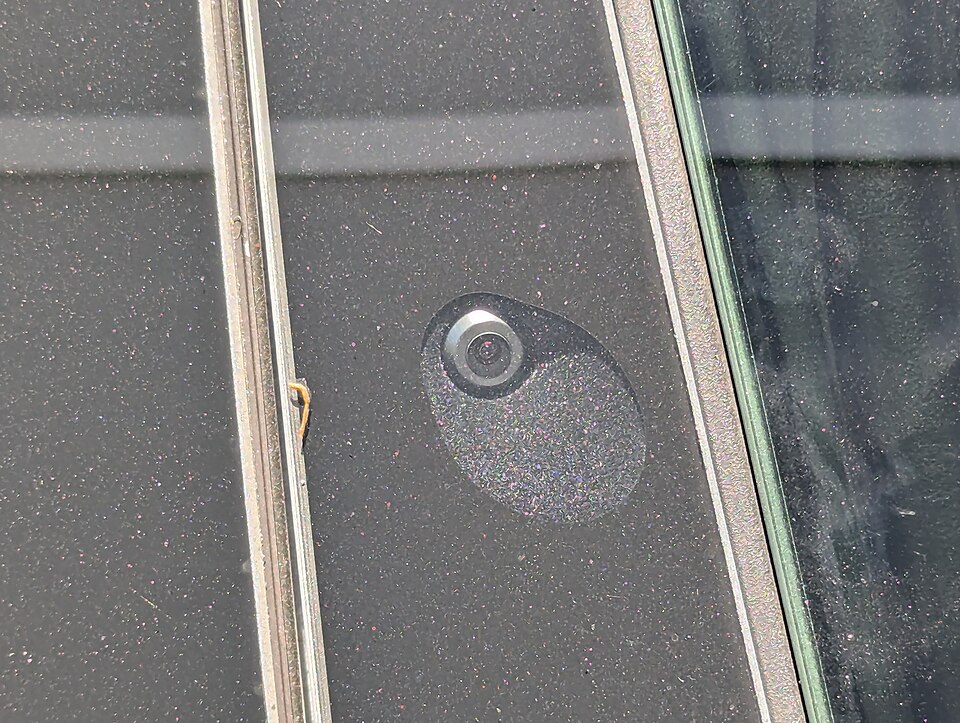
Photo: Mliu92, CC BY-SA 4.0, via Wikimedia Commons, resized. A camera in a passenger-side door pillar.

The manual gives places. Tesla’s Autopilot page gives names and jobs. I matched the two myself: the pillar camera looks forward and to the side, the fender camera looks back along the flank. In Tesla’s words, from its 2021 page:
- Wide forward: a “120 degree fisheye lens captures traffic lights, obstacles cutting into the path of travel and objects at close range.”
- Main forward: “covers a broad spectrum of use cases.”
- Narrow forward: “a focused, long-range view of distant features. Useful in high-speed operation.”
- Forward-looking side: “90 degree redundant forward looking side cameras look for cars unexpectedly entering your lane on the highway.”
- Rearward-looking side: they “monitor rear blind spots on both sides of the car.”
- Rear: “useful when performing complex parking maneuvers.”
Three forward cameras exist because one lens cannot do two jobs. A lens that sees far sees a thin slice. A lens that sees wide sees little detail far away. So Tesla fits one of each, and a network has to combine them.
How far they see
Tesla’s Autopilot page of May 2021 put a number on each camera. It said “eight surround cameras provide 360 degrees of visibility around the car at up to 250 meters of range.” The same page listed a “max distance” for every camera, and for the radar and ultrasonic sensors that were still fitted then (page, archived 3 May 2021):
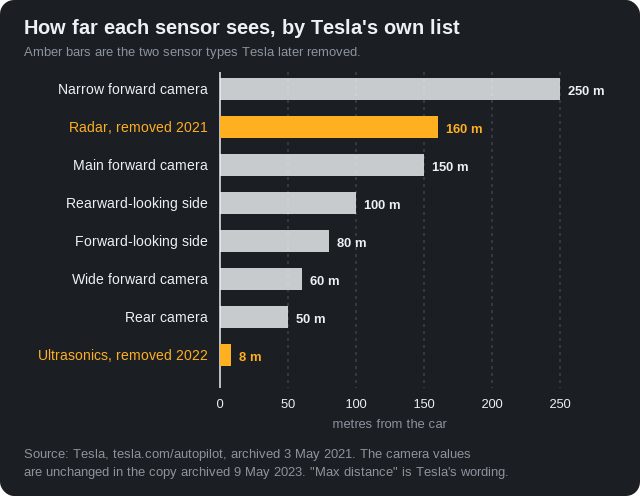
Two things stand out. The narrow camera out-reached the radar, 250 m against 160 m, on paper. And the ultrasonic sensors saw 8 m, which fits a parking aid and little else.
The picture below draws the same numbers to scale. A Commons user, Mliu92, made the original drawing and released it into the public domain. I redrew it in the series colours.
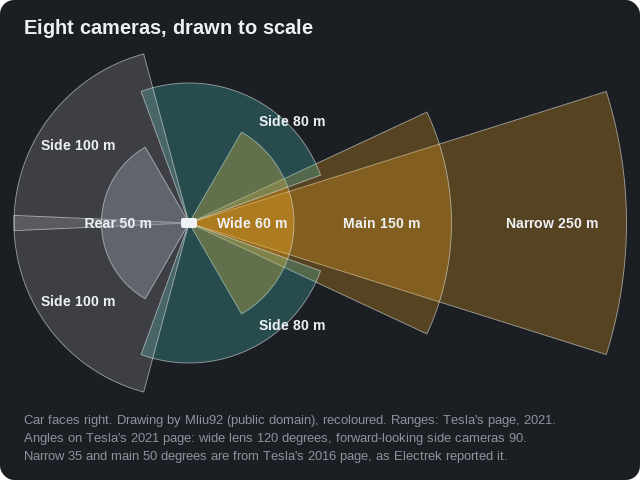
Read the numbers with care.
- “Max distance” is Tesla’s wording. It is not a promise that the car detects a pedestrian at that range.
- The 2021 page gives angles for two cameras, the wide lens (120 degrees) and the side cameras (90). Electrek reported that Tesla’s 2016 page gave 50 degrees for the main camera and 35 for the narrow one (Electrek, 20 Oct 2016). The same report gave 150 degrees for the wide camera, so Tesla changed that figure at some point.
- Tesla’s 2025 and 2026 manuals give positions but no ranges. The latest Autopilot page I could read is the copy archived on 9 May 2023, and its camera numbers match 2021 (archive). I found no Tesla range list for newer cars.
HW3 and HW4: the same count, sharper pictures
Tesla has not published a camera spec sheet that I could reach. What exists comes from teardowns and firmware digging, so treat these figures as unofficial:
| Older cars (HW3) | Newer cars (HW4) | |
|---|---|---|
| Resolution | about 1.2 MP, 1280 x 960 | about 5 MP, 2896 x 1876 |
| Sensor chip, per Electrek (firmware, estimated) | onsemi AR0136AT | Sony IMX963 |
| Behind the windshield | three cameras (Tesla manual) | two cameras (Tesla manual) |
| Front camera | none listed | above the grille on some cars (Tesla manual) |
The resolution and chip names are from Electrek, 2 Dec 2025, which cites firmware, not a teardown. Its text says IMX963 for HW4, while its own table lists “Sony IMX490 (Estimated)”. So the chip name is the shakiest cell in the table. The same article says the researcher @greentheonly found a newer sensor name, “IMX00N”, in Tesla firmware, and that Tesla made no statement about it. Not a Tesla App (September 2023) reports the same 1.2 and 5 MP, with the 5 MP figure tied to a supplier report.
The jump is 2896 / 1280, about 2.3 times as many pixels across. My arithmetic: if the lens angle were the same, a sign far away would cover 2.3 times as many pixels across on a new car as on an old one. That is why people could read license plates and signs in the owner footage that Not a Tesla App cites. It does not by itself tell you how far a car can see. The lens, the software and the weather matter as much.
What came out, and when
Tesla’s first Autopilot hardware set, announced on 19 Oct 2016, had all three kinds of sensor. Tesla’s blog said every new car would have eight cameras, twelve ultrasonic sensors and a forward radar (Tesla blog, archived). Then the sensors left, one type at a time:
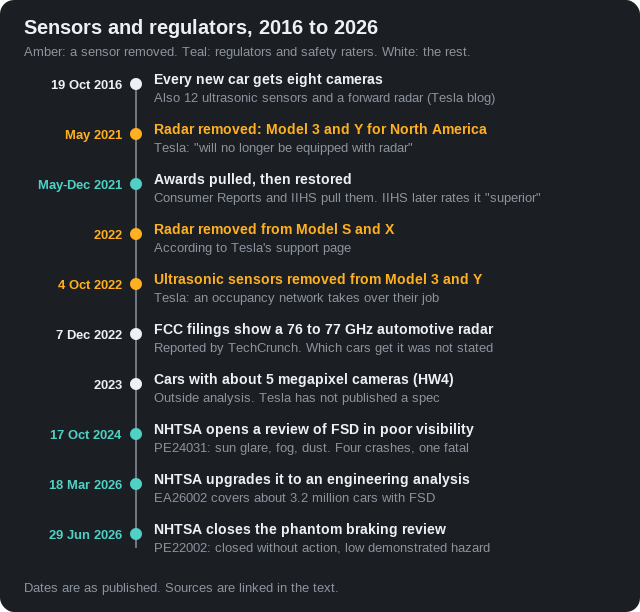
Radar, May 2021
Tesla says, on its support page of 25 May 2021: “Beginning with deliveries in May 2021, Model 3 and Model Y vehicles built for the North American market will no longer be equipped with radar. Instead, these will be the first Tesla vehicles to rely on camera vision and neural net processing to deliver Autopilot, Full-Self Driving and certain active safety features.” Smart Summon and Emergency Lane Departure Avoidance “may be disabled at delivery.” Model S, Model X and cars for other markets kept radar for the time being (page, archived). By 2025 the page says radar left the S and X in 2022.
Tesla’s AI lead then, Andrej Karpathy, explained the move at a computer-vision workshop (CVPR) in June 2021. As CleanTechnica reported it, he said: “Three weeks ago, we started to ship cars that have no radar at all.” He read out a question from Elon Musk: “When radar and vision disagree, which one do you believe?” and the answer: “Vision has much more precision, so better to double down on vision than do sensor fusion.” Karpathy added that once vision is that good, radar “is really starting to contribute noise.” I did not see the talk myself, so these are the words as reported.
Outside reaction came within days. CNBC reported on 27 May 2021 that Consumer Reports dropped the Model 3 as a “top pick”, that the insurance-funded group IIHS planned to remove its Top Safety Pick+ award, and that NHTSA’s ratings pages no longer showed check marks for forward collision warning, lane departure warning, crash imminent braking and dynamic brake support on cars built from 27 April 2021 (CNBC). The reason given was features that were missing or untested, not a crash result.
Then the tests came in. Consumer Reports restored the Model 3 on 29 June 2021 after IIHS tested the camera-only system. IIHS’s David Aylor said “the performance seems to be similar for both systems” (Jalopnik). On 21 December 2021 IIHS restored the Model Y’s award, saying cars built after April 2021 earned “superior” ratings in both the vehicle-to-vehicle and vehicle-to-pedestrian tests (Repairer Driven News).
Ultrasonic sensors, October 2022
The ultrasonic sensors were twelve small discs in the bumpers. Each sent a sound pulse and timed the echo, which is why Tesla’s 2021 page gave them 8 m. On 4 Oct 2022 Tesla said new Model 3 and Model Y cars would ship without them. Tesla says: “Along with the removal of USS, we have simultaneously launched our vision-based occupancy network - currently used in Full Self-Driving (FSD) Beta - to replace the inputs generated by USS.” The same page says “high-definition spatial positioning, longer range visibility and ability to identify and differentiate between objects.” Cars without the sensors “will be delivered with some features temporarily limited or inactive”: Park Assist, Autopark, Summon and Smart Summon (page, archived Oct 2022). TechCrunch added that Tesla said the features would “eventually be restored” over the air (TechCrunch). An occupancy network predicts which small blocks of space around the car are filled. A later part of this series covers it.
What does the car do today? Tesla’s Model Y manual (Australian edition, April 2026 copy) describes “Tesla Vision Park Assist”: “Your vehicle uses the cameras mounted on the front, rear, and sides of Model Y to create a high-fidelity reproduction of surrounding objects on the touchscreen.” The same page says Park Assist “does not detect children, pedestrians, bicyclists, animals, or objects that are moving, protruding, located too far above or below the cameras, or too close or too far from the cameras”, and that the feature “may be temporarily limited or inactive until it is enabled with a future software update for vehicles manufactured as of approximately mid-February 2024” (manual, April 2026 copy).
Was radar really gone for good?
Outside analysis. On 7 Dec 2022 TechCrunch reported FCC filings from Tesla for a “76-77 GHz Automotive Radar”, with a letter saying it would not be marketed before mid-January 2023. The article said it was not yet clear which models would get it (TechCrunch). I found no Tesla statement on which cars carry one. The manuals still say “Radar (if equipped)” in places, as the 2023 Model Y copy above does. So “Teslas have no radar” is true for many cars, but it depends on the model, the market and the build date.
What each kind of sensor measures
All three sensors answer one question: what is out there, how far, and how fast is it moving? They answer it with different physics.
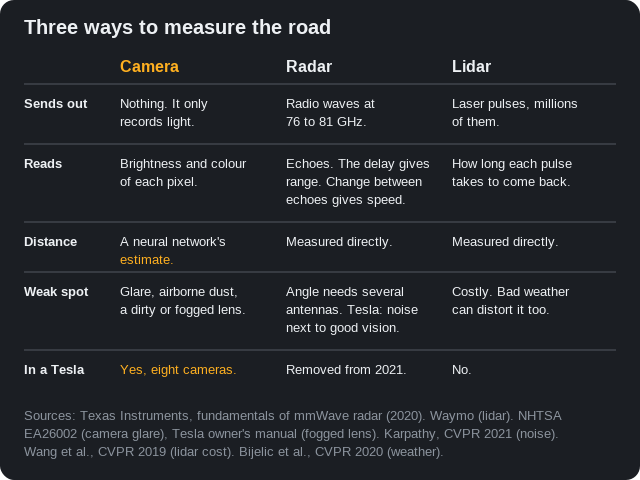
Radar sends radio waves and listens for the echo. Texas Instruments’ guide to automotive-band radar says the signal travels at 76 to 81 GHz, a wavelength of about 4 mm. The echo’s delay gives the range. The phase change between two transmitted chirps gives the speed, and at least two receive antennas are needed to get the angle (TI, 2020). So a radar reads distance and speed straight off the echo, and it needs no light. Waymo says radar “is effective in rain, fog, and snow” (Waymo).
Lidar sends laser pulses and times their return. Waymo says its lidar “paints a 3D picture of the vehicle’s surroundings” and sends “millions of laser pulses in all directions.” The result is a cloud of points:
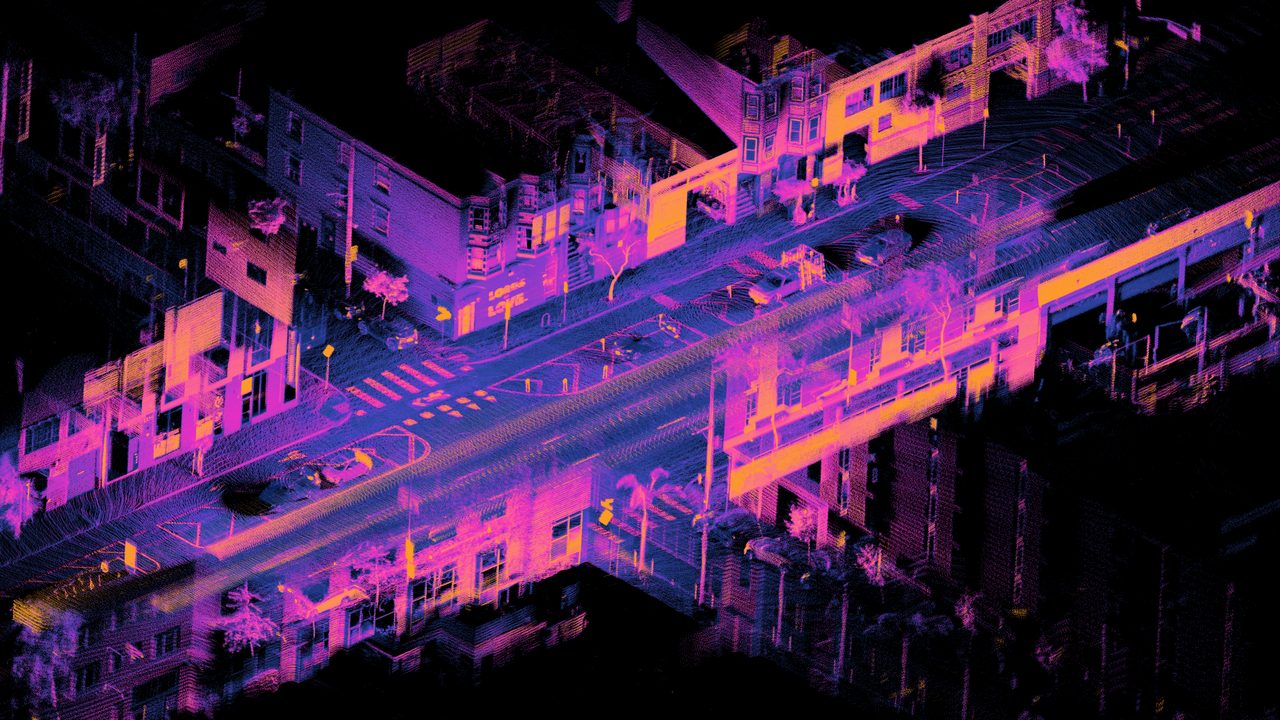
Photo: Daniel L. Lu, CC BY 4.0, via Wikimedia Commons, resized and converted to JPG. Ouster OS1 lidar on a moving car, about 23 million points over 18 seconds.

A camera sends nothing. It records how much light reaches each pixel. One flat picture has no depth in it. Distance has to be worked out from clues such as size, perspective and how things move between frames. Karpathy said in 2021 that “our neural net is able to process visual input to understand the depth and velocity of objects around us” (VentureBeat). That is a Tesla claim, and the next part of the series looks at how the network works.
Academics have studied the gap. Wang and colleagues (CVPR 2019) wrote that top 3D detectors used lidar while camera-based ones lagged, which people blamed on poor depth estimates. They argued that “it is not the quality of the data but its representation that accounts for the majority of the difference,” and that changing the representation helped a lot (arXiv). Camera-only depth was a real weakness then, and part of it may have been fixable in software.
For comparison, here is what a lidar-first car looks like. Waymo’s sixth-generation Driver has 13 cameras, 4 lidar and 6 radar, with “overlapping fields of view, all around the vehicle, up to 500 meters away” (Waymo, Aug 2024).
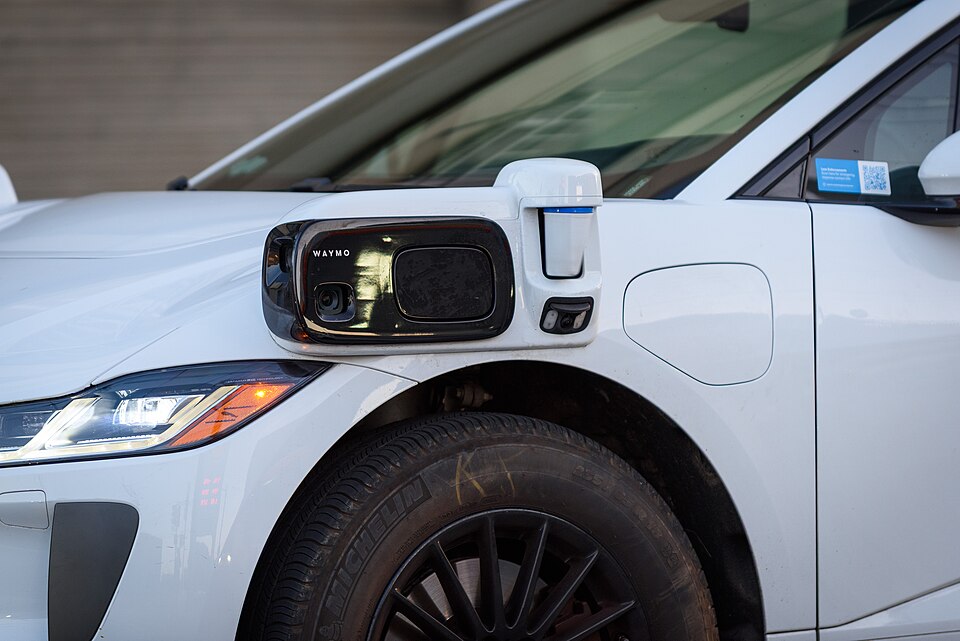
Photo: 9yz, CC BY 4.0, via Wikimedia Commons. One of four side sensor packages on a Waymo Jaguar I-Pace.

Radar as a teacher
If radar measures distance, how does a camera-only car learn distance? One answer is in a Tesla patent, US 11,288,524, “Estimating object properties using visual image data”, granted on 29 March 2022. It describes training a model with camera images that are paired with readings from a distance-sensing source, with radar distances matched to objects in the pictures. The readings serve as ground truth (Google Patents).
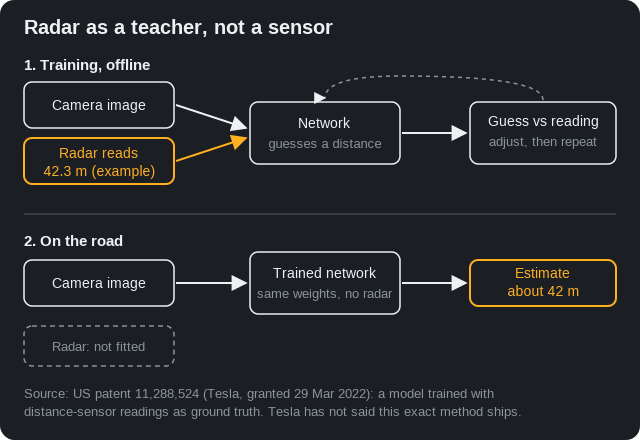
So radar can be a teacher in training and be absent on the road. The author of the VentureBeat piece wrote that Tesla used radar data to verify the network’s inferences while labelling. The patent has a 2019 priority date (filed 19 Feb 2021), and Tesla has not said that this exact method runs in its cars today.
What critics and regulators raise
Can a camera be blinded?
Yes, and Tesla’s own manual says so (the opening alert). The regulator question is how well the car notices. In the engineering analysis EA26002, opened on 18 Mar 2026, NHTSA says FSD “relies exclusively on vision-based cameras”. It says Tesla built a “degradation detection system” when it moved to Tesla Vision in mid-2021, and that “available incident data raise concerns” that the system “fails to detect and/or warn the driver appropriately under degraded visibility conditions such as glare and airborne obscurants.”
The numbers in that document: about 3.2 million cars with FSD, nine crashes, one fatal. NHTSA adds that in each of the further crashes it found in Tesla’s responses, “FSD also lost track of or never detected a lead vehicle in its path.” Tesla’s own analysis said a later update to the system may have affected 3 of the 9. An engineering analysis is an investigation, not a finding of a defect. The step before it, PE24031, opened on 17 Oct 2024 with four crashes in sun glare, fog or airborne dust (EA26002, PE24031).
One more item, from outside analysis. Electrek reported on 21 Jul 2026 that NHTSA’s information request of 2 July asks Tesla for an internal document titled “Radar Saves Us”, which NHTSA says Tesla gave it earlier. Only the title is public, and Electrek says it does not know what is inside (Electrek).
Is one kind of sensor enough?
Tesla says yes, because disagreement between sensors is a cost. Karpathy also argued that lidar needs high-definition maps and that “it’s unscalable to collect, build, and maintain these high-definition lidar maps” (VentureBeat).
Others build in a second channel on purpose. Mobileye describes “true redundancy”: a camera subsystem and a separate radar-and-lidar subsystem, each building its own full model. It says it saw “complementary, not redundant, sensors” elsewhere, and that if one system fails, “the vehicle can continue operating safely” (Mobileye). That is an argument about independent failure, not about which sensor is more precise. One research team found that existing methods that fuse camera, lidar and radar “fail in adverse weather where the sensory streams can be asymmetrically distorted”. Their point is that sensors fail unevenly, which is the case for having more than one (Bijelic et al., CVPR 2020).
Did removing radar cause phantom braking?
NHTSA’s review PE22002 started on 16 Feb 2022 after owners reported sudden slowdowns, called phantom braking, on 2021 and 2022 Model 3 and Model Y. NHTSA closed it on 29 June 2026. Its closing note says Tesla’s complaint and field data “exhibited some behavior that aligned with the transition from a radar-vision fusion system to vision-only in mid-2021.” No collisions were identified. It describes typical complaints as a 10 to 20 mph slowdown over 1 to 3 seconds, and says reports fell to 45 in 2024, 19 in 2025 and 3 in early 2026. NHTSA closed the case citing “a low demonstrated hazard to drivers”, and added that this “does not constitute a finding by NHTSA that a safety-related defect does not exist” (NHTSA closing resume). It also says Tesla released firmware updates in February and March 2022 aimed at the unexpected slowdowns.
Do camera-only cars pass the tests?
On the published tests, yes. Tesla says its Model 3 and Y with Tesla Vision “have either maintained or improved their active safety ratings in the U.S. and Europe” (support page, 2025 version). IIHS rated the camera-only system “superior” in 2021 (above). NHTSA announced on 7 May 2026 that the 2026 Model Y was the first vehicle to pass its new driver-assistance tests, according to The Next Web’s report of the NHTSA release. Scripted track tests and the field crashes in EA26002 measure different things, and both are on the record.
What the rules say about sensors
The US rule for automatic emergency braking, FMVSS 127, was published on 9 May 2024, and compliance is due on 1 Sept 2029. It tests braking for a car ahead (in daylight) and for pedestrians (in daylight and in darkness), plus two false activation tests. In the final rule NHTSA quotes its earlier FMVSS 126 rule, saying the agency “has striven to set motor vehicle safety standards that are as performance-based as possible”. Its own test fleet included camera-only and radar-camera systems. As I read it, the rule is about what the car does, not about which sensor it uses.
One clause bears on cameras. The system must “continuously detect system malfunctions, including performance degradation caused solely by sensor obstructions”, and must warn the driver with a telltale (Federal Register). A fogged lens is exactly that case.
The date may slip. According to a Nelson Mullins legal summary of 22 Apr 2026, the Department of Transportation told a court on 23 Mar 2026 that it was preparing a two-year extension. I could not open that summary myself.
Update, November 2026: after this post’s date, NHTSA filed a proposed rule, listed for publication in the Federal Register on 27 Nov 2026, that would delay the compliance date by two years, add test procedures for the malfunction telltale, and clarify the test speed tolerance. Comments close on 26 Jan 2027 (Federal Register).
Questions people ask
How many cameras does a Tesla have? Seven or eight outside the car. Older cars have eight: three behind the windshield, two in the door pillars, two in the front fenders and one at the rear. Later cars changed the mix: Tesla’s 2025 Model 3 manual lists seven (two behind the windshield, no grille camera), and its 2026 Model Y manual lists eight with a front camera. A cabin camera is separate.
Does a Tesla still have radar? Tesla says it removed radar from Model 3 and Y in 2021 and from Model S and X in 2022. In December 2022 an FCC filing for a 76-77 GHz automotive radar was reported, and the manuals still list radar “if equipped”. Check the manual for your own car.
Why did Tesla remove the ultrasonic sensors? Tesla’s stated reason is that its vision-based occupancy network replaces their inputs, and its support page speaks of safety and of “longer range visibility”. It gives no cost reason there.
How far can Tesla cameras see? Tesla’s 2021 Autopilot page listed “max distance” figures from 50 m for the rear camera to 250 m for the narrow forward camera. That is a ceiling from Tesla, not a tested detection range.
What happens when a camera is blocked? The touchscreen shows an alert and “some or all Autopilot features may be temporarily restricted until the camera vision is clear”, according to the manual. NHTSA is studying how well FSD detects reduced visibility.
Cheat sheet
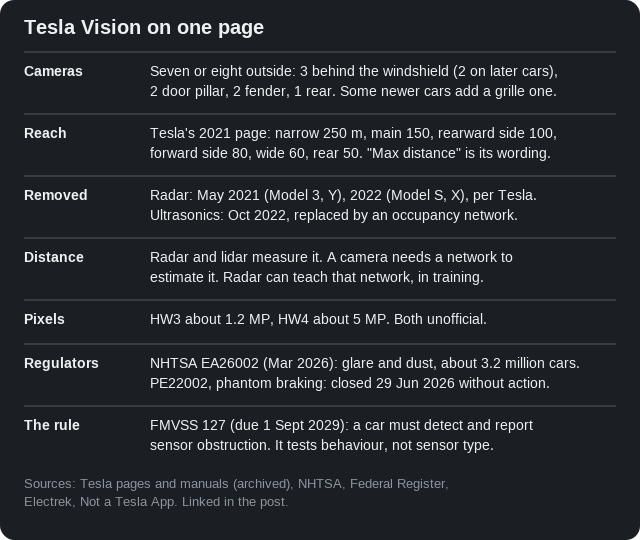
Next: Eight video streams arrive many times a second, and the car has very little time to make sense of them. What kind of computer does that, and how did Tesla’s own chip compare with the one it replaced?
Further reading
Tesla (archived copies)
- Autopilot page, 3 May 2021 and 9 May 2023: camera names, angles and ranges
- Transitioning to Tesla Vision, 25 May 2021, Oct 2022 update, and the 2025 version
- Tesla blog, 19 Oct 2016: all new cars have the hardware
- Owner’s manuals: Model 3, 2025, Model Y, 2023, Model Y, 2026 and its Park Assist page
Patents
Regulators
- NHTSA, EA26002 opening resume, 18 Mar 2026 and PE24031, 17 Oct 2024
- NHTSA, PE22002 closing resume, 29 Jun 2026
- FMVSS 127 final rule, Federal Register, 9 May 2024
- NHTSA, Model Y passes new driver-assistance tests, 7 May 2026
Papers and vendor documents
- Wang et al., Pseudo-LiDAR from Visual Depth Estimation, CVPR 2019
- Bijelic et al., Seeing Through Fog Without Seeing Fog, CVPR 2020
- Texas Instruments, The fundamentals of millimeter wave radar sensors, 2020
- Waymo, the Waymo Driver and the 6th-generation Driver
- Mobileye, True Redundancy
Outside analysis and press
- CleanTechnica, Karpathy’s CVPR 2021 keynote, and VentureBeat, why self-driving cars don’t need lidar
- CNBC, Consumer Reports and IIHS suspend endorsements, 27 May 2021
- Jalopnik, Consumer Reports restores the Model 3, and Repairer Driven News, IIHS and the camera-only system
- TechCrunch, ultrasonic sensors removed, 4 Oct 2022 and FCC radar filings, 7 Dec 2022
- Electrek, 2016 hardware suite, new camera sensor, Dec 2025 and “Radar Saves Us”, Jul 2026
- Not a Tesla App, HW3 and HW4 cameras compared
- The Next Web, Model Y and the NHTSA tests, 8 May 2026
- Drawing: TeslaVision eight-camera system by Mliu92, public domain, redrawn


Backend engineer who builds high-volume systems that move money. More about Rafi