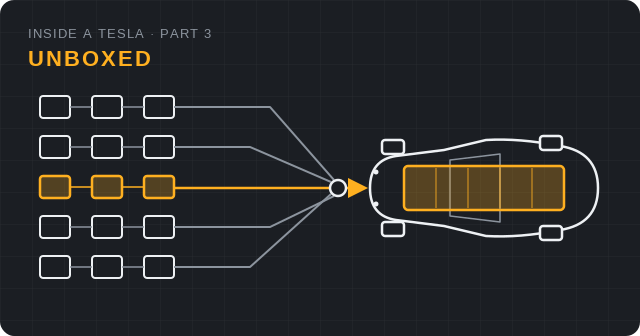
Part 3 of 12: Inside a Tesla Previous: One Casting Instead of 70 Parts: Tesla's Giga Press Next: The Battery Is the Floor: Cells, Chemistry and the Structural Pack
All 12 parts
- Inside a Tesla: A Computer That Happens to Have Wheels
- One Casting Instead of 70 Parts: Tesla's Giga Press
- Building a Car in Pieces: Tesla's Unboxed Process
- The Battery Is the Floor: Cells, Chemistry and the Structural Pack
- Fewer Wires, One Valve: Tesla's Electrical and Thermal Design
- Eight Cameras, No Radar: How a Tesla Sees
- The Chip in the Glovebox: Tesla's FSD Computer (HW3, HW4, AI5)
- Tesla HydraNet and Bird's-Eye View: From Eight Cameras to One Map
- Tesla Occupancy Network: Seeing Things It Has No Name For
- From Hand-Written Rules to One Network: How FSD Plans
- The Data Engine: How Tesla Teaches the Car
- Robotaxi: A Car With Nobody in the Driver's Seat
A car rolls out of the paint shop. It is finished: glossy, one colour, no marks. Then a worker takes the doors off.
That is normal. Most cars you have seen were built that way. On 1 March 2023, at Tesla’s Investor Day in Austin, Lars Moravy, Tesla’s head of vehicle engineering, described the step like this, as GoAuto reported it: “Once you get the colour, you take the doors off, and then you start putting the interior in the car.” Tesla’s slide for it, called “Current Way of Assembling a Vehicle”, shows a red car body with its doors and panels lifted away (Investor Day deck, page 41).
Part 2 ended on a question: if the parts get bigger, why not build the car in bigger chunks? Tesla’s answer is a process it calls “unboxed”. It comes with big numbers attached, and as of 9 October 2026 only one car is tied to it.
Part 3 of Inside a Tesla. I like the car and the tech, so I researched it to feed my own curiosity; not affiliated with Tesla, not investment advice.
Short version:
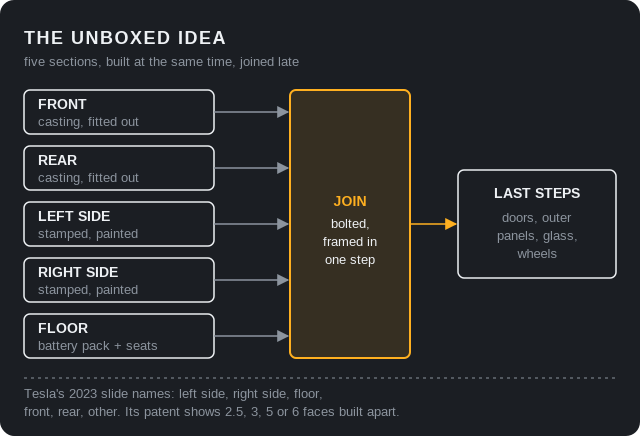
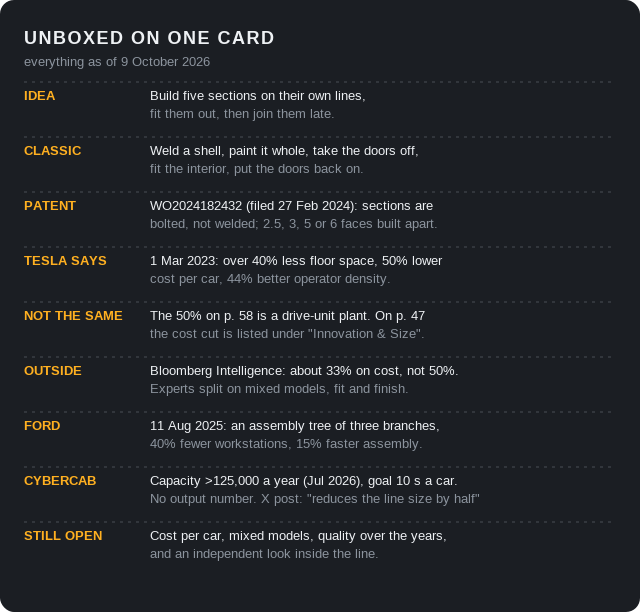
- A classic line builds one body. It welds the body shut, paints it whole, takes the doors off, fits the inside through the gaps, and puts the doors back. Unboxed builds five sections at the same time, fits them out, and joins them late.
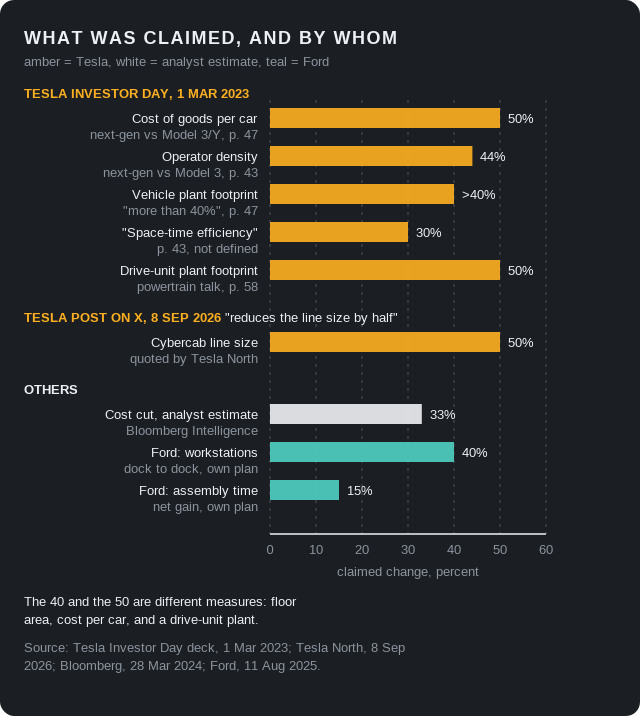
- Tesla says (Investor Day, 1 March 2023) the next-generation car would need “more than 40%” less factory floor, and 50% lower cost per car. Those are two different measures, and the press often merged them. The 50% also covers a smaller car, not only the line.
- Tesla ties the process to the Cybercab, in its July 2025 update and in a September 2026 post on X. Its July 2026 update lists Cybercab capacity of more than 125,000 a year and gives no output number. Outside experts are split on whether the process works for a whole product range.
The line most cars come from
A classic car line is a relay with five stages. A car passes each stage once, in order.
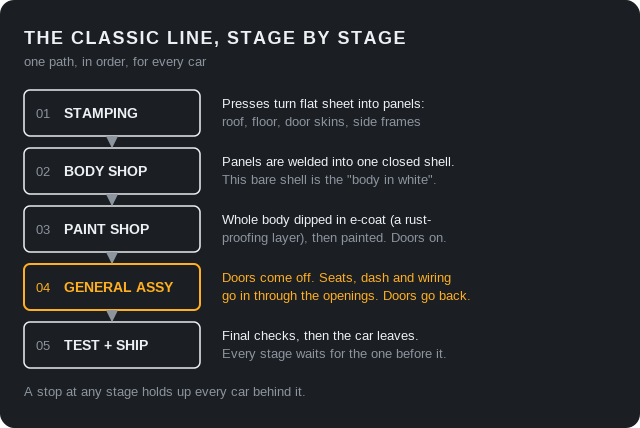
The welded shell has a name: the body in white. At this stage the body frame is joined and not yet painted. Closures such as doors can already be on it. The motor, chassis parts, glass, seats and trim are still to come.
The idea is old. In 1913 Ford started using a moving line at its Highland Park plant, and Ford says it brought the build time of a Model T down to ninety minutes. This photograph from that year is captioned on Wikimedia Commons “Experimenting with the mounting body on Model T chassis”:
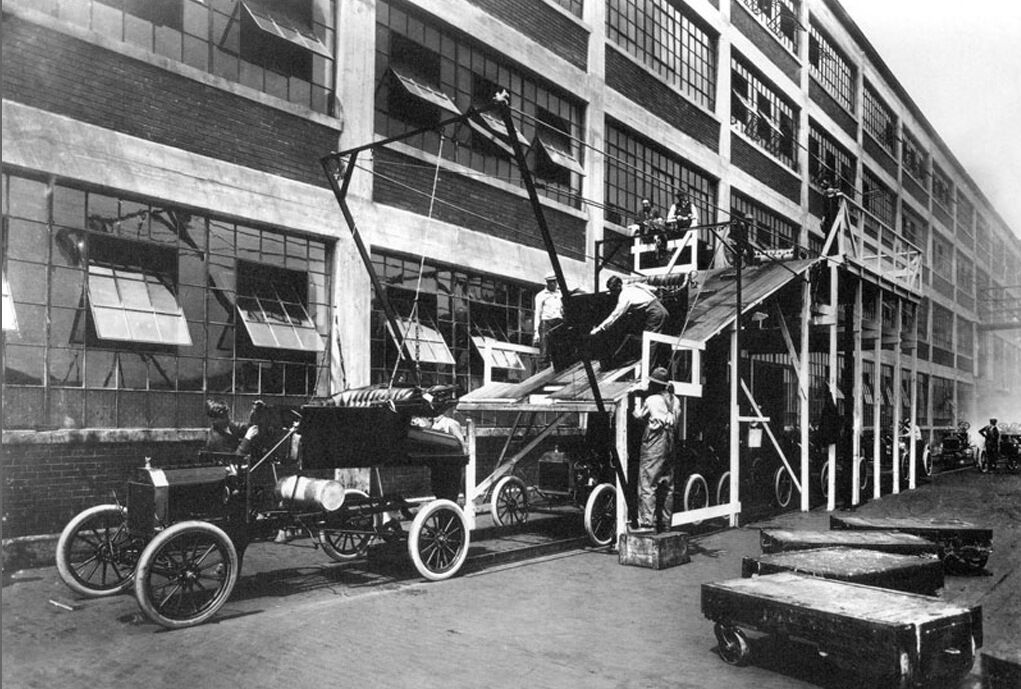
Photo: Ford Motor Company, 1913, public domain, via Wikimedia Commons.
A modern line looks different, but the order is the same. Here is a Tesla body line in Fremont in March 2012, with robots around a bare Model S body:
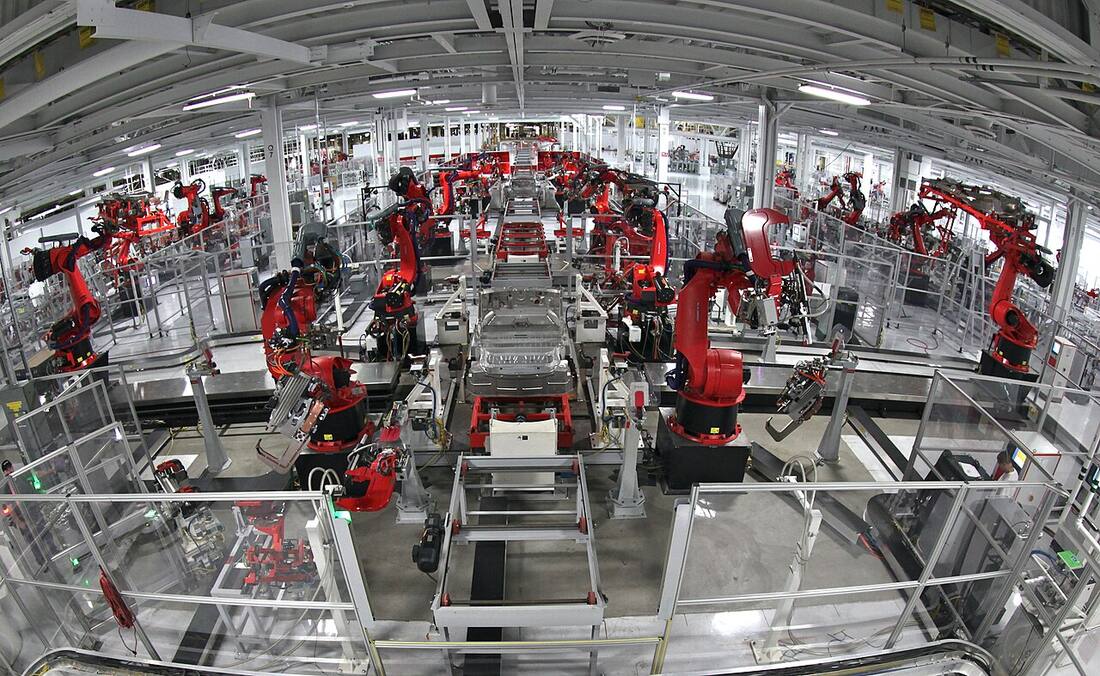
Photo: Steve Jurvetson, CC BY 2.0, via Wikimedia Commons, taken 21 March 2012. Resized.
Tesla’s 2023 slide called this the “Current Way of Assembling a Vehicle”, and set its new plan against it. The stage that matters most for this post is the last one, general assembly. This is where the interior, wiring, glass and doors go in:
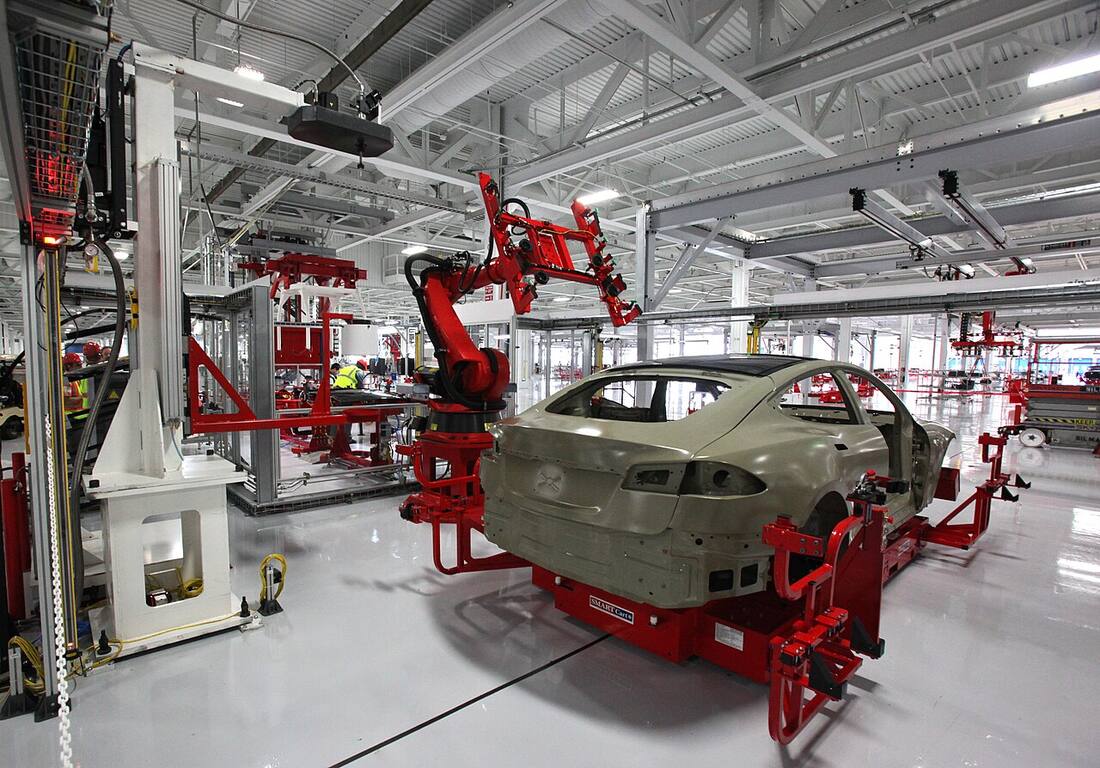
Photo: Steve Jurvetson, CC BY 2.0, via Wikimedia Commons, taken 5 October 2011. Resized.
What is slow about it
Tesla’s own patent lists the problems. It is a Tesla application published by WIPO as WO2024182432, “Modular vehicle architecture for assembling vehicles”. Twelve people are named as inventors, and Lars Moravy is one of them. It was filed on 27 February 2024 and claims priority from a US provisional filing of 28 February 2023, the day before Investor Day. In the patent’s words, the traditional process:
- moves “the entire weight/footprint of the vehicle” to fit even small parts, such as headlamps or wheels;
- makes it “difficult/expensive to datum/locate the assembly at the full vehicle level”, which limits automation. Datum means a fixed reference point that tells a robot where the part is.
The paint shop is a third cost. Bloomberg reported on 28 March 2024 that dipping or spraying a whole body is energy-hungry and slow. It quoted Caresoft, an engineering benchmarking firm, as seeing at least a 50% cut in paint-shop investment for new factories if the unboxed idea works. That is an outside estimate of a claim, not a measurement.
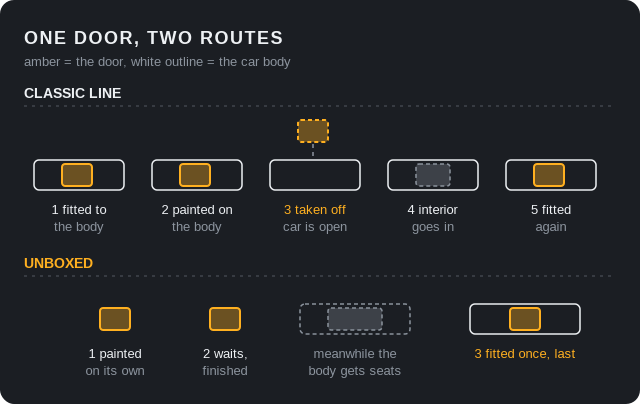
Then there are the doors. The body is painted with the doors on. Then the doors come off, so people and robots can reach the inside, and later they go back on. Assembly magazine quotes Moravy: “you put the doors on and then you paint them”, then “you take the doors off”. Bloomberg describes the same order. The door makes a round trip:
Unboxed: build the sections, join them late
“Unboxed” is a pun on the “box” in the classic line, the closed body. The patent flips the order. Instead of welding the box and then filling it, it fills sections first and makes the box last. In its words, “assembling the body or ‘box’ of the vehicle after the internal components have been assembled to individual sections or modules” lets “the length of the GA line” shrink.
Tesla’s slide, “Parallel & Serial Assembly” (page 44 of the deck), shows two feeder streams. Stamping and paint make the left side, right side and floor. Casting makes the front, rear and “other”. Each stream ends in the same place, vehicle assembly. Moravy’s own summary, as GoAuto reported it: “When we take all of these tested sub-assemblies and put them together, we finally assemble the car only one time.”
Three details from the patent show how different the result is.
- Bolts instead of welds. The sections are joined by “bolting or riveting”, or by stir welding, and in some embodiments “no welding is used to connect major portions of the vehicle”. Stir welding joins metal by friction, with no melting.
- The paint shop shrinks. Because surface treatment such as e-coat and paint can be done on the sections, the patent says the approach can eliminate “the need for traditional full-body-scale body and paint shops”.
- The floor is the battery. In claim 8, the left and right sides join the front and rear sections to make a cabin. Then the top and the battery pack join. Claim 15 adds that the pack has seats already attached.
The patent also shows that not every design needs all six faces of the box built apart. Figures 8A to 8D draw versions that build 2.5, 3, 5 or 6 faces separately. So “unboxed” is a dial, not a switch.
The numbers Tesla gave, and the 40 and 50 mix-up
At Investor Day, four slides carry the numbers. I downloaded the 169-page deck and read them. The page numbers below are the PDF’s own.
| Claim (Tesla says) | Number | What it measures | Page |
|---|---|---|---|
| Manufacturing footprint | “>40%” reduction | Factory floor for the next-generation car vs the legacy layout | 47 |
| Cost of goods sold per car | “50%” reduction | Next-generation car vs Model 3/Y. The slide labels the gap “Innovation & Size” | 47 |
| Operator density | “44%” improvement | Next-generation vs Model 3: more people working at once | 43 |
| Space-time efficiency | “30%” improvement | The slide does not define it | 43 |
| Drive-unit factory footprint | “50%” reduction | The motor factory, in the powertrain talk | 58 |
Here is how the mix-up happens. Reuters wrote on 15 May 2023 that Tesla said the process could cut production costs by half and reduce factory footprint by 40%. That joins two numbers from the same slide into one sentence about the process. But the slide’s cost bar is about the whole next-generation car, which the same slide credits to “Innovation & Size”. The footprint number is about floor area. A third 50%, on page 58, is a different factory, the one that builds drive units.
A footprint claim is easy to picture. If a classic layout needs 100 units of floor, “more than 40% less” means the new layout needs under 60.
The cost claim is harder. A cost waterfall on page 158, in the finance section, shows the path to a “50% Target” in three steps: “Vehicle”, “Battery & Powertrain” and “Manufacturing & Other”. The manufacturing step is drawn as the smallest of the three. The slide has no numbers on the steps, so how much of the saving comes from unboxed is not published.
One outside estimate puts it lower. Bloomberg on 28 March 2024 cited a Bloomberg Intelligence analysis that estimated the modular process would cut costs by 33%, not half. The story does not name the analyst, and Tesla did not respond to Bloomberg’s request for comment.
Ford and Toyota drew a similar tree
Tesla is not alone in this shape. Two other carmakers have shown plans:
| Maker | Shape | What it says | Reported |
|---|---|---|---|
| Ford | “Assembly tree”: front, rear and structural battery with seats, three lines that join | 40% fewer workstations dock to dock, 15% faster assembly, 20% fewer parts, 25% fewer fasteners | 11 Aug 2025 |
| Toyota | Three-part modular structure (front, centre, rear), self-propelled line, large castings | Self-propelled line reduces the need for conveyor equipment | 19 Sep 2023 |
Sources: Ford’s own article, TechCrunch on Ford and Electrek on Toyota.
The Ford numbers are a good model for how to read any of these. Ford says its production system could be up to 40% faster than Louisville’s current vehicles. After it reinvests some of that saving in more in-house work and automation, the net is 15% faster. A “40%” and a “15%” for the same plan, both from Ford. When you see one number for unboxed, ask which one it is.
The Cybercab line, as of 9 October 2026
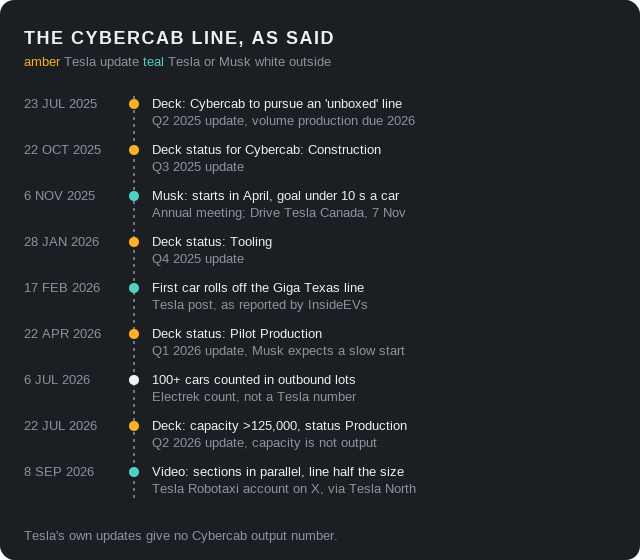
Tesla’s quarterly updates show how the Cybercab line moved. Each update has a table of factories with a status column:
What Tesla says in its own filings:
- 23 July 2025. The Q2 2025 update says Cybercab “will continue to pursue a revolutionary ‘unboxed’ manufacturing strategy and is scheduled for volume production starting in 2026”.
- 22 October 2025 to 22 April 2026. The status for Cybercab went from Construction (Q3 2025) to Tooling (Q4 2025) to Pilot Production (Q1 2026).
- 22 July 2026. The Q2 2026 update lists Cybercab at “>125,000” with status “Production”. It says the same table carries the note “Installed capacity ≠ current production rate”. It also says engineering test drives on public roads began in the quarter, and employee rides on the factory campus began in July.
Two things I checked in the PDFs. First, the words “volume production” appear for Cybercab in the Q1 2026 update (“We expect volume production of both Cybercab and the Tesla Semi this year”) but not in the Q2 2026 update. TechCrunch read that as Tesla dropping the volume goal for 2026; Tesla does not say so itself. Second, the word “unboxed” does not appear in the four updates from Q3 2025 to Q2 2026. It appears in the Q2 2025 update only.
Pace claims come from people, not from filings. At the annual meeting on 6 November 2025, TechCrunch reported that Musk said production would start in April. Drive Tesla Canada (7 November 2025) quotes his goal as “less than a ten second cycle time, basically a unit every ten seconds”. TechCrunch set that against a one-minute cycle for a Model Y; that comparison is TechCrunch’s, not Musk’s words. On 17 February 2026 Tesla said its first Cybercab rolled off the line. After the Q1 call, Electrek reported Musk called the start “very slow”, then “going kind of exponential towards the end of the year”.
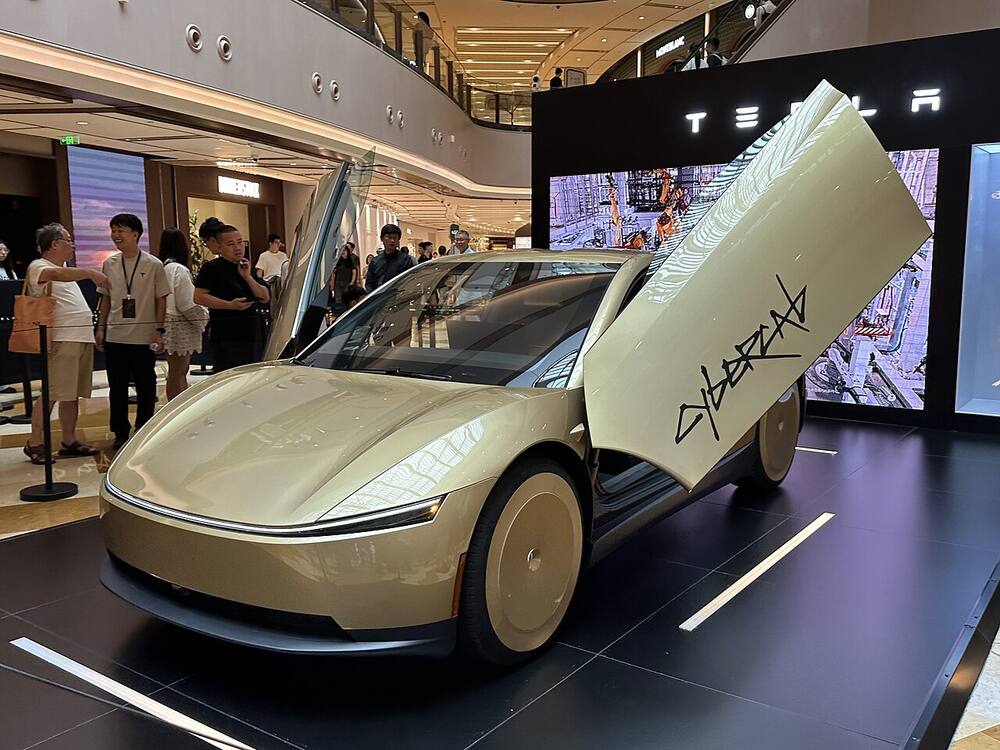
Photo: JustAnotherCarDesigner, CC0, via Wikimedia Commons, file dated 19 September 2026. Resized.
On 8 September 2026 Tesla posted a factory video on X. InsideEVs reported that it shows the battery box, front section and rear section built at the same time on parallel lines, then joined at the end, where the side sections, roof and doors go on. Tesla North quoted the post as saying the process “assembles vehicle modules in parallel & frames the car in one step at the end” and “reduces the line size by half”. EVwire added that Musk reposted it, writing: “We redesigned Cybercab production for production over 5 times faster than conventional automotive manufacturing!”
So what can we check? Here is my arithmetic, not Tesla’s. An installed capacity of 125,000 cars a year is one car every 4.2 minutes if the line ran non-stop, about 252 seconds. A 10-second cycle would be 3.15 million a year non-stop, which is the order of the 2 to 3 million Musk mentioned. The gap between those two numbers is the gap between what is installed in July 2026 and the goal. Tesla’s own note says capacity is not the production rate.
The nearest thing to an output figure is from outside. Electrek reported on 6 July 2026 that it had seen more than 100 Cybercabs in the factory’s outbound lots. What is not public as of 9 October 2026: a Cybercab output number from Tesla, a cost per car, a defect or yield figure, or an independent look inside the line. I did not find an audit or an independent factory study. InsideEVs wrote in February 2026 that Tesla “claimed” the benefits, and that Musk’s claims should be taken with a grain of salt.
One more piece of context. In 2023 the process was tied to a car under $30,000 and a new plant in Monterrey, Mexico (Reuters). By May 2025, Automotive Manufacturing Solutions described that plant as on hold. In October 2025 Tesla’s Q3 update showed new “Standard” Model 3 and Model Y trims at $36,990 and $39,990. Tesla’s July 2025 update ties unboxed to the Cybercab. I found no Tesla statement that the Model Y or Model 3 lines have moved to it.
What critics and outside engineers say
Experts were split when the idea was new in 2023, and I found no newer outside study that settles it.
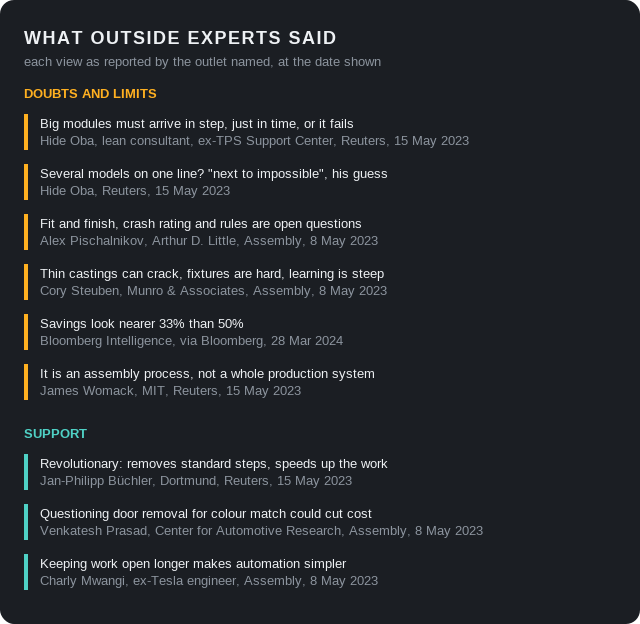
The doubts come in four kinds.
- Timing and synchronisation. Hide Oba, an independent lean consultant who worked at the Toyota Production System Support Center, told Reuters the system “won’t work unless production of these big, high-content unboxed vehicle modules are completely synchronized”. If one big module is late, the whole join waits.
- One line, many models. Oba on mixing models: “My guess is that’s next to impossible.” The S&P Global Mobility analysis of 1 September 2023 repeated the doubt, with critics asking whether the approach can serve several models in one plant.
- Fit and finish. Alex Pischalnikov of Arthur D. Little said a new plant suits the idea better and flagged fit and finish, crash rating and regulatory risk. Cory Steuben of Munro & Associates warned of thin castings cracking, hard fixturing and a steep learning curve with fit and sealing. Tesla’s own patent gives figures to this problem: 9A to 9C show bolt patterns on hinge pillars, and 11A and 11B show ways to seal corners and edges between sections.
- Savings. The Bloomberg Intelligence number is 33%. AMS also lists painting quality, corrosion and attaching modules without damaging interiors as open technical issues, and it quotes an unnamed German premium maker’s production director saying the method is “not compatible with our quality promises”.
There is a framing doubt as well. James Womack of MIT, co-author of The Machine That Changed the World, says Tesla’s method “is an assembly process”, while Toyota’s is a broader production management system.
And there is support. Jan-Philipp Büchler, a researcher in Dortmund, called it “revolutionary” and said “This is much more than modular production”. Venkatesh Prasad of the Center for Automotive Research said questioning habits such as removing doors for colour matching could cut cost. Charly Mwangi, a former Tesla manufacturing engineering executive, pointed to “delayed 3D” assembly: keep the work open for longer so robots can reach it.
Ford’s version of the shape counts as evidence too. Ford chose three branches for a new pickup due in 2027. That does not prove Tesla’s numbers. It does show that a large carmaker, with its own plants and its own risks, looked at the same idea and picked a version of it.
Questions people ask
What is Tesla’s unboxed process? It builds a car as sections, such as front, rear, sides and a battery floor, on separate lines at the same time. The sections are finished first and joined late. Tesla says this needs less floor space and fewer steps than a classic line.
Is unboxed the same as gigacasting? No. A gigacasting makes a big part. Unboxed is about the order of work. Tesla’s slide has casting feeding the front, rear and “other” streams, so the two fit together, but you could use one without the other.
Does Tesla build the Model Y this way? Tesla’s 2023 slides compare the Model 3 with a “Next Gen Vehicle”, and the July 2025 update ties unboxed to the Cybercab. I found no Tesla statement that the Model Y line has moved to it.
Will unboxed halve the cost of a car? Tesla’s 50% is a target for a next-generation car, and its slide lists “Innovation & Size” as the reason, not only the line. Bloomberg Intelligence estimated 33% for the process. No one outside Tesla has published Cybercab line costs.
Why do doors come off at all? To reach the inside of the car. A door in the way slows a person or a robot fitting a seat or a dashboard, so the line removes it, then fits it again. Unboxed paints the door on its own and fits it once, at the end.
Cheat sheet
Next: the biggest section in this process is the floor, and the floor is the battery. How do you build a battery pack that holds up the seats and the car?
Further reading
Tesla
- Investor Day 2023 keynote deck (169 pages; unboxed on pages 39 to 47, cost target on page 158)
- Q2 2025 update, Q3 2025 update, Q4 2025 update
- Q1 2026 update and Q2 2026 update, as filed with the SEC
Patents
- WO2024182432, Modular vehicle architecture for assembling vehicles, Tesla, published 6 September 2024
Outside analysis and press
- Reuters analysis, “Tesla’s new car-making process stokes debate among industry experts”, 15 May 2023
- Assembly magazine, “Tesla rethinks the assembly line”, 8 May 2023
- S&P Global Mobility, “Talking Heads: reimagining production”, 1 September 2023
- Bloomberg (reprint), “Tesla’s $25,000 car means tossing out the 100-year-old assembly line”, 28 March 2024
- Automotive Manufacturing Solutions, “Game theory: is Tesla’s unboxed process a new production paradigm?”, May 2025
- GoAuto on Investor Day, 3 March 2023
- TechCrunch, Cybercab production in April, 6 November 2025
- InsideEVs, first Cybercab off the line, 17 February 2026
- Electrek, Cybercab production starts, 23 April 2026
- Electrek, Cybercab production before autonomy, 6 July 2026
- TechCrunch, Cybercab, Semi and Megapack timelines slip, 22 July 2026
- InsideEVs, Tesla video of the unboxed Cybercab line, 9 September 2026
- Tesla North, Cybercab unboxed line size, 8 September 2026
- EVwire, Cybercab unboxed manufacturing video, 9 September 2026
Other carmakers and history
- Ford, affordable EV platform and production system, 11 August 2025
- TechCrunch, Ford’s assembly tree, 11 August 2025
- Electrek, Toyota’s next-generation line, 19 September 2023
- Ford, the moving assembly line
- Body in white, Wikipedia

Backend engineer who builds high-volume systems that move money. More about Rafi