Part 12 of 12: Inside a Tesla Previous: The Data Engine: How Tesla Teaches the Car This is the last part.
All 12 parts
- Inside a Tesla: A Computer That Happens to Have Wheels
- One Casting Instead of 70 Parts: Tesla's Giga Press
- Building a Car in Pieces: Tesla's Unboxed Process
- The Battery Is the Floor: Cells, Chemistry and the Structural Pack
- Fewer Wires, One Valve: Tesla's Electrical and Thermal Design
- Eight Cameras, No Radar: How a Tesla Sees
- The Chip in the Glovebox: Tesla's FSD Computer (HW3, HW4, AI5)
- Tesla HydraNet and Bird's-Eye View: From Eight Cameras to One Map
- Tesla Occupancy Network: Seeing Things It Has No Name For
- From Hand-Written Rules to One Network: How FSD Plans
- The Data Engine: How Tesla Teaches the Car
- Robotaxi: A Car With Nobody in the Driver's Seat
On Sunday 22 June 2025, Tesla’s Model Ys began carrying paying riders around South Austin with the driver’s seat empty. Riders paid a flat $4.20. In the front passenger seat sat a Tesla employee, called a safety monitor. TechCrunch put the fleet at about ten cars, going by Musk’s figure.
By the next day NHTSA, the US car safety regulator, had contacted Tesla. It told Fortune it was “in contact with the manufacturer to gather additional information”. On 22 January 2026 Musk wrote that Tesla had “just started” Robotaxi drives in Austin “with no safety monitor in the car” (CNBC). By October, Tesla’s Q3 deck counted nearly two million “unsupervised” miles.
So what does “unsupervised” mean, and who is still watching? That is the whole story of this last part. Every claim below is labelled: “Tesla says”, “regulator”, or “outside”. Where they disagree, I show both.
Part 12 of Inside a Tesla. I like the car and the tech, so I researched it to feed my own curiosity; not affiliated with Tesla, not investment advice.
Short version:
- “Supervised” means a human must watch the road and is responsible. “Unsupervised” means nobody in the car has that job. Around the unsupervised Robotaxi there are still people: remote staff, and, in Electrek’s report of 22 Jan 2026, trailing cars with monitors (no source I found says they stopped).
- Tesla says nearly two million unsupervised miles by 30 Sep 2026. NHTSA’s crash file has 43 Tesla reports from its automated driving system through Sep 2026. Neither number alone shows how safe it is.
- Regulators have opened files on Tesla’s driver-assist system, on the Cybercab and on the Robotaxi. An opening is a question, not a finding.
The scale everyone uses: SAE levels
When people argue about self-driving, they use the levels from SAE International, a standards body. The standard is SAE J3016, and SAE shows it as a colour chart. I drew my own simple version, in my own words:
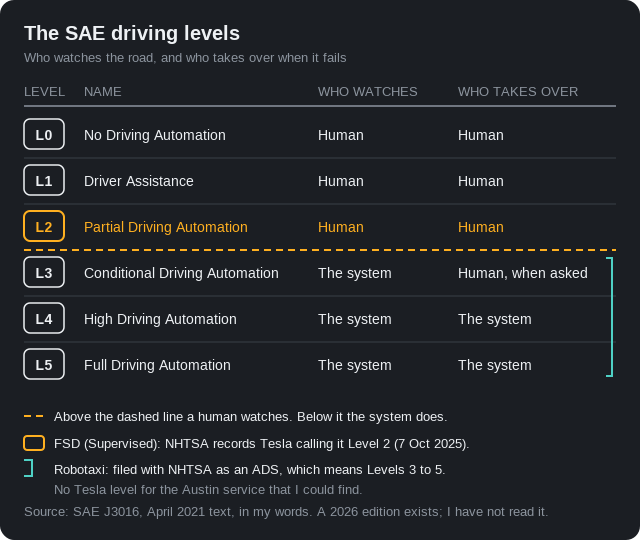
The line that matters sits between Level 2 and Level 3. At Level 2 the system steers and controls speed, but the human is the one watching the road, and must be ready to act at once. J3016 says the driver “completes the OEDR subtask and supervises”. OEDR means object and event detection and response, which is the job of noticing things and reacting. From Level 3 up, the system watches. At Level 4 it also handles its own failures, but only inside the area and conditions it was built for.
Two points about the labels. NHTSA’s file on Tesla’s driver-assist software says that “Tesla characterizes FSD as an SAE Level 2 partial automation system requiring a fully attentive driver” (NHTSA PE25012, 7 Oct 2025). Tesla’s Q3 2026 deck says only this in a footnote: “Active driver supervision required; does not make the vehicle autonomous” (Tesla, 8-K exhibit 99.1). It does not say “Level 2”. That label is NHTSA recording Tesla’s own description. The Robotaxi is different. Tesla’s crash reports to NHTSA are filed as “ADS” (automated driving system), and in J3016 that word means Levels 3 to 5. I found no Tesla statement that names a level for the driverless Austin service.
One more note. ANSI lists a 2026 edition of J3016 that rewords the short level descriptions. I used the April 2021 text, because I could not read the new one.
The levels say who should watch. They do not say who actually does. Take one Robotaxi and look at the seats.
Supervised and unsupervised: who is watching?
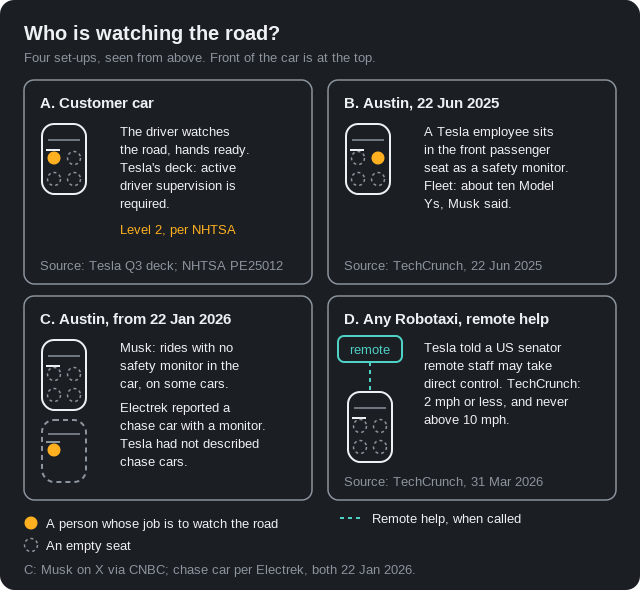
Set-up A is the car in a driveway. Tesla calls the software FSD (Supervised), and the driver is the supervisor.
Set-up B is the launch. A person sits in the front passenger seat. TechCrunch noted it was unclear what control, if any, those monitors have.
Set-up C is where the word gets hard. Musk said some rides had no safety monitor in the car. Tesla’s vice president of software, Ashok Elluswamy, wrote that the service had “a few unsupervised vehicles mixed in with the broader robotaxi fleet with safety monitors” (CNBC). In an update to its story of that day, Electrek reported video of black Tesla cars with monitors inside following the empty cars. Electrek’s reading: Tesla “just moved them to a different vehicle”. Tesla’s statement did not describe trailing cars, and I did not find another Tesla description of them.
Set-up D is the one most people forget. Somewhere, a person can help the car.
Remote help: advice or driving?
J3016 draws a clear line here. Remote assistance is a person giving “information or advice” to a driverless car, and the car still does all the driving. Remote driving is a person doing the driving task in real time. The standard notes that remote driving is sometimes called “teleoperation”, and avoids the word because people use it in different ways.
Tesla told a US senator’s inquiry that its remote staff “are authorized to temporarily assume direct vehicle control” as a final step (TechCrunch, 31 Mar 2026, quoting Tesla’s reply). TechCrunch’s account of the same reply: this applies to Tesla’s pilot fleet at 2 mph or less, and the remote operator cannot drive faster than 10 mph. Tesla gave no figure for how often this happens.
NHTSA’s crash file shows what that looks like in practice. In my reading of the 43 Tesla narratives, five describe a person at a distance in control when the car hit something. The speeds were between 0.4 and 9 mph, so inside the 10 mph cap TechCrunch reports. Two of the five were in 2025 and 2026 and were reported by Electrek: the call for help came from the safety monitor in the car, and the teleoperator then drove. The other three were later, with no passengers aboard. J3016 would call those cases remote driving, since a person controlled the car in real time. That last sentence is my reading of the standard. It is not NHTSA’s or Tesla’s.
There is one more edge. The Robotaxi Safety Report that Tesla published on 21 October 2026 excludes miles with a monitor aboard. Drive Tesla writes (article; I could not open Tesla’s own page): “Tesla says it counts every collision reported to NHTSA while a Robotaxi drives without a safety monitor, including cases where a remote operator is assisting.” So Tesla keeps remote help inside “unsupervised”. Someone else could fairly count a remote person who can step in as a form of supervision. The word does not settle it.
So the label depends on what you count as watching. The next question is how that label spread from one city to many.
From one city to many
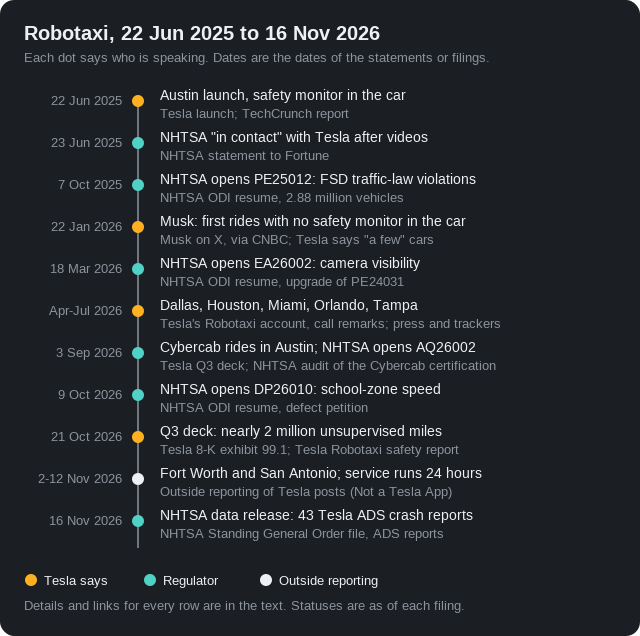
Austin came first, with monitors. On 18 April 2026, Teslarati reported that Tesla’s Robotaxi account announced Dallas and Houston, with a video from a passenger seat showing no monitor. Miami followed in early July, according to press reports. Orlando and Tampa were added on 21 July, the day before the Q2 call (Fox Business). In Austin, Tesla’s Q3 deck said hours were “6am to midnight”. About three weeks later Tesla’s Robotaxi account said service now runs 24/7 in every city it serves (Not a Tesla App, 12 Nov 2026, quoting the post).
How many cities is that? It depends on the date and on who is counting:
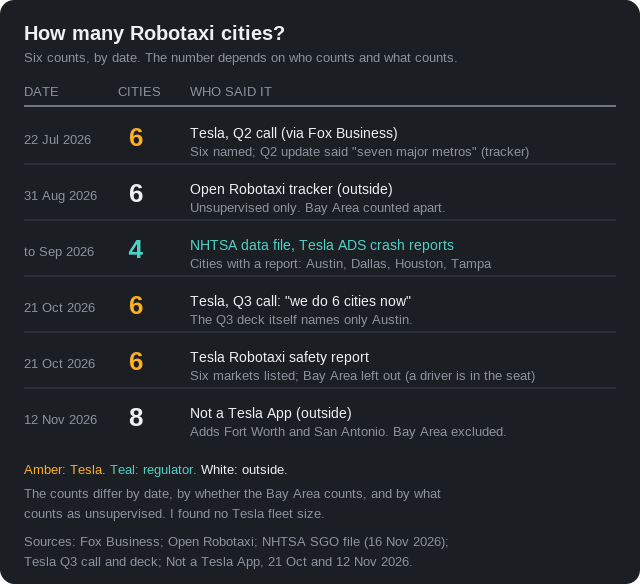
Tesla’s Elluswamy said “we do 6 cities now” on the Q3 call of 21 October. The deck itself names only Austin. The Q2 call (via Fox Business) named Austin, Dallas, Houston, Miami, Orlando and Tampa. The Open Robotaxi tracker says Tesla’s Q2 update counted “seven major metros”, with the Bay Area, against the call’s six. By 12 November, Not a Tesla App listed eight unsupervised markets, after adding Fort Worth (2 Nov) and San Antonio. The Open Robotaxi tracker uses a strict rule: a city counts when unsupervised rides with no in-car monitor were publicly announced. Its snapshot of 31 August had six, plus the Bay Area apart as supervised.
Fleet size is just as unclear. Tesla has not published one that I could find. The same tracker estimated about 85 cars at the end of August, and noted that Texas registrations showed about 269 Robotaxi Model Ys, which it treats as registered cars, not active ones. In January, a tracker cited by Electrek found 32 different Model Ys in Austin, with fewer than ten running at once. These are outside estimates, each with its own method.
California is a different case. The state’s DMV permit list, as of 17 November 2026, shows “Tesla Robotaxi LLC” only under testing with a safety driver. It is not under driverless testing or deployment. A California Public Utilities Commission official, Pat Tsen, said on the Driverless Digest Podcast that “Tesla is not operating an autonomous vehicle service” (Electrek reported it on 25 March). The Bay Area service uses a person in the driver’s seat. Electrek also reports that Tesla’s February 2026 filing to the commission called the service Level 2 (I did not read the filing). Texas has its own rule: since 28 May 2026, companies that run automated vehicles commercially must hold an authorization from the state’s DMV. That page does not name companies, so I do not know Tesla’s status there.
Cities are one count. Miles are the other.
Miles: three Tesla numbers, three wordings
The Q3 deck says: “We reached nearly two million cumulative unsupervised miles for our Robotaxi service as of the end of the quarter”, and that these miles “grew eightfold quarter over quarter”. The deck gives no exact figure. Its chart axis runs to 2,000,000. If “nearly two million” is eight times the figure three months before, then end of June was about a quarter of a million miles. That is my arithmetic, not a Tesla number.
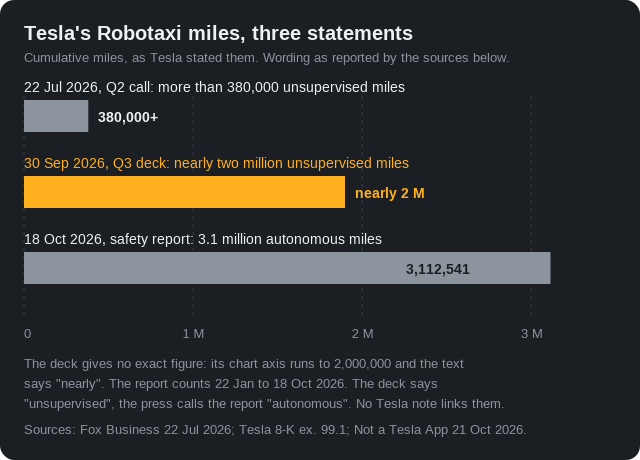
On the day of the Q3 call, 21 October, Tesla also published a Robotaxi Safety Report. It gave a bigger number: 3,112,541 miles between 22 January and 18 October 2026, as Not a Tesla App reported it. The per-city miles add up to that total exactly:
| City | Miles, 22 Jan to 18 Oct 2026 |
|---|---|
| Austin | 2,118,015 |
| Dallas | 608,130 |
| Houston | 225,964 |
| Orlando | 61,053 |
| Tampa | 53,117 |
| Miami | 46,262 |
The deck says “unsupervised”. The report, as the press describes it, says “autonomous”. The windows differ too: the deck is cumulative to 30 September, and the report starts on 22 January. I found no Tesla note that reconciles them. So I would not chain these three into one line on a graph, and I did not.
What does Tesla’s report claim about safety? Per Drive Tesla’s summary, no one was injured by a Robotaxi, there were no airbag deployments, and no pedestrians or cyclists were hit. Tesla discloses its own limits. The injury count only covers crashes where a Robotaxi made first contact, while its human benchmark, built from Texas police data, counts all collisions. The miles exclude those with a monitor aboard. The benchmark covers only Tesla’s Texas markets.
Now compare what a regulator publishes.
What NHTSA’s crash file shows
NHTSA runs a rule called the Standing General Order, or SGO. It says named companies must report crashes on public roads when an automated driving system, or a Level 2 driver-assist system, was engaged within 30 seconds of the crash. Crashes that meet set criteria are reported within five days, and other ADS crashes monthly (Federal Register notice 2026-10363). The full data is a public file. I used the ADS file, whose server header says it was last modified on 16 November 2026. Its newest submissions are from October 2026.
I counted Tesla’s rows in that file, taking the newest version of each report ID:
import csv

newest = {}
for row in csv.DictReader(open("SGO-2021-01_Incident_Reports_ADS.csv", encoding="utf-8-sig")):
    if row["Reporting Entity"] != "Tesla, Inc.":
        continue
    key = row["Report ID"]
    if key not in newest or int(row["Report Version"]) > int(newest[key]["Report Version"]):
        newest[key] = row

print(len(newest))  # 43 in the file dated 16 Nov 2026
The file is at static.nhtsa.gov. Here is what the 43 reports show, in my counts:
- All are model year 2026: 39 Model Y and 4 Cybercab. By city: Austin 30, Dallas 10, Houston 2, Tampa 1.
- 38 are property damage only. Three allege a minor injury, two of them with hospital care. None reports an airbag in the Tesla.
- 35 of 43 happened at 5 mph or less, and 17 with the Tesla at 0 mph. 15 were in parking lots. The fastest was 29 mph, a pothole.
- 19 narratives say a safety monitor was in the car (July 2025 to April 2026, plus one Cybercab in August 2026). Of the 25 reports from May to September 2026, 24 do not mention one.
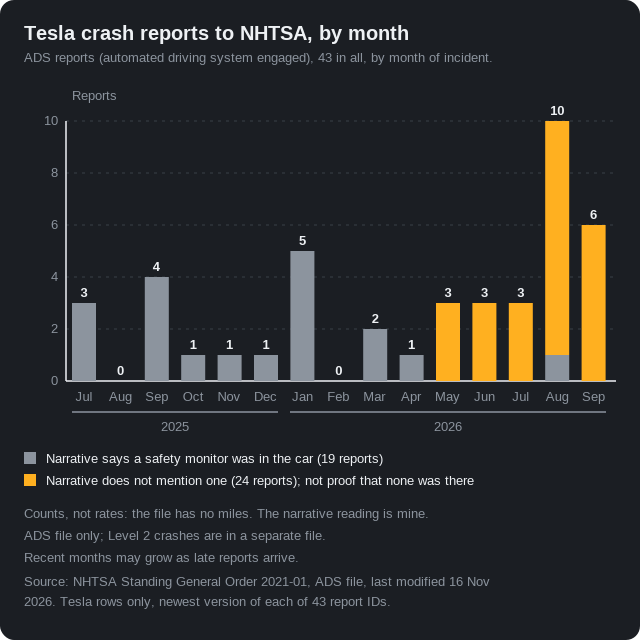
Please read the chart for what it is. It counts reports, and the fleet grew a lot. The file has no miles. NHTSA says so itself, in its May 2026 Federal Register notice. The order “is an early-warning mechanism”, and “not currently a program designed to support normalized, ‘apples-to-apples’ comparison scorecards”. It adds that putting fleet mileage into the program “would alter the focus and burdens of the reporting requirements”. Also, “does not mention a monitor” is not proof that none was there. The file has no field that says so directly.
The injury count is one place where Tesla’s report and the file need careful reading. Tesla’s report says no one was injured by a Robotaxi. The file has three minor-injury reports. Two are from July 2025, before the report’s 22 January start, and one is from September 2026. That one is a Dallas car hitting a pothole at about 29 mph, where the narrative says “one customer alleged they sought medical care”. Tesla says its injury count covers crashes where a Robotaxi made first contact. I cannot tell whether a pothole counts, so I do not call this a conflict. It is a definition to ask about.
Electrek’s earlier count for July 2025 to March 2026 was 17 reports. That matches my count for the same months. Tesla had at first marked every narrative as confidential, and later refiled the older reports without the label (Electrek reported it on 15 May 2026), so all 43 narratives can now be read in the file.
The Cybercab
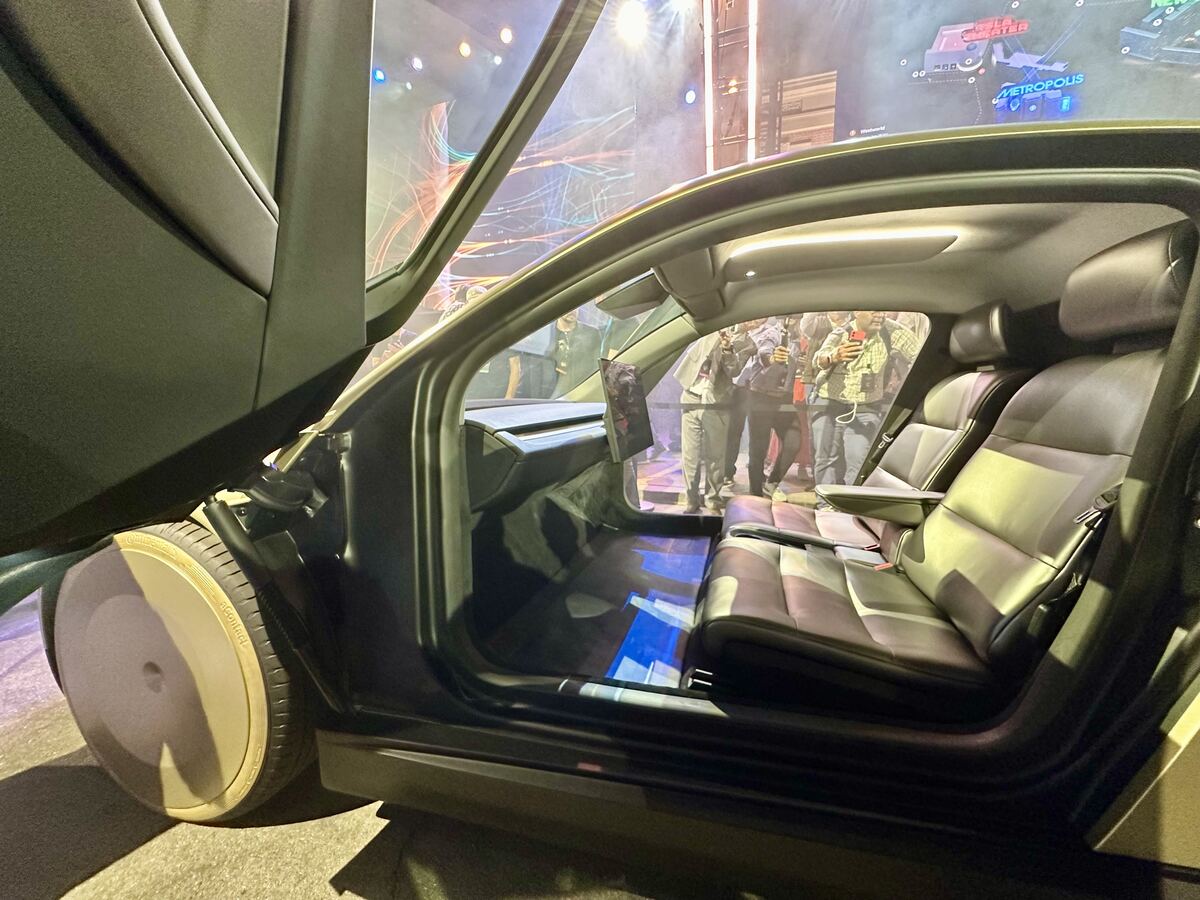
Photo: Steve Jurvetson, CC BY 2.0, via Wikimedia Commons. This is the 2024 prototype, not a production car.

The Cybercab is the car built for this job: two seats, and no steering wheel or pedals. The photographer’s caption on the 2024 prototype reads “No steering wheel or pedals. Two comfy seats. One big screen.” On the Q1 2026 call Musk said, “We have just started production of Cybercab” (Electrek, 23 Apr 2026).
Tesla’s Q3 deck says Cybercab rides in Austin began on 3 September 2026. It lists installed annual capacity at Texas of “>125,000” with the status “Production”. Capacity is not output. On the call, Tesla said every Cybercab built so far goes to its own Robotaxi fleet, and that the Austin Cybercab fleet had grown “by a factor of 10” in about a month. Tesla’s Q3 call also said Cybercab rides were available only in Austin at that point.
The same day, 3 September, NHTSA opened audit query AQ26002. Its resume says Tesla “notified the Agency that it certified those Cybercab vehicles as compliant with all applicable Federal Motor Vehicle Safety Standards (FMVSS)”. It notes the vehicles “lack permanently attached, conventional manual controls, such as a brake pedal, gas pedal, steering wheel, and mirrors”. NHTSA will “consider the extent to which Tesla’s certification depended on determinations that certain FMVSS are inapplicable to the Cybercab”. Earlier, when asked on X whether a 2,500-vehicle exemption cap applied to the Cybercab, Tesla’s Lars Moravy answered with one word: “No” (Electrek). NHTSA’s file takes no side. It is an audit of the paperwork, and I found no outcome as of 25 November.
Where does the Cybercab sit in the crash file? Four of the 43 reports are Cybercabs: one in August (with a monitor aboard, a water-filled pothole at 5 mph) and three in September, all at 5 mph or less.
The regulators, file by file
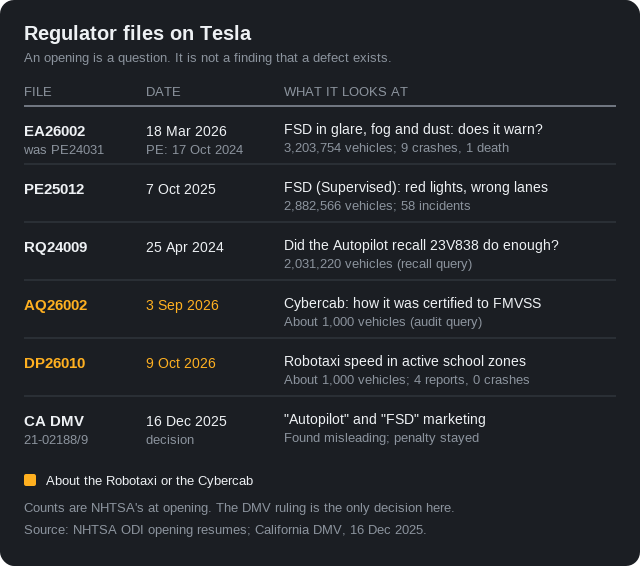
The codes are letters and a number. The letters tell you the stage. Here is what each file says in its own words, from NHTSA’s opening resumes:
- DP26010, opened 9 October 2026. This is a defect petition, a request from the public. NHTSA received it on 23 September, about “MY 2026 Tesla Robotaxi (Model Y and Cybercab)”, about 1,000 vehicles. The allegation is that the driving system “exceeds posted speed limits in active school zones”. The petitioner gave three video links. NHTSA lists four incidents, one complaint and three social media reports, with no crashes or injuries. It opened the file “to evaluate the allegations and determine whether to grant or deny the petition” (resume).
- AQ26002, opened 3 September 2026. The Cybercab audit above.
- EA26002, opened 18 March 2026. An engineering analysis, upgraded from preliminary evaluation PE24031 of 17 October 2024. It covers 3,203,754 cars with FSD (Supervised). It asks about “failure of the FSD’s degradation detection system, when encountering reduced roadway visibility conditions, to detect a degraded state and to warn the driver appropriately”. NHTSA describes Tesla’s system as one that “relies exclusively on vision-based cameras” (part 6 covers those cameras). It lists 9 crashes and 1 fatality. Tesla’s own analysis, NHTSA says, was that an update “may have affected 3 of the 9 incidents” (resume).
- PE25012, opened 7 October 2025. A preliminary evaluation of FSD (Supervised) behaviours such as “proceeding through red traffic signals and driving against the proper direction of travel”, over 2,882,566 cars. At opening, NHTSA had 58 incidents on file, 14 of them crashes. A follow-up information request of 3 December 2025 listed 62 complaints, 4 media reports and 14 SGO reports and asked Tesla to answer by 19 January 2026. NHTSA then gave Tesla about five more weeks, to 23 February (Bloomberg, 16 Jan 2026); Electrek reports a second extension, to 9 March (I read only its search summary). I found no later upgrade or closing document (resume).
- RQ24009, opened 25 April 2024. A recall query, to check whether Tesla’s own Autopilot recall 23V838 was enough. NHTSA writes that its earlier investigation “identified at least 13 crashes involving one or more fatalities” where “foreseeable driver misuse of the system played an apparent role”. Tesla’s recall report had said “the prominence and scope of the system’s controls may be insufficient to prevent driver misuse” (resume).
Status in this list is as the files were opened. For the NHTSA items I did not find closing documents by 25 November 2026, but I did not check every page NHTSA hosts.
The Robotaxi has two open questions, one about speed in school zones and one about how the Cybercab was certified. The older files are about the supervised software that customers drive with. The two may not stay separate: on the Q3 call, Elluswamy said “somewhere around Q2 next year is when we can turn on some of the first customer vehicles” for the unsupervised network.
One more regulator acted on words instead of software. California’s DMV found in its 16 December 2025 decision that Tesla’s use of “Autopilot” and “Full Self-Driving Capability” “is misleading and violates state law”. The judge had proposed 30-day licence suspensions. The DMV stayed the manufacturer one and gave Tesla 60 days. On 17 February 2026 the DMV said Tesla had stopped using “Autopilot” in its California marketing, and uses “Full Self-Driving (Supervised)”. In this case the regulator did decide. It ruled on advertising, and it did not rule on how the car drives.
Before any of these, there was the NTSB.
The NTSB: what happens when the supervisor stops watching
The NTSB is a separate agency. It investigates crashes and makes recommendations. NHTSA writes and enforces the rules. Its work on Tesla is older, from 2016 and 2018, and it is about supervised cars.
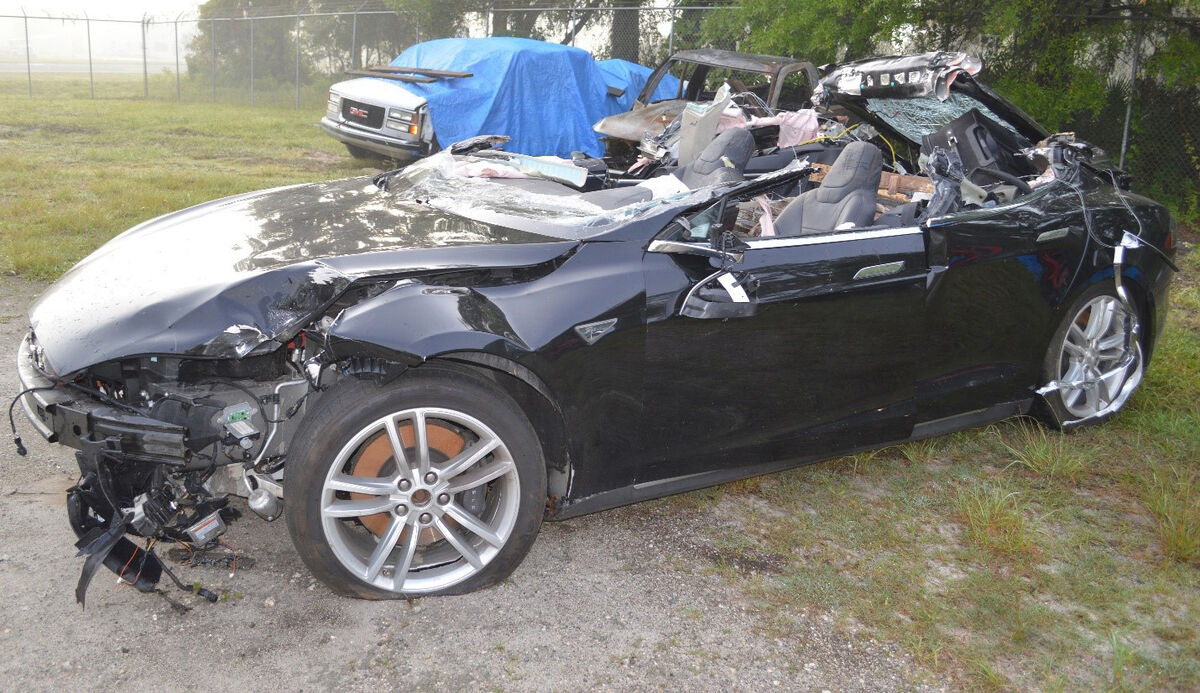
Photo: Florida Highway Patrol, via NTSB (public domain), via Wikimedia Commons. The 2015 Model S after the 7 May 2016 crash near Williston, Florida.
The Williston crash killed the Model S driver. The NTSB found the probable cause was “the truck driver’s failure to yield the right of way to the car” together with “the car driver’s inattention due to overreliance on vehicle automation” (NTSB HWY16FH018). It said the system’s design permitted prolonged disengagement from driving. For Mountain View in 2018, it found the cause was the Autopilot system “steering the sport utility vehicle into a highway gore area due to system limitations”, and also cited the driver’s lack of response, likely from a phone game, and overreliance on Autopilot. Ineffective monitoring of driver engagement was a contributing factor (NTSB HWY18FH011).
The common thread is a person who is supposed to supervise and stops. Taking the human out of the supervisor’s job is one answer to that. It also means the system, and the company running the fleet, must handle every case that a supervisor used to catch. That is my reading, not the NTSB’s.
Questions people ask
Is Tesla’s Robotaxi really driverless? Some rides have nobody inside, per Tesla’s statements since January 2026. Remote staff can help, and as a last step, per Tesla’s reply to a senator, take control at low speed. In California the service runs with a person in the driver’s seat.
Is FSD (Supervised) the same as the Robotaxi? No. FSD (Supervised) is Level 2 driver assistance, per Tesla’s description as recorded by NHTSA, and the driver is responsible. The Robotaxi is filed with NHTSA as an automated driving system and runs on Tesla’s own fleet.
Has NHTSA found the Robotaxi defective? In the files I read, no. DP26010 asks whether to grant or deny a petition. AQ26002 audits the Cybercab’s certification. Neither is a finding.
Can I compare Tesla’s crash count with another company’s? Not from the SGO file. It has no miles, and NHTSA says it is not built for ranking. A fair comparison needs miles, the same definitions and independent checks. Tesla’s own report adds miles, but only Tesla’s.
Is a safety monitor the same as a driver? Not in J3016. The words “safety monitor” do not appear in the standard. In California the CPUC treats the person in the driver’s seat as the driver (Electrek’s account of the CPUC). In Austin the monitor sits in the passenger seat, and what control that seat gives is not clear from public sources.
What to watch next
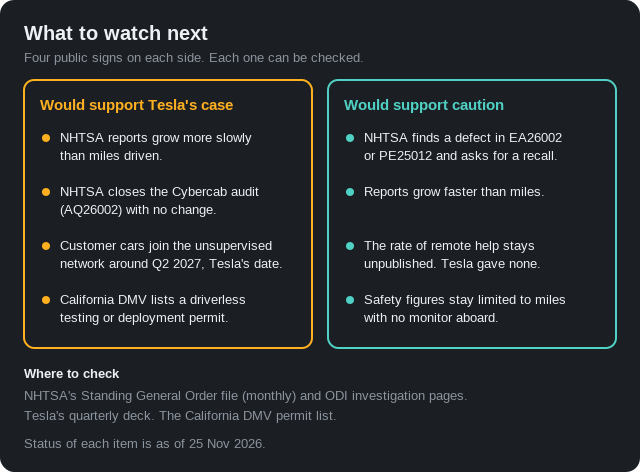
Each side has something it can point to. For Tesla: nearly two million unsupervised miles by 30 September, more cities each month, and a safety report with no injuries counted under its rules. For the cautious reading: 43 crash reports from a young fleet, a Cybercab certification under audit, one school-zone petition, and remote help that is real but unmeasured in public.
My own view is a modest one. The numbers are public, and most of them can be checked. The two things I would look at first are miles next to crash reports for the same period, and how often remote staff step in. Tesla could publish both. NHTSA’s file has neither miles nor the number of remote interventions, only the crashes.
Next: this is the end of the series. The car is built, it sees, it decides, it learns, and Tesla says it now drives some rides with nobody inside. What to watch is whether the next few NHTSA releases and Tesla’s next decks let someone outside the company check that claim, one mile at a time.
Further reading
Tesla
- Tesla Q3 2026 update, 8-K exhibit 99.1
- Tesla Q3 2026 earnings call transcript (Motley Fool copy of the call)
- Tesla Robotaxi Safety Report (21 Oct 2026; I could not load the page and relied on press summaries)
Regulators and standards
- NHTSA files: DP26010, AQ26002, EA26002, PE24031, PE25012, RQ24009
- NHTSA Standing General Order crash reporting and the ADS data file
- Federal Register notice 2026-10363 on SGO incident reporting
- California DMV decision, 16 Dec 2025 and follow-up, 17 Feb 2026
- California DMV autonomous vehicle permit holders
- Texas DMV automated vehicles program
- NTSB HWY16FH018, Williston and NTSB HWY18FH011, Mountain View
- SAE J3016 (April 2021), the SAE levels chart and the 2026 edition listing
Outside analysis and reporting
- TechCrunch: the Austin launch, 22 Jun 2025
- Fortune: NHTSA contacts Tesla, 25 Jun 2025
- CNBC: no safety monitor in some Austin cars, 22 Jan 2026 and Electrek, the same day
- TechCrunch: robotaxi companies and remote help, 31 Mar 2026
- Electrek: Tesla unredacts crash narratives, 15 May 2026
- Electrek: the CPUC on Tesla, 25 Mar 2026 and Electrek: Cybercab production, 23 Apr 2026
- Teslarati: Dallas and Houston, 18 Apr 2026
- Fox Business: Tesla’s Q2 call remarks, 22 Jul 2026
- Not a Tesla App: markets and their sizes, 24/7 in every city and Tesla’s safety report, 21 Oct 2026
- Drive Tesla: the Robotaxi Safety Report
- Open Robotaxi tracker (independent, snapshot of 31 Aug 2026)

Backend engineer who builds high-volume systems that move money. More about Rafi