Part 9 of 12: Inside a Tesla Previous: Tesla HydraNet and Bird's-Eye View: From Eight Cameras to One Map Next: From Hand-Written Rules to One Network: How FSD Plans
All 12 parts
- Inside a Tesla: A Computer That Happens to Have Wheels
- One Casting Instead of 70 Parts: Tesla's Giga Press
- Building a Car in Pieces: Tesla's Unboxed Process
- The Battery Is the Floor: Cells, Chemistry and the Structural Pack
- Fewer Wires, One Valve: Tesla's Electrical and Thermal Design
- Eight Cameras, No Radar: How a Tesla Sees
- The Chip in the Glovebox: Tesla's FSD Computer (HW3, HW4, AI5)
- Tesla HydraNet and Bird's-Eye View: From Eight Cameras to One Map
- Tesla Occupancy Network: Seeing Things It Has No Name For
- From Hand-Written Rules to One Network: How FSD Plans
- The Data Engine: How Tesla Teaches the Car
- Robotaxi: A Car With Nobody in the Driver's Seat
On 1 June 2020 (Taiwan time) a Model 3 drove into a truck lying on its side on a highway in Taiwan. Security cameras filmed it. The truck’s roof faced the traffic. Tyre smoke in the video suggests braking at the last second. Electrek said it could not tell whether the driver or the car’s automatic braking did it. The driver was reportedly unhurt (Electrek, 1 June 2020).
I don’t know why the car did not stop sooner, and I could not find a final ruling. Local media quoted the driver telling police that an assist system was on. Electrek said it was unclear what that meant, and that the car reportedly had some Autopilot features on. What the video does show is a hard question for any camera system: what do you do with something big that is not on your list of things?
For years the usual answer was a list. Find the cars. Find the trucks. Find the people. Draw a box around each one. A truck on its roof is on no list in that pose. This post is about the answer Tesla showed at AI Day in September 2022: stop asking what each thing is, and ask a simpler question about every small cube of space around the car. Is something there?
Part 9 of Inside a Tesla. I like the car and the tech, so I researched it to feed my own curiosity; not affiliated with Tesla, not investment advice.
Short version:
- A box detector needs a class and a shape for everything it reports. Odd shapes, debris and things with no name fall between the boxes.
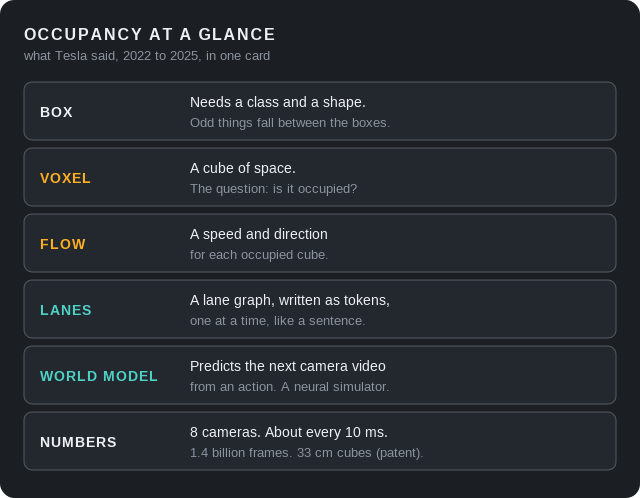
- Tesla’s occupancy network cuts the space around the car into cubes (voxels), says whether each one is occupied, and adds a speed and direction for each (flow). Tesla said in 2022 that it runs about every 10 milliseconds, on the car.
- Tesla also writes lane maps as a string of tokens, like a sentence, and has shown a generative world model that predicts the next camera video. What runs in the car today is not public.
Why a box needs a name
A typical object detector hands the planner a list. Each entry has a class (car, truck, pedestrian), a position, a size, a heading and a speed. The planner never sees the road itself. It only sees the list.
That works until something is not on the list. The authors of the Occ3D benchmark put it this way: existing methods “typically focus on estimating 3D bounding boxes, neglecting finer geometric details and struggling to handle general, out-of-vocabulary objects” (Occ3D, arXiv, April 2023). Out-of-vocabulary means a thing the model was never given a name for.
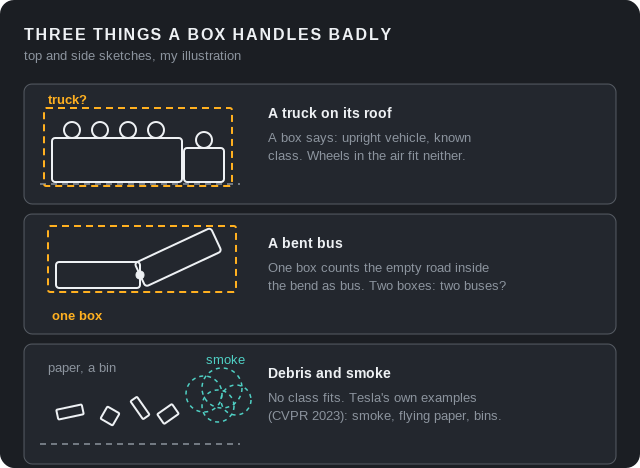
Tesla’s own examples came from Ashok Elluswamy of Tesla’s Autopilot team, in his CVPR 2023 keynote (video, transcript copy). He listed smoke (“you can drive through it, but it is occupying space”), paper flying everywhere, flying trash bins and construction vehicles with their lever arms moving.
Two regulator reports show the same habit in other systems:
- Tesla, 2019 (NTSB). A Model 3 on Autopilot hit the side of a semitrailer crossing a Florida road. Tesla told the NTSB that its collision avoidance needed the radar and the camera to agree, and that “complex or unusual vehicle shapes can delay or prevent the system from classifying the vehicles as targets or threats”. The vision system did not consistently detect and track the truck, and the radar and vision never matched on it. The NTSB’s probable cause named the truck driver’s failure to yield and the car driver’s inattention, with the design of the partial automation contributing (NTSB/HAB-20/01, 22 Jan 2020). That was the radar-and-camera system of the time, not the occupancy network.
- Uber’s test car, 2018 (NTSB). Not a Tesla, and it used lidar. The system saw a pedestrian pushing a bicycle 5.6 seconds before impact. It classified her as a vehicle, then also as an unknown object and a bicyclist. When the class changed, the system dropped that object’s tracking history, and it never correctly predicted her path (NTSB/HAR-19/03).
Both are about the name. When the name is wrong or missing, everything built on the name goes with it. So what if the car never needed one?
Cubes instead of boxes
A voxel is a pixel in three dimensions: a small cube of space. An occupancy grid chops the space around the robot into cubes and stores one number for each: the chance that something is in it. The idea is old. Wikipedia says occupancy grids were first proposed by Moravec and Elfes in 1985, for mobile robots (Wikipedia). Here is the same bent bus as before, once with a box and once with cubes:
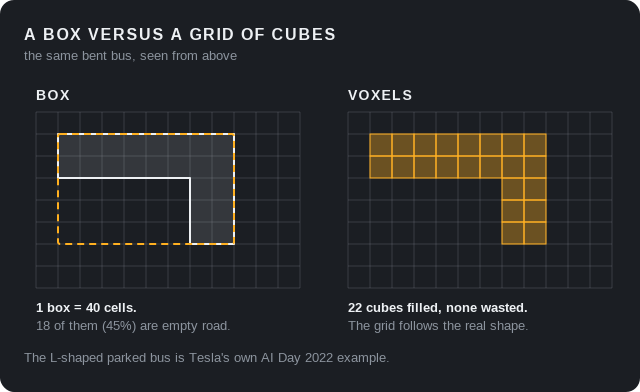
The bus is Tesla’s example, not mine. At AI Day 2022 a Tesla engineer showed an articulated bus parked at the side of the road and said it came out as an L-shaped voxel shape. He pointed out that a box detector would have to decide between one cuboid and two to fit the bend, while the occupancy network only cares about “the occupancy in the visible space” (AI Day 2022, video, machine-made transcript).
Building the grid takes four steps. The numbers below are made up to show the idea:
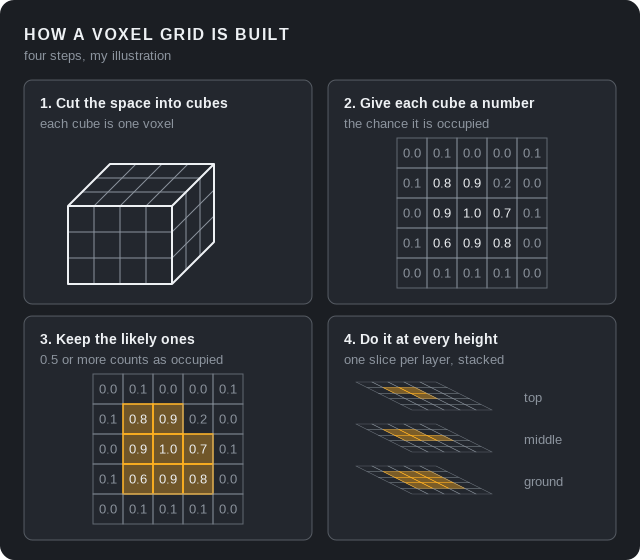
Nothing in those four steps asks what the occupied cubes are. A parked bus, a fallen branch and a mattress on the road all look the same to the grid: filled cubes. That is the point. The planner needs to know where it cannot drive. It does not need the noun.
| Box detector | Occupancy grid | |
|---|---|---|
| What it reports | A list of named objects | A number for every cube |
| Needs a class first? | Yes | No |
| Odd shapes | One cuboid, or a guess | The cubes follow the shape |
| Empty space | Counted inside the box | Left empty |
| Something new | May not appear | Still fills cubes |
Tesla had used grids before. A summon patent filed in February 2019 describes an occupancy grid that “contains drivability values at each grid location”, a chance that a spot can be driven on, produced by a neural network from camera images (US 11,567,514 B2). The 2022 network flips the question from “can I drive here?” to “is something here?”, and makes the grid three-dimensional.
What Tesla showed in 2022 and 2023
At AI Day, Elluswamy called the occupancy network the “base geometry layer” of the system. He said it predicts the full physical occupancy of the world around the car, and that anything physically present, “trees walls buildings”, gets predicted along with its future motion. The network takes the video streams of all eight cameras as input. A Tesla engineer said it produces a single volumetric occupancy and runs “about every 10 milliseconds” on the car’s accelerator chip. That is about 100 runs a second. I read that number in a machine-made transcript, so treat the exact figure as approximate.
Elluswamy’s 2023 keynote gave the plain version: the network “really just predicts whether some voxel in 3D space is occupied or not and the probability of that”. It “doesn’t have any specific ontology”. An ontology here is the list of classes. Tesla also said it predicts the flow of the voxels, and that everything runs in real time.
Customers met it in October 2022. Tesla said it was launching a “vision-based occupancy network” in FSD Beta to replace what the ultrasonic sensors used to supply, and that cars built without those sensors would have some features limited or inactive until software restored them (TechCrunch, 4 Oct 2022).
There is no Tesla paper on the network, so the best look inside is a patent application. US 2025/0282344 A1, published on 11 September 2025, lists Tesla as applicant and Ashok Elluswamy among ten inventors. It is pending, so it is not a granted patent, and it does not say what runs in the car today. Its figure 2A reads left to right like the 2022 talk:
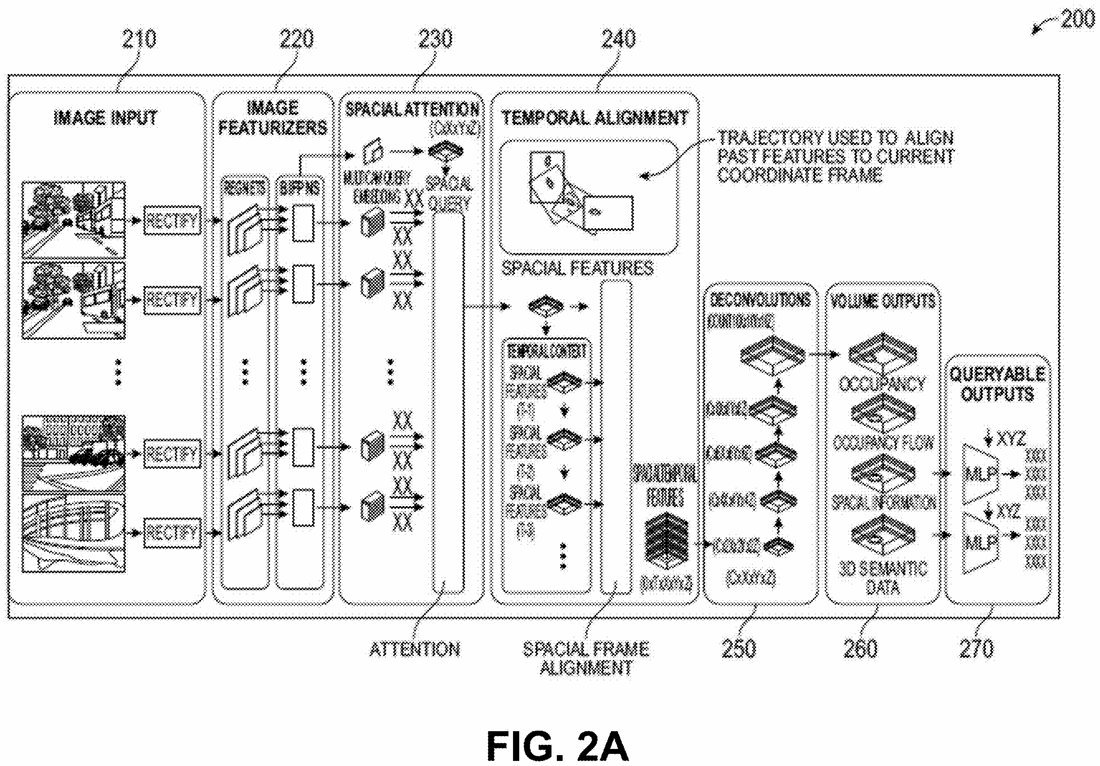
US patent application 2025/0282344 A1, fig. 2A (cropped, converted to grey scale).
Read the boxes in order. Each camera image is straightened (“rectify”), turned into features, and combined across cameras by attention. Features from earlier frames are shifted using the car’s own motion, so a cube that was visible a moment ago is not forgotten when a van hides it. Deconvolutions then grow the result back into a 3D grid. The last box is the clever one. The grid is not the end of the line.
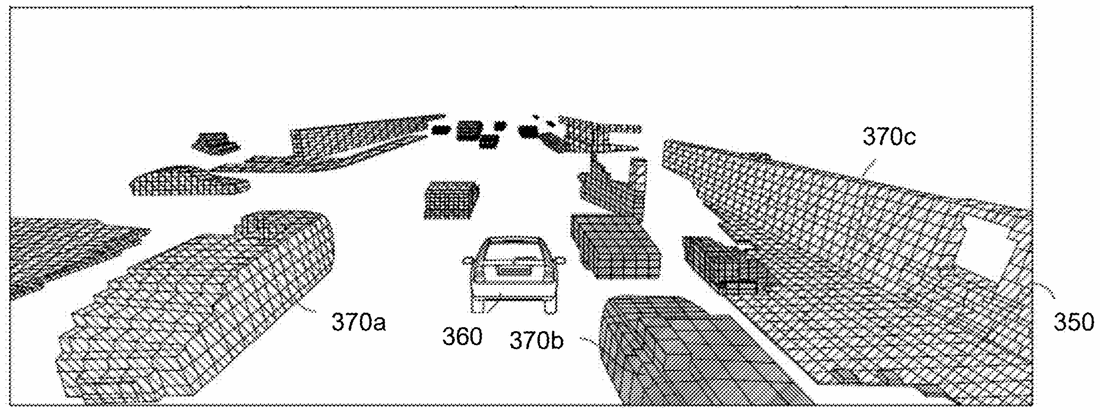
US patent application 2025/0282344 A1, fig. 3B (cropped, converted to grey scale).
The patent describes this picture as a simulation of the car’s surroundings with simulated masses in the cubes around the car. It is what the cubes look like once you draw them.
Cubes get expensive fast
Why is the last box clever? Because a fine grid is very costly. Cut the cube edge in half and you need eight times as many cubes (two times two times two). I worked it out for an 80 m by 80 m by 6 m box around the car. The 6 m height is the patent’s range of -3 m to +3 m. The 80 m is my guess, because Tesla has not said how far the grid reaches:
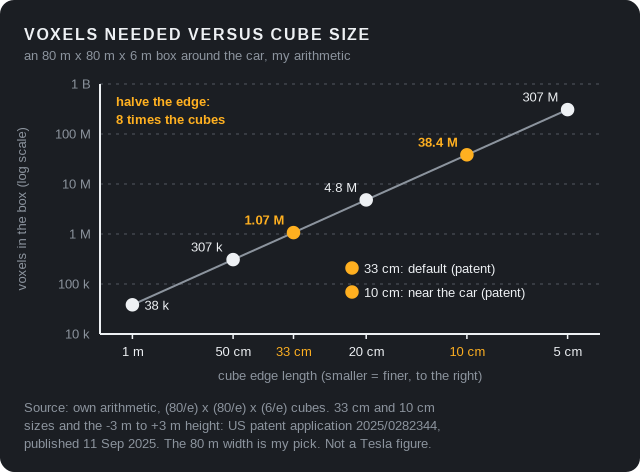
The patent says the default voxel may be 33 cm on a side, and that the size can be cut to 10 cm for occupied voxels near the car or its driving surface. In my box that is about 1.07 million cubes against 38.4 million. That is a lot of cubes to fill 100 times a second.
Tesla’s AI Day answer was to keep the grid coarse and add detail on request. The grids are “fixed-size voxel grids, which might not be precise enough for planning”, so the network also makes a feature for each voxel and feeds it to a small network (an MLP) to get a higher resolution. That is the “queryable outputs” box in the figure. You hand it an x, y, z position and it answers for that exact spot, not just for the cube that contains it.
The patent adds a second trick: a signed distance. Instead of “occupied or not”, each cube stores how far it is from the nearest surface. Positive means outside an object, negative means inside:
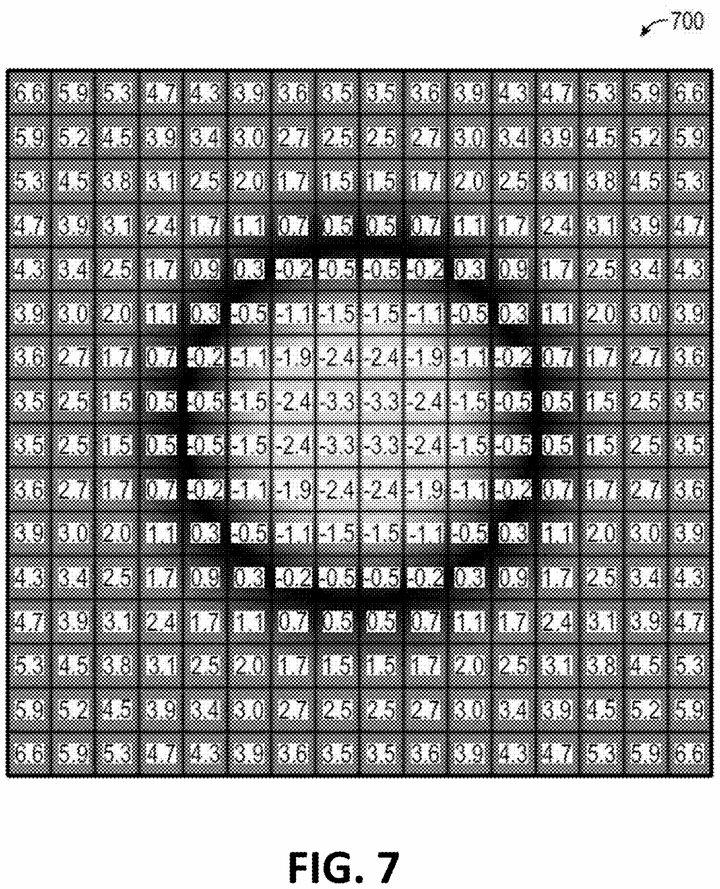
US patent application 2025/0282344 A1, fig. 7 (resized, colours reduced).
The zero crossing is the surface, so a distance can place a surface inside a cube. The patent gives a related example: a 33 cm voxel on a curb that is only half occupied, 16 cm of it.
Flow: which cubes are moving
Occupancy alone has a hole in it. A parked van and a van pulling out look the same in one frame: filled cubes. The planner needs to know which cubes will be somewhere else in a moment.
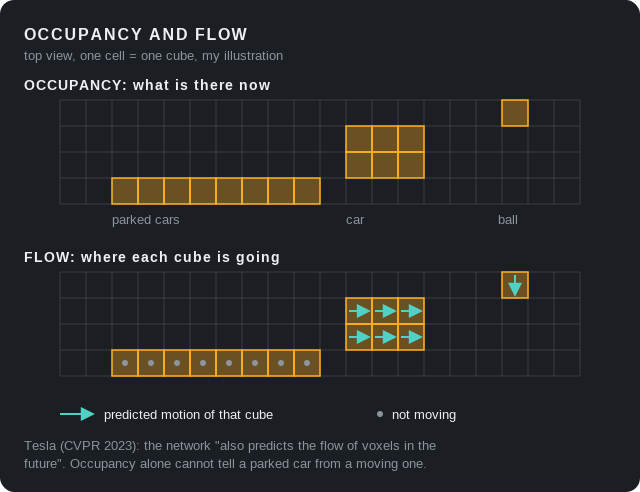
At AI Day Tesla said the network predicts occupancy flow for motion. In 2023 Elluswamy said it predicts “the flow of voxels in the future”. So each cube carries a motion estimate as well as an occupied chance. A ball rolling into the road and a parked car are the same kind of object to a box detector only if it first names them. In a flow grid the ball’s cube has an arrow and the car’s cubes have none, and no name was needed.
Teaching it without hand labels
Someone has to say which cubes were really occupied so the network can learn. Marking cubes by hand over billions of frames is impossible. Tesla talked about two ways around it.
Render it back. At AI Day a Tesla engineer said geometry “gives us a nice way to supervise these networks” and frees the team from defining an ontology. He said the supervision is “essentially free” because you can differentiably render the scene into any image that was observed. This is the idea behind NeRF, short for neural radiance field. A NeRF is a small network that, given a 3D position and a viewing direction, answers with a density and a colour. You draw (render) the scene from a camera’s position and compare it to that camera’s real picture (Mildenhall et al., arXiv 2020). If your 3D guess is right, the drawing matches the photo. The error trains the guess, and no person labels anything.
Tesla said at AI Day it was “looking into” both using NeRF features in occupancy training and using the network’s output as the input state for NeRF. That was a plan, not a finished product. In June 2023 Elluswamy said the occupancy network is “quite similar to NeRF in general”, with one difference: NeRF multi-view reconstruction is usually done for a single scene as an offline step, while the occupancy network predicts from the eight streaming cameras in real time.
Reconstruct offline. Tesla also said it builds 3D reconstructions from many trips over the same place, then runs more networks offline “to produce the labels that we want”. It called this a hybrid of NeRF and general 3D reconstruction. A warning from the same talk: a NeRF can look good while “the underlying geometry might be very fuzzy and cloudy”. At AI Day Tesla said the occupancy network is “trained with large auto-labeled data sets without any human in the loop” and that it took 1.4 billion frames to train.
The patent application describes a third source. Some cars may carry a 3D sensor that fires laser pulses, and its readings say which voxels hold something with mass. Those readings are paired with the camera images of the same places. Once trained, the model uses cameras only. The patent also notes a camera can think a cube is full because of fog, when nothing with mass is there. Smoke is the same problem from the other side: Elluswamy’s example of something you can drive through that still occupies space.
Lanes as language
Lanes do not fit in cubes. A lane is a path with a direction, and it joins other paths. At AI Day 2022 a Tesla engineer said early Autopilot treated lanes as an image-space segmentation task. That handled “a few different kinds of geometries”, forks and merges needed special cases, and at intersections it “just totally breaks down”.
The goal became a graph: the nodes are lane segments and the edges say which one leads to which. Tesla’s trick was to write that graph out as a sentence. The engineer described a special language for encoding lanes and their connectivity, where “the words and tokens are the lane positions in 3D space”. A new lane starts with a start token. Points along it use a continuation token. A fork gets a fork token that points back to the earlier token it splits from.
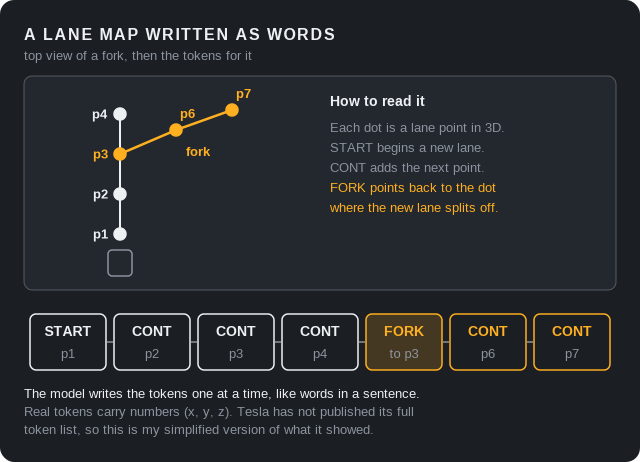
Why do this? Because a model that writes one token at a time can say “there is a fork here” and keep going, with no fixed list of lane shapes. The engineer said modelling the task as language let the team use recent autoregressive architectures, and that a simple segmentation approach “would just draw both” when it was unsure. In 2023 Elluswamy said the lanes are modelled with autoregressive transformers “quite similar to I would say GPT”, with a difference: unlike language, which is mostly linear, the model has to predict a full graph. His line about the hard part: lanes “can fork and merge and cause all kinds of trouble”.
Tesla has not published the token list. My picture is a simplified version of what the talk showed. A real token carries numbers, not a name like p3.
The world model idea
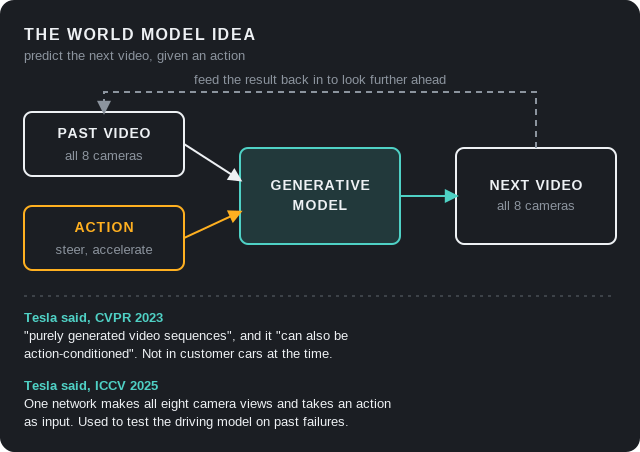
If a network can imagine the space around the car, can it imagine what comes next? In the same 2023 keynote Elluswamy showed a generative model that predicts future video. He called it “purely generated video sequences”, and said it can also be “action-conditioned”: ask it to keep in lane, or to change lanes to the right, and the imagined video follows. The aim, he said, was “a more general world model that can really just represent arbitrary things”. He called it “work in progress”. Asked whether it would reach cars, he said it “doesn’t ship to customers yet and we are still optimizing it”, and added “Maybe later this year, I don’t know.”
Others were working on the same idea in public. Wayve’s GAIA-1 takes video, text and actions and generates driving scenes (arXiv, Sept 2023). Drive-WM generates multi-camera video and scores imagined futures to pick a trajectory (arXiv, Nov 2023).
In October 2025 Elluswamy gave a talk at an ICCV workshop (transcript copy). He described a world simulator where “all eight cameras are generated simultaneously by a single neural network” that takes an action as input. He said it is useful for evaluation: you can replay past failures and check the new model against them. Training the driving model inside the simulator he described as something one could imagine, not as current practice.
The same talk matters for the rest of this post. He said the driving network “no longer is doing explicit perception of like vehicles, road boundaries or things like those”. Things like 3D occupancy can still be predicted, but as auxiliary outputs that “can be quite helpful”. The only thing that matters in the car, he said, is the control actions it produces.
What is not public
Here is what I could not find.
- What runs in the car today. Tesla has shown no architecture diagram for its current driving software. The 2022 modules may still exist as outputs or as training aids. That is my inference from the 2025 talk, not a Tesla statement.
- The grid size. Tesla has not said how far the grid reaches. The 33 cm and 10 cm figures are from a pending patent application, not a Tesla spec.
- The 10 ms figure. It comes from a machine transcript of one talk, and it describes AI Day 2022, not today’s hardware.
- How often it fails. No outside data I found says how well the occupancy network finds odd objects in real traffic, compared with box detectors.
What other researchers built
Within months of AI Day 2022, camera-only occupancy became a research topic in the open. These are link-only, since arXiv’s default licence does not allow copying their figures:
- TPVFormer (Feb 2023) turns multi-camera images into a 3D semantic occupancy grid using three planes through the scene instead of a full grid, trained with sparse supervision.
- SurroundOcc (Mar 2023) predicts dense occupancy from several cameras, and builds its training labels from lidar scans over many frames.
- Occ3D (Apr 2023) is a benchmark with labels made from Waymo and nuScenes data, so teams can compare occupancy models fairly.
- Scene as Occupancy (Jun 2023) uses occupancy as the shared scene description for detection, segmentation and planning.
None of these is Tesla’s code. They show the idea works outside Tesla, on public data, with cameras.
Questions people ask
What is a voxel? A voxel is a 3D pixel: a small cube of space. Where a picture is a grid of coloured squares, a voxel grid is a stack of them, one for each small cube of the world around the car.
Is an occupancy network the same as lidar? No. Lidar is a sensor that measures distance with laser pulses. An occupancy network is software that outputs a grid, and it can be built from camera images. Tesla’s patent application describes training with 3D sensor readings and then running on cameras alone.
How is occupancy different from a depth map? A depth map gives one distance per pixel, the first surface that pixel sees. Occupancy describes a volume. Tesla’s design also shifts features from past frames with the car’s motion, so earlier frames can inform cubes that are hidden now.
Does Tesla still use an occupancy network? Tesla has not said. In October 2025 Elluswamy described one large network that outputs steering and acceleration, with things like 3D occupancy as outputs it can be prompted for. Whether the car runs the 2022 network as described then is not public.
Why not just use boxes and add more classes? You can, and detectors do. The problem is the long tail: the next odd thing is never on the list. A grid needs no list.
Cheat sheet
Next: now the car has a 3D grid with motion, a lane graph, and a way to imagine what comes next. Something still has to turn that into a steering angle. For years that was hand-written rules and a search over possible moves. Tesla says it replaced most of that with one network. What did the old planner do, and what did Tesla say changed?
Further reading
Tesla (talks)
- Tesla AI Day 2022, 30 Sep 2022 (video)
- Ashok Elluswamy, CVPR 2023 WAD keynote (video, June 2023)
- CVPR 2023 keynote, transcript copy and AI Day 2022, machine transcript (third-party copies, with recognition errors)
- Elluswamy at an ICCV 2025 workshop, transcript copy
Patents
- US 2025/0282344 A1, vision-based high-fidelity occupancy (pending, published 11 Sep 2025)
- US 11,567,514 B2, summon to a target, with an occupancy grid of drivability values (granted 31 Jan 2023)
Regulators
- NTSB/HAB-20/01, Delray Beach, Florida, 1 March 2019
- NTSB/HAR-19/03, Tempe, Arizona, 18 March 2018
Papers
- NeRF, Mildenhall et al., 2020
- Occ3D, TPVFormer, SurroundOcc, Scene as Occupancy, 2023
- GAIA-1 and Drive-WM, world models for driving, 2023
Outside analysis
- TechCrunch, 4 Oct 2022: ultrasonic sensors out, occupancy network in
- Teslarati, 21 Aug 2022: Elluswamy on occupancy networks and NeRF
- Electrek, 1 June 2020: the Taiwan crash
- Occupancy grid mapping, Wikipedia

Backend engineer who builds high-volume systems that move money. More about Rafi