Part 2 of 12: Inside a Tesla Previous: Inside a Tesla: A Computer That Happens to Have Wheels Next: Building a Car in Pieces: Tesla's Unboxed Process
All 12 parts
- Inside a Tesla: A Computer That Happens to Have Wheels
- One Casting Instead of 70 Parts: Tesla's Giga Press
- Building a Car in Pieces: Tesla's Unboxed Process
- The Battery Is the Floor: Cells, Chemistry and the Structural Pack
- Fewer Wires, One Valve: Tesla's Electrical and Thermal Design
- Eight Cameras, No Radar: How a Tesla Sees
- The Chip in the Glovebox: Tesla's FSD Computer (HW3, HW4, AI5)
- Tesla HydraNet and Bird's-Eye View: From Eight Cameras to One Map
- Tesla Occupancy Network: Seeing Things It Has No Name For
- From Hand-Written Rules to One Network: How FSD Plans
- The Data Engine: How Tesla Teaches the Car
- Robotaxi: A Car With Nobody in the Driver's Seat
In September 2020 a drone flew over Tesla’s Fremont factory and filmed a machine standing outside the main building. InsideEVs wrote up the video on 10 September and called it the first view of the new gigacastings (InsideEVs).
A few months earlier, SAE’s Automotive Engineering had explained what the machine was for. Tesla wanted to make the rear floor of the Model Y as one casting. SAE wrote that it would replace around 70 stampings, extrusions and castings in the Model 3’s rear structure, and quoted Musk calling the old structure “a patchwork quilt” (SAE, 1 June 2020).
This part follows that casting from liquid metal to body shop. It also checks the numbers on the way, because “about 70 parts” is the kind of figure that gets repeated more often than it gets measured. It comes from SAE’s article, not from a Tesla deck.
Part 2 of Inside a Tesla. I like the car and the tech, so I researched it to feed my own curiosity; not affiliated with Tesla, not investment advice.
Short version:
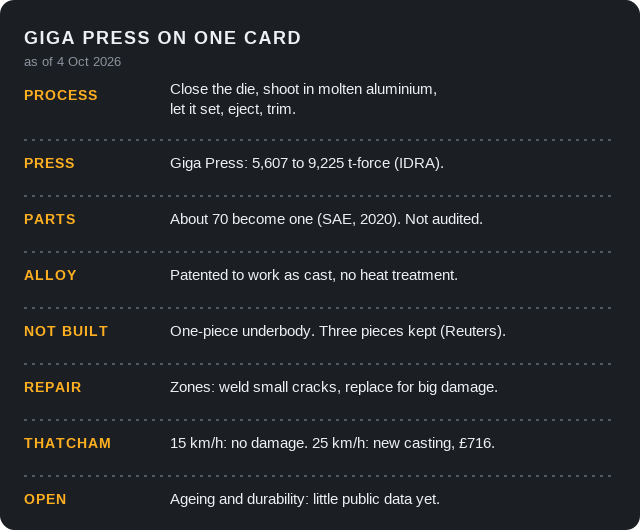
- A die casting machine shuts a two-piece steel mould, pours in about 100 kg of molten aluminium and pushes it into the mould in roughly a tenth of a second. The Giga Press from IDRA, an Italian machine maker, holds the mould shut with more than 5,600 tonnes of force.
- SAE reported in 2020 that the Model Y rear casting replaces about 70 parts. An outside UK study repeats the 70, and I found no Tesla deck or call that states it. Other counts, such as 370, measure other things.
- Tesla patented an aluminium alloy meant to be used as cast, with no heat treatment. Tesla’s repair manual lets a body shop weld small cracks and bans repairs in the red zones. A one-piece underbody was reported but not built.
How high-pressure die casting works
Die casting is an old idea. Make a steel mould, called a die, in two halves. Force molten metal in, wait until it sets, open the die and take the part out. The “high pressure” in the name is real: the metal goes in at somewhere between 10 and 175 megapascals (Wikipedia).
Aluminium is cast on a “cold chamber” machine. The metal is melted in a separate furnace, a measured amount is moved into a short tube called the shot sleeve, and a piston drives it into the die. One trip through the machine looks like this:
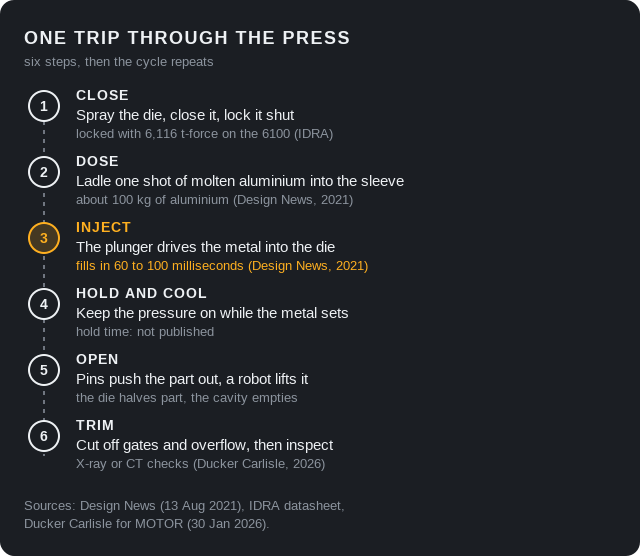
Step 3 is the one that matters. Design News reported in August 2021 that a Giga Press moves about 100 kg of aluminium into the die and fills it in 60 to 100 milliseconds (Design News). It has to be that quick. Aluminium starts to freeze as soon as it touches cold steel, and the part is a big thin-walled shape. Tesla’s alloy patent asks for metal that can flow at least about 1.8 m in high-pressure casting (WO2021150604A1, claim 4).
Speed has a cost. Fast filling can trap air in the metal, and a paper on die casting calls gas-induced porosity “the main limitation and important problem” of the process, with pores formed by gas trapped during high-speed injection (Cao et al., Materials, 2019). A pore is a tiny hole inside the metal. One fix is to pump the air out of the die before the shot. Vacuum-assisted casting is said to reduce porosity and make heat treating and welding possible (Wikipedia).
I could not find a cycle time from Tesla. IDRA’s datasheet gives a “dry cycling” rate of 1.3 per minute for its 6100 machine (IDRA GIGAPRESS catalogue). I read that as the press opening and closing with no metal in it, about 46 seconds. A real cycle adds the spray, the pour and the robot, so it is longer. How long, nobody outside has published.
Why the press is so big
Here is the surprise. Once the metal is in, it pushes back. The pressure inside the die tries to force the two halves apart, and the clamp has to hold them shut. The sum is simple:
force to keep the die shut = pressure on the metal x area of the part
40 MPa (400 bar) x 1.5 square metres = 60 MN = about 6,100 tonnes-force
A tonne-force is the push of one tonne of weight. IDRA’s datasheet makes the same sum: at 400 bar on the metal, the 6100 model can hold shut a part and runner system covering up to 15,291 square centimetres, about 1.5 square metres. A car’s rear floor is a big flat shape, so it needs a big clamp.
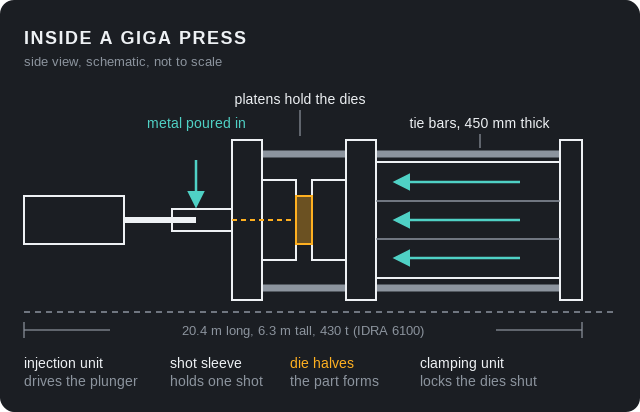
The numbers on that drawing come from IDRA’s datasheet. SAE described the first machine in 2020 as 64 feet (19.5 m) long, 17 feet (5.3 m) tall and “in excess of 410 tons”, with a maximum shot of 104.6 kg (SAE). The two sources roughly agree on length and weight but not on height, and the datasheet is undated, so treat the height as approximate.
Press makers rate machines by clamping force, and IDRA’s own range shows how far the Giga Press stretches it:
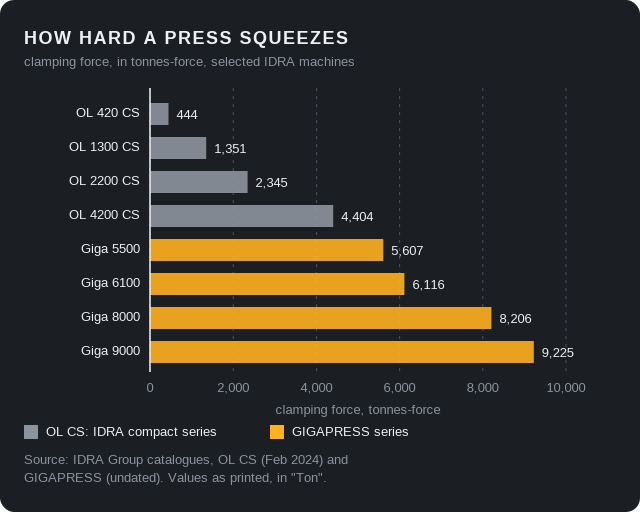
IDRA’s compact OL CS series tops out at 4,404 tonnes-force in its February 2024 catalogue (IDRA OL CS catalogue). The Giga Press line starts above that. News reports give the machines Tesla uses as 5,500 and 6,200 tons (Design News, 2021) and as the 6,100 class (SAE, 2020). Those are the same family rounded in different ways. Which of the bigger presses casts which Cybertruck part is reported differently by different outlets, so I leave it out.
For scale, here is a 9,000-tonne machine at an IDRA open day in June 2022:
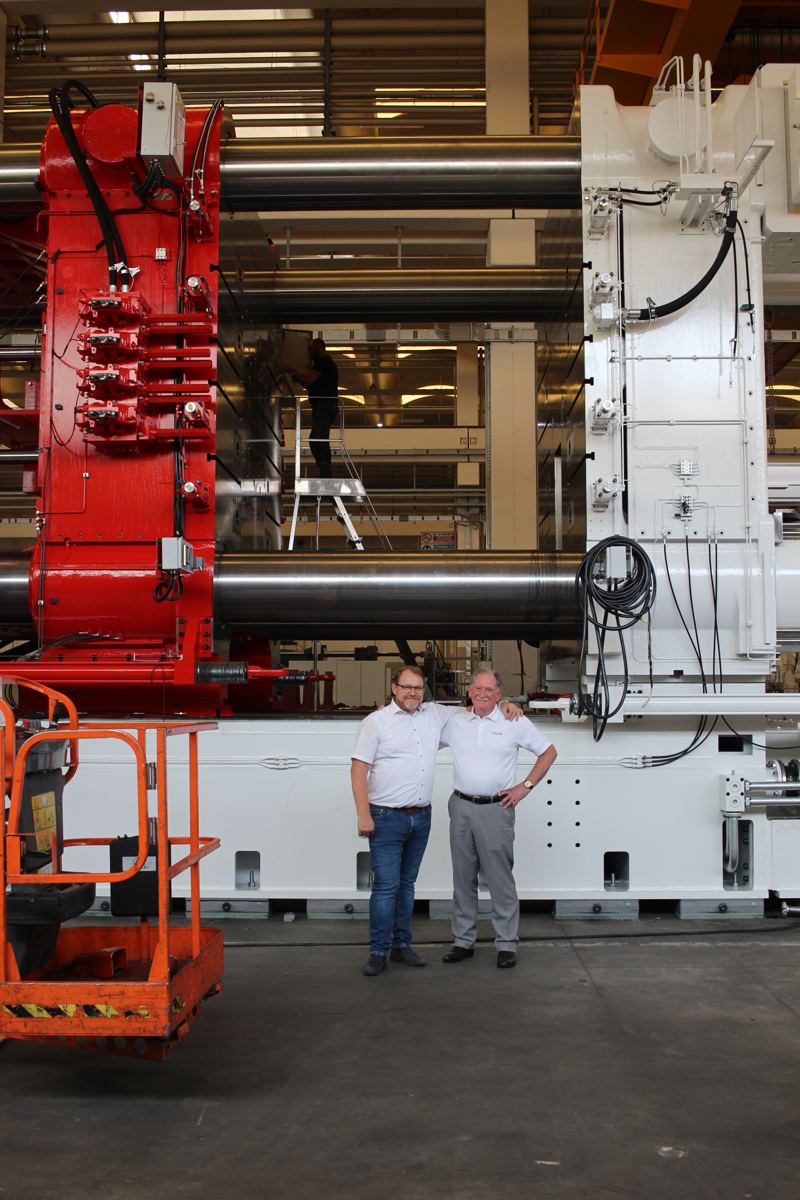
Photo: Paul Sladen, CC0, via Wikimedia Commons, 29 June 2022. The Commons description names the two men as John Stokes of IDRA and Sandy Munro. Resized.
Tesla is not alone. Ducker Carlisle, a consultancy, wrote for MOTOR in January 2026 that Tesla is the only high-volume adopter in North America. In the same piece, machine maker Bühler’s Michael Cinelli puts the largest machines at 6,000 to 9,000 tons of locking force. Volvo leads in Europe, and BYD, Geely/Zeekr, Li, NIO and XPeng use cast modules in Asia (MOTOR, 30 January 2026).
What the casting replaces
Tesla’s Model Y has a casting at the rear. In October 2021 InsideEVs relayed an Electrek report that a former Tesla employee confirmed the bodies in a Q2 2021 financial report photo use a single front and a single rear casting (InsideEVs, 6 October 2021). A Tesla patent granted on 23 December 2025 shows both. It describes a front casting with the wheel wells, bumper mounts and crumple zones, and a back casting with the rear wheel wells and a transverse strut (US 12,503,165 B2). In the drawing below, 110 is the front casting and 115 is the back one:
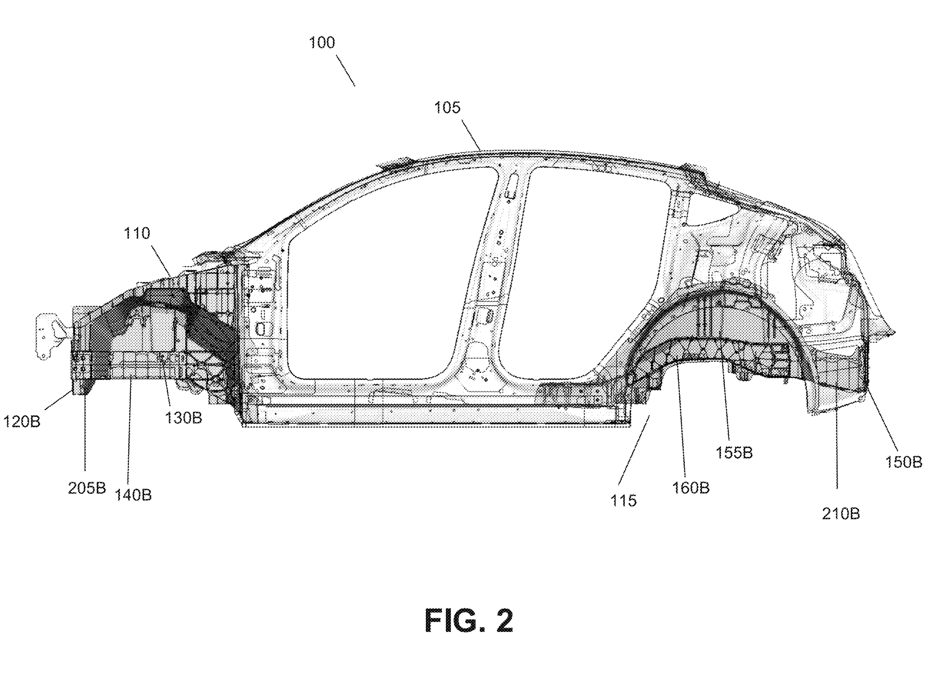
US patent 12,503,165 B2, fig. 2. Rotated and cropped. The patent text carries no copyright notice.
The patent says the vehicle frame is made of three main parts: a front cast piece, a rear cast piece and a central cab frame. It also says the castings remove the need for much of the spot welding, seam welding, riveting, bolting and gluing that traditional bodies use. And this is what a gigacast frame part looks like in real life:
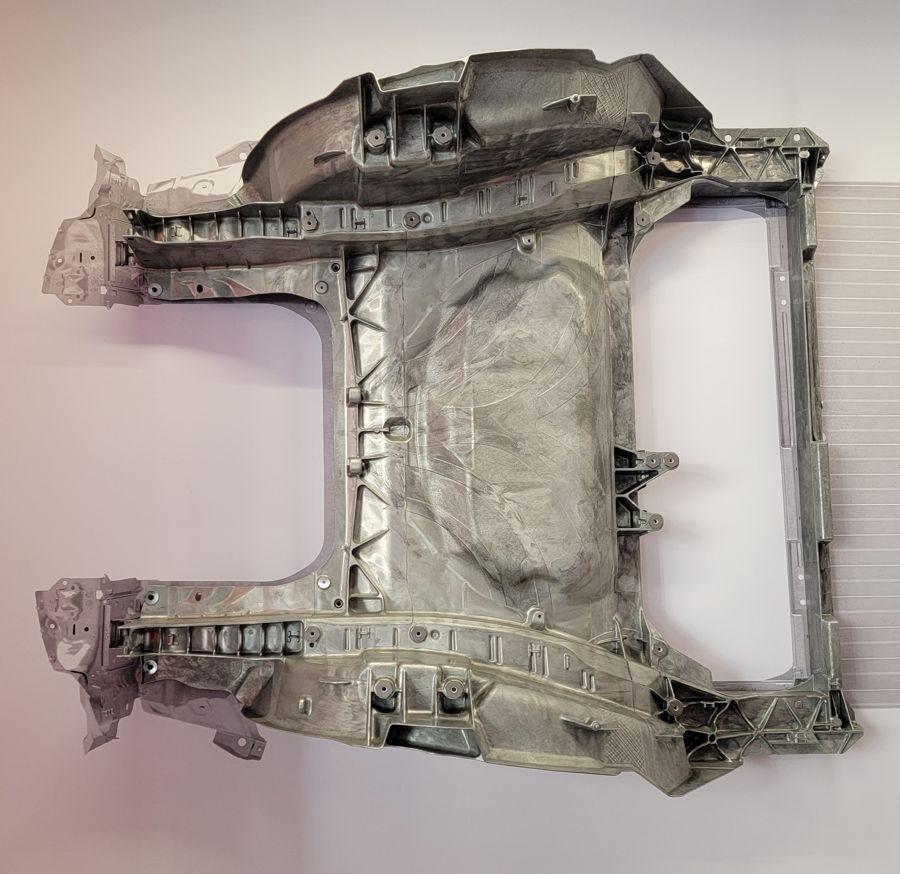
Photo: Votpuske, CC BY 4.0, via Wikimedia Commons, 25 November 2023. The uploader describes it as part of a Tesla frame made by gigacasting and does not say which model. Resized.
Now the count. Here is what the casting replaces, as SAE reported it:
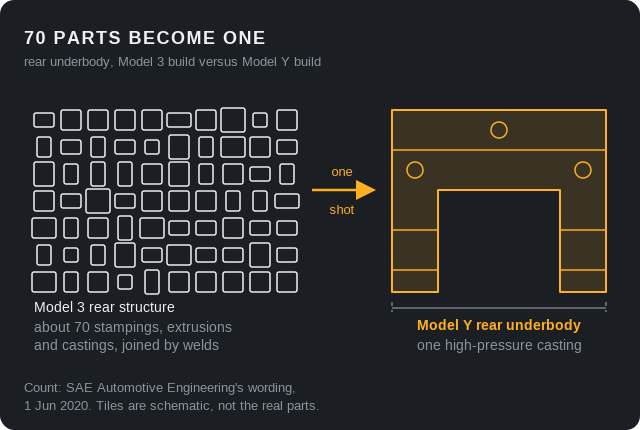
Treat every number in that picture as a claim. The 70 is SAE’s own wording, in its 2020 article. It covers the rear casting only, compared with the Model 3’s rear structure. In the same article Musk said the new design would cut the body shop’s size by 30% (SAE), and that “we got rid of 300 robots, just with that rear body casting”, from a body line Design News says had roughly 1,000 robots (Design News). I found no outside audit of those two.
Outside data repeats the 70. Thatcham Research, a UK vehicle research centre, says the Model Y’s rear casting combines about 70 components (Thatcham, September 2025). That is agreement on a number, not a count of the parts.
The trouble starts when other numbers join in:
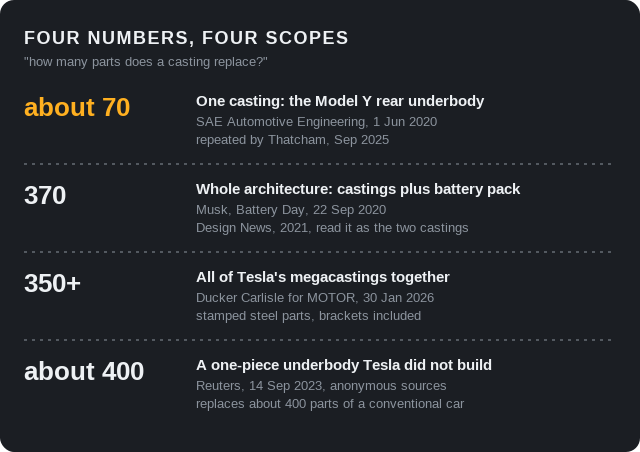
At Battery Day on 22 September 2020, Musk said “10% mass reduction in the body of the car, 14% range increase, 370 fewer parts”. Reading the transcript, those results came with the whole structural architecture, not the casting alone (Battery Day transcript, Rev). A year later Design News put 370 in its headline as the saving from two castings. Ducker Carlisle gives a third figure, more than 350 stamped steel parts removed by Tesla’s megacastings. I use “about 70 for the rear casting” and nothing bigger.
The alloy that skips the oven
A big casting has a second problem after the shot. Metal parts are often heat treated to make them stronger: heated in an oven, then cooled fast, which is called quenching. Musk told the Battery Day audience that heat treating a large casting afterwards “tends to deform”, and described it as doing “this like potato chip thing”. Tesla, he said, developed its own alloy that “did not require coatings or heat treatment” (transcript).
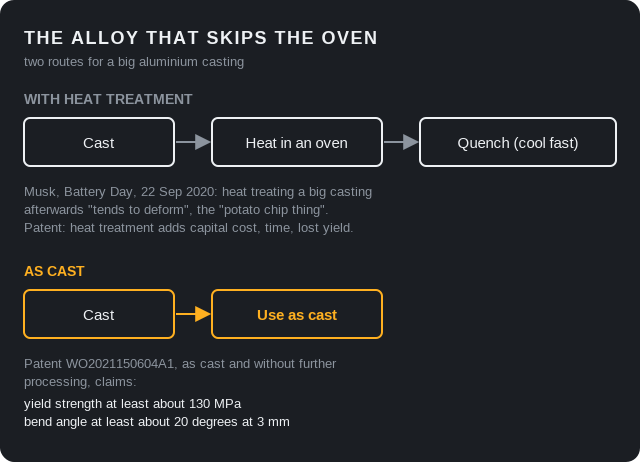
The patent is WO2021150604A1, “Die cast aluminum alloys for structural components”. It has a priority date of 22 January 2020 and was published on 29 July 2021. Its first claim describes an alloy by what it can do, as cast and without further processing:
- A yield strength of at least about 130 MPa. Yield strength is the load at which the metal starts to bend and stay bent.
- A bend angle of at least about 20 degrees at 3 mm thickness. The bend angle says how far a strip can bend before it cracks.
The patent’s reasons for avoiding heat treatment are cost, not just shape. It says heat treatment can need large capital spending, long process times and can cost yield, and that large parts are harder to put through quenching. The preferred example reaches about 143 MPa and about 25 degrees. One claim lists a recipe with 6 to 11 percent silicon and small amounts of copper, manganese, magnesium, vanadium, strontium, titanium and chromium.
What I cannot tell you is which alloy is in the cars. A patent shows what Tesla covered, not what the production line pours, and Tesla has not said. Reuters reported in 2023 that casting specialists working on a one-piece underbody had also come up with “an after-production heat treatment” (Reuters, via KSL). That was a different project with anonymous sources, and it sits next to Tesla’s public story, so I show both and do not pick.
The one-piece underbody that did not happen
The casting is big, but it is not the whole floor. The car’s underbody is three pieces: a front casting, a rear casting and a middle section where the battery sits. Reuters reported in September 2023 that Tesla was trying for more. Five anonymous sources said it was working on casting nearly the whole underbody in one piece for a small car, using 3D-printed sand cores for the hollow parts. The sources said such a part would replace about 400 parts of a conventional car (Reuters, 14 September 2023, via KSL). People call this “unicasting”. Reuters does not use that word.
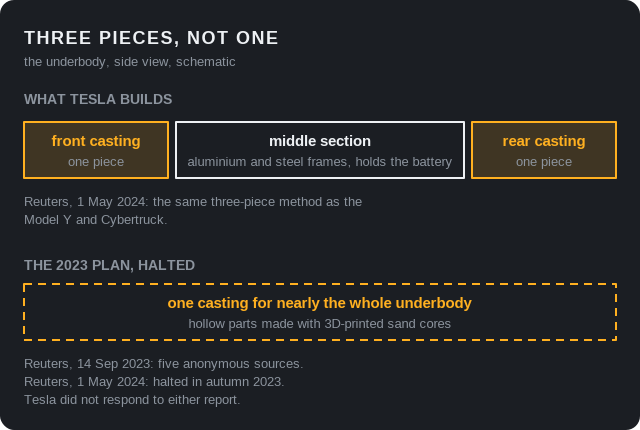
On 1 May 2024 Reuters reported that Tesla had stopped. Two sources said it decided in autumn 2023 to halt the one-piece effort and keep the three-piece method used for the Model Y and Cybertruck. One said suppliers were adapting the three-piece process for the next car. Tesla did not respond (CNBC carrying the Reuters report). One analyst, Terry Woychowski of Caresoft Global, put it this way: “Would they rather have done it all in one big piece? Sure, they would’ve, but at what cost?”
The idea itself is not new. A Tesla patent application filed in January 2018, US 2019/0217380, describes a casting machine with a central hub and several die parts that slide in from different directions to form a whole frame. Google Patents lists it as abandoned in November 2020 after no reply to an office action, and warns that its status field is an assumption, not a legal finding. So the dream was on paper two years before the Giga Press showed up outside Fremont. It stayed on paper.
What happens when it cracks
A casting that large raises an obvious worry. Welded steel can be cut and patched a piece at a time. A single casting cannot. Tesla’s own answer is in its public collision repair manual (Model Y cast rear underbody guideline). It splits the casting into colour zones, and the rule depends on the colour:
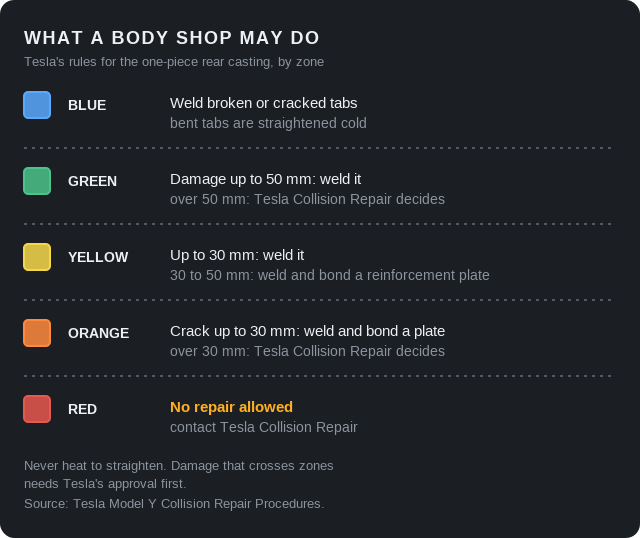
Two more rules sit outside the table. Heat is never used to straighten bent metal. And damage that crosses zones needs Tesla Collision Repair’s approval before any work starts. The reinforcement plates are not welded: the manual has the shop glue them with structural adhesive and clamp them. The manual also says that cars with a two-piece rear underbody follow a different guideline.
Does it work in a crash? Thatcham ran a two-year study at its Berkshire site, with the Allianz Centre for Technology in Germany, and published it in September 2025. Repairer Driven News carried the numbers:
| Test | Result |
|---|---|
| Crash at 15 km/h | No structural damage to the casting. Car repaired without touching it |
| Crash at 25 km/h | Cracking and misalignment. The whole casting was replaced |
| Replacement casting | £716 |
| Replaceable cast rear rail | £31 each |
| Partial replacement, against the Model 3’s steel rear | £2,167 cheaper |
| Full replacement | £519 saved (the report gives no comparison for this one) |
So outside data says the casting can be cheaper to fix than steel, even when a crash breaks it. The caveats are in the same report. Welding must be done at Tesla-approved sites, which may mean moving a car between repair centres. Big irregular parts are hard for small body shops to handle. Thatcham wants clearer non-destructive testing, and says the result depends on the maker selling reasonably priced replacement parts. The full report is open to Thatcham members only.
The long-term picture is open. In February 2024 Ducker Carlisle said the effects of ageing on megacastings were unknown. It had found one reported crack after production: an owner reported a “sizable” crack in the front casting of a Model Y two months after delivery with no collision, and said it would take years to know whether that was an isolated case. It also said replacing a megacasting is “nearly impossible” unless the part is designed with repair zones (Repairer Driven News, 22 February 2024). Tesla’s zones, and Thatcham’s tests, are an answer to that worry. They are not a proof about year ten.
The wider industry is split on the bet. Automotive Manufacturing Solutions reported in August 2025 that a defective megacasting can make a whole structural assembly unusable, where a bad stamping spoils only itself. Volvo expects one casting to replace around 100 stamped parts, while BMW and Stellantis are quoted as not seeing the economic case (Automotive Manufacturing Solutions). Ducker Carlisle adds that each die costs “several million dollars” and that makers need X-ray or CT scanners to inspect the parts.
Questions people ask
What is a Giga Press? It is a very large high-pressure die casting machine made by IDRA, an Italian company. IDRA’s catalogue lists Giga Press models from 5,607 to 9,225 tonnes-force of clamping force. The first ones at Tesla were in the 6,100 class.
How many parts does the Model Y rear casting replace? SAE reported about 70 in 2020, comparing it with the Model 3 rear structure. Thatcham repeated about 70 in September 2025. I found no Tesla deck or call that states the number. The figure 370 includes the structural battery pack, so it is not the same thing.
Does Tesla heat treat its castings? Tesla says it developed an alloy that does not need heat treatment, and a Tesla patent describes one. Tesla has not said which alloy the cars use, so the production process is not public.
Can a Tesla casting be repaired? Small cracks, yes, in the right zones: up to 50 mm in green, up to 30 mm in yellow and orange, with a bonded plate in some cases. Red zones allow no repair, and bigger damage means Tesla approval or a new casting.
Is a Tesla’s whole body one casting? No. Tesla builds the underbody in three pieces, with front and rear castings and a middle section. Reuters reported that a one-piece underbody was tried and dropped.
Cheat sheet
Next: the biggest parts of the car are now single pieces. So why not build the car in big chunks as well, instead of one long line of workers and robots? Part 3 looks at Tesla’s “unboxed” plan: what Tesla said, and what is known so far.
Further reading
Tesla
- Model Y collision repair: cast rear underbody guidelines, Tesla Service
- Battery Day 2020 transcript, a third-party transcript of Tesla’s 22 September 2020 event
Patents
- WO2021150604A1, die cast aluminum alloys for structural components
- US 12,503,165 B2, integrated energy absorbing castings, also as the USPTO PDF
- US 2019/0217380 A1, multi-directional unibody casting machine
Machine maker
Papers
Outside analysis
- Tesla Casts a New Strategy for Lightweight Structures, SAE Automotive Engineering, 1 June 2020
- Here Are The Tesla Model Y Gigacastings, InsideEVs, 10 September 2020
- Tesla’s Switch to Giga Press Die Castings Eliminates 370 Parts, Design News, 13 August 2021
- Tesla Begins Industry-First Model Y Front and Rear Castings, InsideEVs, 6 October 2021
- Gigacasting 2.0: Tesla reinvents carmaking, Reuters via KSL, September 2023
- Tesla retreats from next-generation gigacasting, CNBC, 1 May 2024
- Megacasting long-term durability unknown, Repairer Driven News, 22 February 2024
- Thatcham Research: mega casting can be cheaper to repair and the Repairer Driven News report
- Production minimalism: how megacasting is reshaping automotive manufacturing, Automotive Manufacturing Solutions, 28 August 2025
- Gigacasting: the next big idea in automotive manufacturing?, Ducker Carlisle for MOTOR, 30 January 2026
- Die casting, Wikipedia

Backend engineer who builds high-volume systems that move money. More about Rafi