Part 11 of 12: Inside a Tesla Previous: From Hand-Written Rules to One Network: How FSD Plans Next: Robotaxi: A Car With Nobody in the Driver's Seat
All 12 parts
- Inside a Tesla: A Computer That Happens to Have Wheels
- One Casting Instead of 70 Parts: Tesla's Giga Press
- Building a Car in Pieces: Tesla's Unboxed Process
- The Battery Is the Floor: Cells, Chemistry and the Structural Pack
- Fewer Wires, One Valve: Tesla's Electrical and Thermal Design
- Eight Cameras, No Radar: How a Tesla Sees
- The Chip in the Glovebox: Tesla's FSD Computer (HW3, HW4, AI5)
- Tesla HydraNet and Bird's-Eye View: From Eight Cameras to One Map
- Tesla Occupancy Network: Seeing Things It Has No Name For
- From Hand-Written Rules to One Network: How FSD Plans
- The Data Engine: How Tesla Teaches the Car
- Robotaxi: A Car With Nobody in the Driver's Seat
In June 2021, at a computer vision workshop, Tesla’s Andrej Karpathy said his team had written 221 small rules by hand to pull hard examples out of customer cars. Tesla calls them triggers. They came out of roughly four months of work on one problem, replacing radar with cameras. One rule asks whether the main and narrow cameras disagree. Another asks whether a new network predicts a car braking hard when the driver does not seem to mind.
Those rules are the key to this part. The network in your car does not learn on the road. It stays the same until the next software update. The learning happens on servers, from examples, and the real question is who picks the examples. Tesla calls the answer the data engine.
Part 11 of Inside a Tesla. I like the car and the tech, so I researched it to feed my own curiosity; not affiliated with Tesla, not investment advice.
Short version:
- The data engine is a loop. Find a mistake, write a rule that finds more cases like it, collect those clips from the fleet, label them, retrain, test the new network quietly in customer cars, and go round again. Karpathy said the dataset behind Tesla’s vision-only Autopilot went through seven rounds of shadow mode.
- Labelling is done more and more by software. Offline networks rebuild the road from many trips and use the future frames of each clip. Simulation covers cases that are rare or hard to label.
- All of it runs on GPUs. Tesla’s own figures go from 5,760 A100s (June 2021) to more than 230,000 H100 equivalents in April 2026 (my sum of two Tesla figures). Dojo, Tesla’s own training chip, has a dated story where Tesla, Musk and the press each say something different.
The loop in one picture
Here is the whole thing. Every box is explained below, and every number has a source and a date.
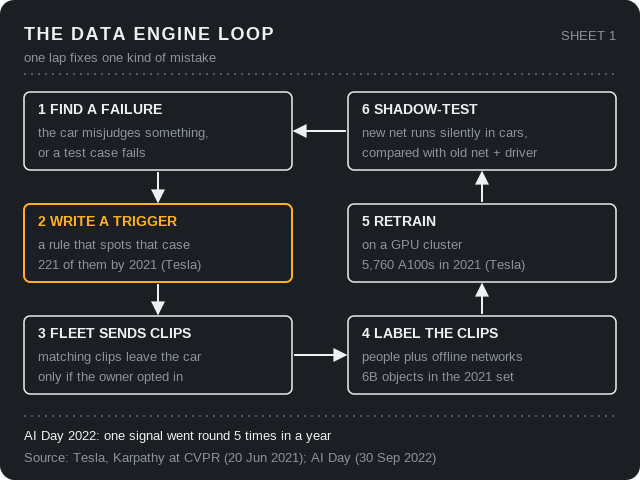
Tesla has given a few numbers for one pass. Karpathy’s June 2021 talk described a dataset of about 1.5 petabytes: one million videos of 10 seconds each, with 6 billion labelled objects. He said the team spun the loop “over and over again until the network basically becomes incredibly good” (talk video, VentureBeat’s report). I checked the figures against the video captions. At AI Day in September 2022, a Tesla engineer said one signal, the one that tells a car whether another vehicle is moving, had been updated five times that year, each time with new data (AI Day 2022).
So one lap is not a one-off project. It is a routine. The first step of the routine is the clever one.
Steps 1 and 2: a rule that spots the moment
A trigger is a rule that runs in the car and says: keep this moment. Karpathy showed examples in 2021 that are mostly disagreements: a new network that does not match the old stack or the radar the car still had then, jitter in a bounding box, the main and narrow cameras not agreeing, a predicted hard brake that the driver ignores. VentureBeat also reports tunnel entry and exit as a known hard scene.
Tesla’s patent EP3850549B1 explains how this can be cheap. Karpathy is the only named inventor, the priority date is 14 September 2018, and the European patent was granted on 28 May 2025. A small classifier reads an intermediate result of the driving network, so the car does not need a second network. If the score passes a threshold, the car keeps the sensor data and uploads it. The patent gives example conditions. A trigger may capture a tunnel “only at dawn and dusk”. Another may fire at most every 30 minutes, and only after the car has been driven for at least 20 minutes. The patent’s Figure 1A shows a car spotting a tyre on the road.
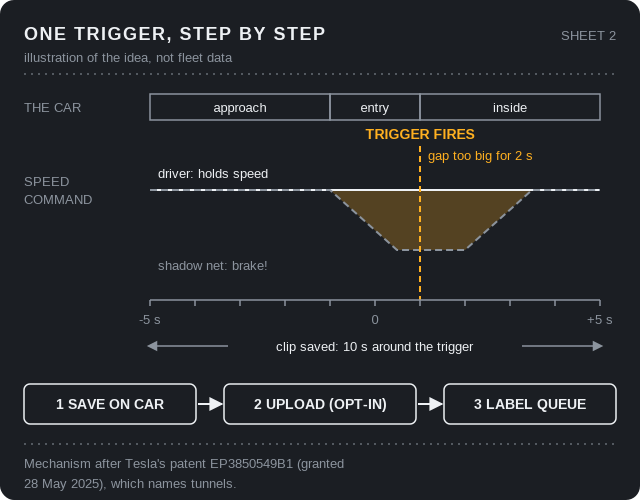
The picture is my illustration of the idea in the patent. It is not a real trace.
The grey line is shadow mode, the second kind of trigger. Karpathy said the new network runs silently in customer cars. It sends no commands. Its output is compared with the old network, with the radar and with what the driver did. A disagreement is a reason to keep a clip. IEEE Spectrum wrote in August 2022 that shadow mode has run since 2016 and that Karpathy told it a new detector brings back thousands of images quickly. It also quotes one outside expert who says shadow mode captures only a small share of driving time.
Why not let a network write the triggers? VentureBeat reports that Karpathy said this is hard, because a trigger is a judgement about meaning: something “semantic that you as a person have to intuit”. That line is not in the talk captions I read, so it may come from the question time. On the count, the captions say 221, a number Dynamically Typed’s summary also gives. VentureBeat wrote “more than 200”.
Four years later the idea was the same. In an October 2025 talk, Tesla’s Ashok Elluswamy said the fleet gives Tesla “the Niagara Falls of data”. He said 500 years of driving is more data than Tesla could ever store on its clusters. He said Tesla picks data with “explicit triggers or small neural networks targeting specific scenarios” and by “constantly evaluating what the model predicted versus what actually happened” (transcript copy).
Step 3: what leaves the car
If a trigger fires, something is uploaded. What exactly, and who agreed to it? This is what Tesla’s own documents say. I could not open tesla.com from my tools, so the manual below is the English edition for China, which Tesla hosts on tesla.cn. Wording for other regions may differ.
| Question | What Tesla says | Where |
|---|---|---|
| Is fleet learning opt-in? | “Certain advanced data collection (e.g., Fleet Learning or Cabin Camera Analytics) is opt-in” and is controlled in Controls > Software > Data Sharing | EU Data Act disclosure (undated) |
| How big is a clip? | Fleet Learning video clips “may be several MBs and are collected only in limited scenarios” | same disclosure |
| Does it name you? | The data “does not identify you personally and can be sent to Tesla only with your explicit consent”. The same passage says “Tesla shares this data with partners that contribute similar data” | Model Y 2025+ manual, Data Sharing section (software 2026.26.200.11) |
| What about location? | Tesla “does not record or store vehicle-specific GPS information, except the location where a crash occurred” | same manual |
| Poor-visibility images | They stay in the car unless Data Sharing allows it, and are deleted after two days | same manual |
| Diagnostic data | The car records VIN, speed, direction, location, charging events and fault codes, and its telematics system sends vehicle information to Tesla “on a periodic basis”. This reads as a separate channel from Data Sharing | same manual, Vehicle Telematics |
Look at the last two rows together. The telematics section lists “location” among the recorded data. The Data Sharing note says Tesla does not store vehicle-specific GPS information apart from where a crash happened. I could not reconcile the two sentences, and they may be written for different purposes or regions.
Two more things are worth keeping in mind. First, the patent also says location and identifying information “may be anonymized” and that its methods “may require affirmative user consent (e.g., opt-in)”. The words are about how the system could work, not a promise about any one car.
Second, the rules have moved before. In November 2021 TechCrunch reported that the FSD Beta agreement asked drivers to consent to “VIN-associated image data” from the external and cabin cameras after a serious safety risk or a collision. It said this was the first time Tesla would link footage to a specific car and driver. The EU Data Act is the law behind the disclosure above: Regulation (EU) 2023/2854. I found no Tesla text that lists which uploads each switch controls. The screen on the car is the place to check.
Step 4: labels, mostly by machine
Clips arrive without labels. Someone has to mark the lanes, the cars and the walkers. At AI Day in August 2021 Karpathy said Tesla had brought labelling in-house, with a team of more than a thousand people, and had moved from drawing on single images to labelling in 3D, then projecting the labels back into every camera view. But he said people are good at meaning and computers are good at geometry, and the future was a mix (AI Day 2021, transcript copy).
The computer side was shown by Elluswamy. Servers run large networks over each clip offline, which can be slow because no car has to run them. A clip is 45 seconds to a minute of video, motion and GPS data. From it the servers rebuild the road surface, and he showed 16 trips through one place being aligned in a single optimisation.
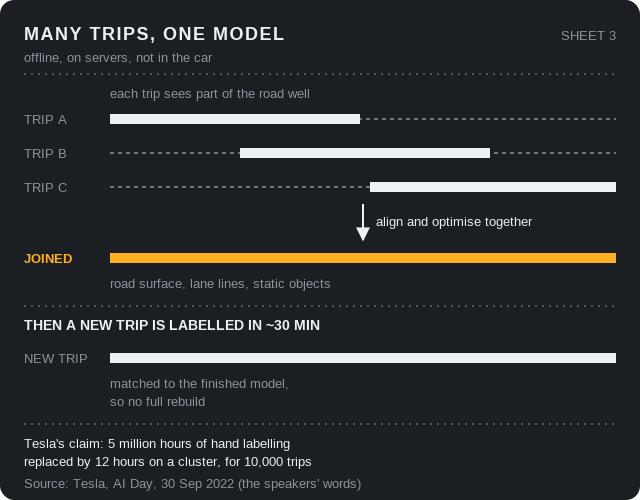
The point of the join is that no single trip sees the whole scene. A parked van hides a lane, and the next trip from another car shows it. The second advantage is easier to see in a picture:
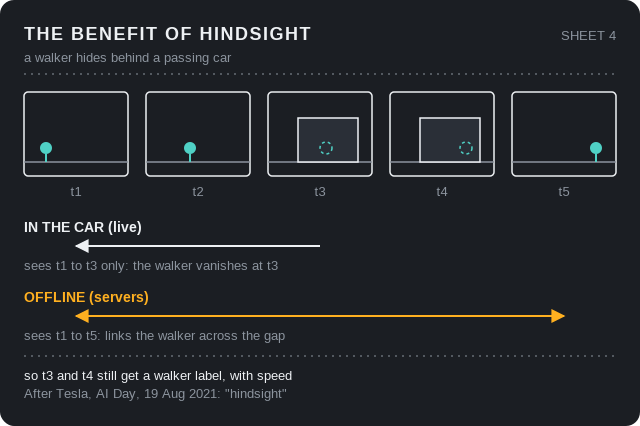
Elluswamy called it “the benefit of hindsight”. The car must guess a speed from the past. The server can look at the future too and get the answer “basically cheat”, in his words. It can also keep a walker’s identity through several occlusions, which the planner needs.
Tesla gave scale numbers for this. In 2021 Elluswamy said the fleet collected clips for the radar-removal project in about 200 conditions. Auto-labelling produced 10,000 clips in about a week, a job that “would have taken several months” with human labelling. At AI Day 2022 a Tesla engineer said the new multi-trip method replaces 5 million hours of manual labelling with 12 hours on a cluster for 10,000 trips, and labels a new trip in about 30 minutes instead of several hours by hand. The same talk gave 10,000 GPUs for training and about 4,000 for auto-labelling. The 2022 numbers come from a speech-to-text transcript of the talk, so I would check them on the video before repeating them.
A human still finishes the job. The 2022 engineer said “the human analyst comes in and finalizes the label”. IEEE Spectrum reported that Tesla laid off 195 data-annotation workers in June 2022. It did not say why.
Step 5: simulation fills the gaps
Some scenes are rare. Others are hard to label, such as a crowd crossing a road. Simulation gives perfect labels, because the scene starts as a list of objects and positions. At AI Day 2021 Elluswamy said Tesla had built about 2,000 miles of simulated road, and that most of its simulated training data was generated by program rather than by artists. The networks then in the cars had been trained with 300 million simulated images carrying almost half a billion labels.
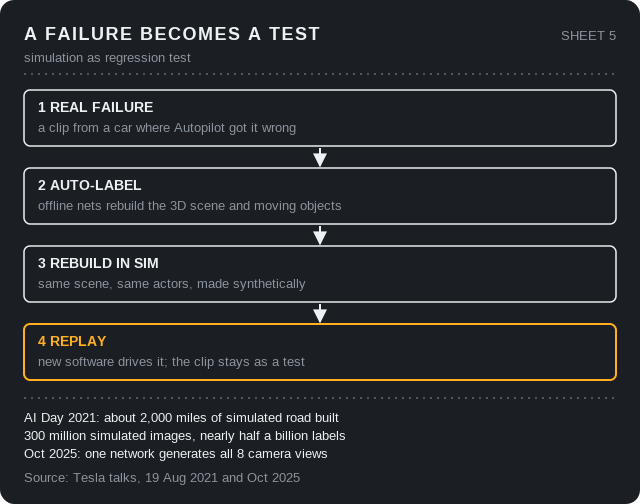
The loop in the picture is the useful part. A real failure is auto-labelled, rebuilt in simulation, and replayed with the new software. The same clip then stays in the test set. At AI Day 2022 a Tesla simulation engineer said a complex San Francisco intersection that takes artists two weeks could be generated in about five minutes from the auto-labels.
In October 2025 Elluswamy described a newer kind, a neural world simulator. One network generates all eight camera streams at once and takes the car’s actions as input. He gave uses such as replaying old failures against a newer model and injecting a vehicle that cuts across the path. He also said it could be powerful for closed-loop reinforcement learning, which means training by trial and error inside the generated world. Similar ideas exist outside Tesla, such as the open CARLA simulator and Wayve’s GAIA-1 world model. I found no independent test of how closely Tesla’s simulator matches real cameras. At AI Day 2021 Tesla showed side-by-side camera exposures as its evidence.
Step 6: the GPUs behind it
All of this ends at one place: a training run. Karpathy gave the numbers for Tesla’s 2021 cluster. He said it was 720 nodes of A100 GPUs with 80 GB each. With eight GPUs per node, which Electrek’s slide summary gives, that is 5,760 GPUs, with 10 petabytes of fast storage. VentureBeat printed “80 nodes” for the same cluster, but 80 times 8 is 640. The 5,760 total only works with 720 nodes. Karpathy said that in terms of FLOPS it was “roughly the number 5 supercomputer in the world”. That is Tesla’s claim. I found no benchmark published by Tesla that others could rerun.
Tesla’s later statements come from its quarterly updates. Each bar below is a statement by Tesla on a date:
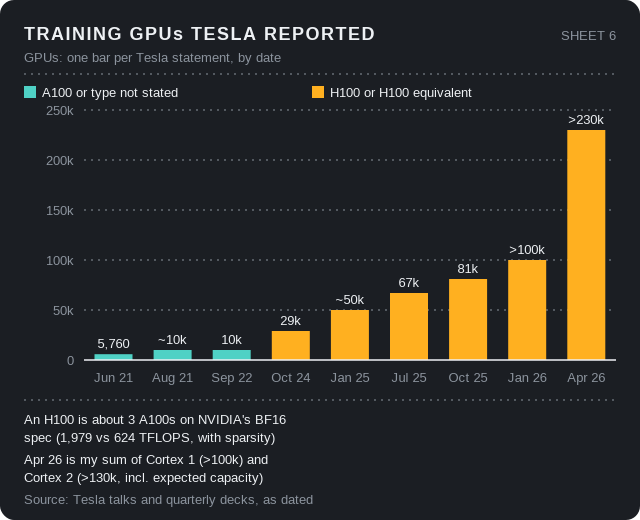
| Date | What Tesla said | Source |
|---|---|---|
| 20 Jun 2021 | 5,760 A100 GPUs | Karpathy at CVPR, via Electrek |
| 19 Aug 2021 | “barely shy of 10,000 GPUs” | AI Day 2021 |
| 30 Sep 2022 | 10,000 GPUs for training, about 4,000 for auto-labelling | AI Day 2022 |
| 23 Oct 2024 | 29,000 H100 cluster at Giga Texas, 50,000 expected by end of October | Q3 2024 update |
| 29 Jan 2025 | Cortex, “a ~50k H100 training cluster”, complete | Q4 2024 update |
| 23 Jul 2025 | 16,000 H200s added, “a total of 67k H100 equivalents” | Q2 2025 update |
| 22 Oct 2025 | “a total of 81k H100 equivalents” | Q3 2025 update |
| 28 Jan 2026 | Cortex 1 over 100k H100e in production, Cortex 2 under construction | Q4 2025 update |
| 22 Apr 2026 | Cortex 1 over 100k, Cortex 2 over 130k H100e (early ramp, which “includes expected capacity”); the 230k in the chart is my sum | Q1 2026 update |
Read the chart with care. An A100 is not an H100. NVIDIA lists 624 TFLOPS of BF16 for the A100 and 1,979 for the H100, both with sparsity, so one H100 is about three A100s. That is why the first three bars are teal. Tesla does not say how it converts other chips into “H100 equivalents”. The Q2 2025 update adds 16,000 H200s to about 50,000 H100s and reports 67,000, so it seems to count an H200 as about one H100. That is my arithmetic, not Tesla’s statement.
Then the unit changed. From the Q2 2026 update, Tesla counts compute in megawatts:
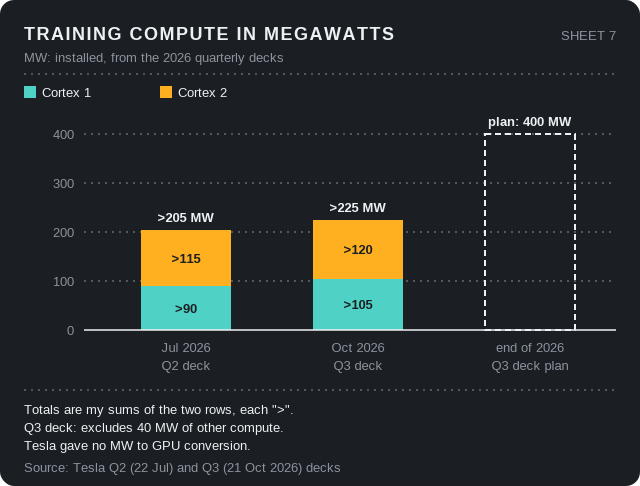
The Q3 2026 update, dated 21 October 2026, lists Cortex 1 at more than 105 MW and Cortex 2 at more than 120 MW, and plans 400 MW by the end of the year. Its footnote says the table leaves out 40 MW of other compute. Tesla gave no reason for the switch and no conversion from megawatts to GPUs, so the two charts must not be joined into one line. My guess is that megawatts let Tesla count a mixed fleet of chips with one number. Tesla did not say that.
The Q4 2025 update also shows that compute is a budget, not a free resource. Tesla said it aims to scale training compute “judiciously, including when the training backlog gets too long”. The 2024 update said training compute grew “by over 400%” that year.
Dojo: Tesla’s own training chip
GPUs were not the original plan. At AI Day 2021 Tesla showed Dojo, a training computer built around its own chip. The goal, in the lead engineer’s words, was the best AI training performance, with good power use and cost.
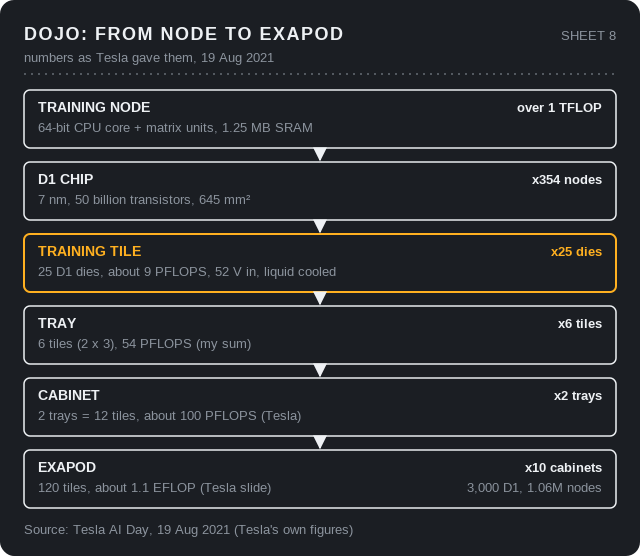
The ladder is built from the numbers in the 2021 talk. The tray, ExaPOD node count and D1 count are my sums from Tesla’s own multipliers, and they match what Tesla said: 120 tiles of 25 dies is 3,000 chips, and 3,000 times 354 is about 1.06 million nodes. The tile is the part that was new. Tesla said it joins 25 tested D1 dies on one package, takes 52 volts in, and is cooled by liquid on both sides. It also said the first working tile had arrived the week before the talk. For the whole machine, Tesla claimed 1.3 times the performance per watt and a footprint five times smaller. The transcript I read does not say what it compared against. I found no independent benchmark of any of this.
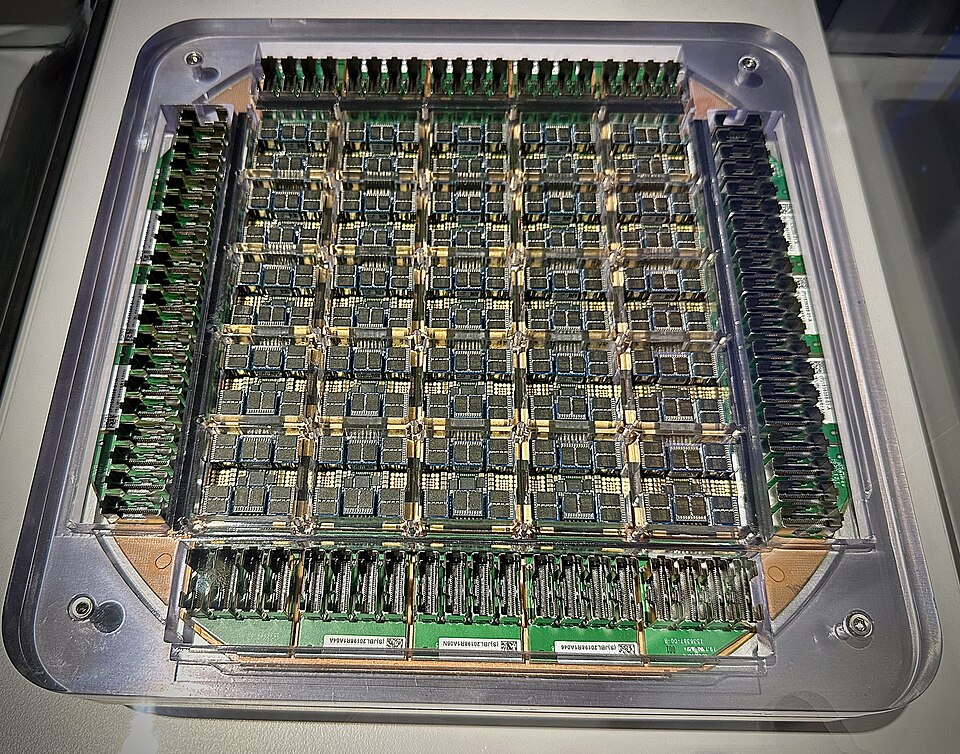
Photo: “Tesla Dojo supercomputer tile.jpg” by Steve Jurvetson, CC BY 2.0, via Wikimedia Commons. The photographer’s caption relays 15 kW per tile and about 9 quadrillion operations per second.

What happened next depends on who is talking, so here it is by date:
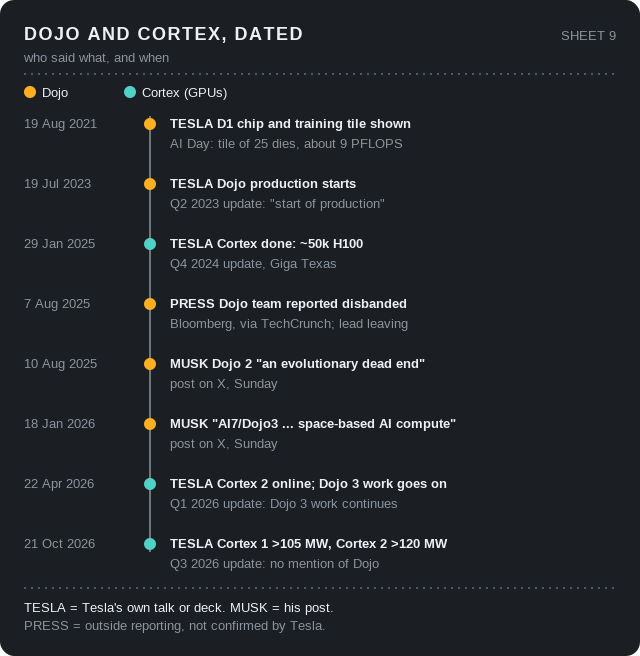
- Tesla’s decks. The Q2 2023 update said Tesla was taking “a step towards faster and cheaper neural net training with the start of production of our Dojo training computer”. I searched every quarterly update from Q1 2023 to Q3 2026 for the word Dojo. Outside the legal notices it appears only in that update and in the Q1 2026 update, which says Tesla is “continuing our custom silicon development with Dojo 3 in an effort to reduce the cost of training over time”.
- Press, August 2025. On 7 August TechCrunch, citing Bloomberg’s anonymous sources, reported that Tesla was disbanding the Dojo team and that its lead, Peter Bannon, was leaving. About 20 people had already left to start DensityAI.
- Musk, August 2025. On Sunday 10 August he posted on X: “Once it became clear that all paths converged to AI6, I had to shut down Dojo and make some tough personnel choices, as Dojo 2 was now an evolutionary dead end.” He added that “Dojo 3 arguably lives on in the form of a large number of AI6 SoCs on a single board” (TechCrunch, Electrek). Electrek argued the explanation did not add up, because training and inference chips have different needs.
- Musk, January 2026. On Sunday 18 January he posted: “AI7/Dojo3 will be for space-based AI compute” (TechCrunch, 20 Jan 2026).
- Q3 2026 update. Tesla’s October 2026 update does not mention Dojo. It reports Cortex only.
I am not going to call Dojo dead or alive. Dojo 2 was stopped, by Musk’s own account. The name Dojo 3 is back, in a post and in one deck line, for a chip plan whose design Tesla has not published in the updates I read.
Cortex: the GPUs Tesla bought instead
Cortex is the name Tesla gives its training cluster at Giga Texas. The Q2 2024 update said the south extension of the factory was nearing completion and would “house our largest cluster of H100s yet”. By January 2025 Cortex was a 50,000-H100 cluster. By April 2026 Cortex 2 was online and “running training workloads”. By October 2026 the two clusters were listed at more than 225 MW in total, with 400 MW planned for the end of the year. None of the updates I read names the GPU supplier. Press names Nvidia and AMD, for example in Bloomberg’s report as relayed by TechCrunch.
Where the loop is weak
Everything above is Tesla’s account. These are the places where I would push on it.
- A person has to think of the rule. A trigger catches what someone imagined. VentureBeat’s report of Karpathy’s remarks says the same about tunnels. Shadow mode and the “predicted versus actual” check cover some of the gap, but a failure nobody thought of may never fire a rule. I found no Tesla figure for how often that happens.
- The fleet is only partly open to Tesla. Clips leave the car only if the owner opts in, and Tesla says clips are collected “only in limited scenarios”. The outside expert in IEEE Spectrum says shadow mode sees a small share of driving. I found no Tesla figure for what share of cars have Data Sharing on.
- Auto-labels are as good as the reconstruction. A bad alignment gives bad labels at scale. The 2022 talk says a human analyst finalises the label, and I found no figure for how often the analyst has to fix the machine.
- Simulation must match the cameras. Tesla showed matched exposures. I could not find an outside test.
- Almost every number is Tesla’s own. They come from talks and decks, and the 2022 figures come from a transcript. The few outside checks, such as NVIDIA’s spec sheets and a regulation, only test small pieces.
Questions people ask
What is Tesla’s data engine? It is the loop Tesla uses to improve its driving network. The fleet finds hard moments with triggers and shadow mode, the clips are labelled, the network is retrained, and the new version is tested quietly in cars before it ships. Karpathy described it at CVPR in June 2021.
What is shadow mode? The new network runs in customer cars without controlling them. Its output is compared with the old network, with the radar when a car has it, and with what the driver did. A disagreement can make the car keep a clip. IEEE Spectrum dates the idea to 2016.
Does Tesla use video from my car to train FSD? Tesla says clips for fleet learning reach it only with Data Sharing turned on, and that the data does not identify you personally. In the FSD Beta agreement from November 2021, drivers also agreed to share VIN-associated image data after a safety event or a collision. The switch on the car’s screen is the place to check your own settings.
Is Dojo cancelled? Bloomberg reported on 7 August 2025 that Tesla was disbanding the Dojo team, and Musk said on 10 August that Dojo 2 was a dead end and he had shut Dojo down. On 18 January 2026 he wrote that “AI7/Dojo3” would be for space-based compute, and Tesla’s Q1 2026 update mentions Dojo 3. Those are all dated statements. The Q3 2026 update does not mention Dojo.
How big is Tesla’s AI training cluster? Tesla’s latest figure, in its Q3 2026 update, is Cortex 1 at more than 105 MW and Cortex 2 at more than 120 MW, with a plan for 400 MW by the end of 2026. Its last GPU count, in April 2026, was more than 100,000 H100 equivalents at Cortex 1 and more than 130,000 at Cortex 2 in early ramp.
Cheat sheet
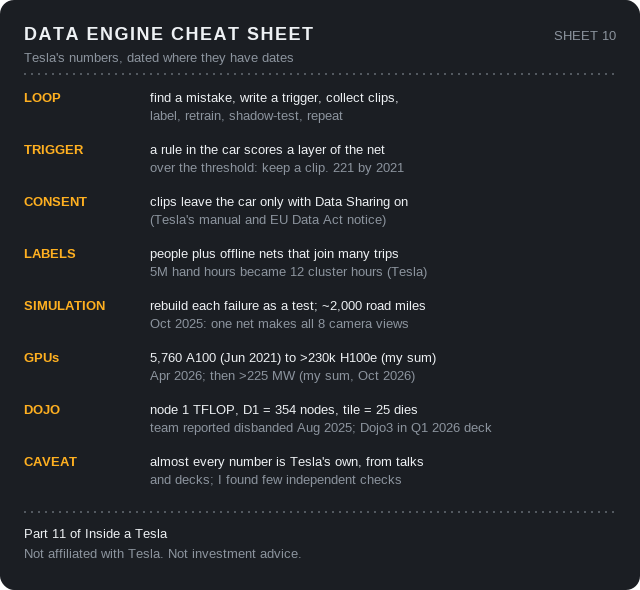
Next: A network trained this way still has to pass one test, a car with nobody in the driver’s seat. What has Tesla actually launched, what do regulators say about it, and what is still open?
Further reading
Tesla (talks, updates, manuals)
- Andrej Karpathy, CVPR 2021 workshop keynote, 20 Jun 2021
- Tesla AI Day 2021, 19 Aug 2021, with a third-party transcript
- Tesla AI Day 2022, 30 Sep 2022
- Ashok Elluswamy, ICCV 2025 workshop talk, October 2025 (transcript copy)
- Quarterly updates: Q2 2023, Q3 2024, Q4 2024, Q2 2025, Q3 2025, Q4 2025, Q1 2026, Q2 2026, Q3 2026 (SEC Exhibit 99.1)
- Model Y 2025+ owner’s manual, China edition in English
- Tesla EU Data Act disclosure
Patents
- EP3850549B1, System and method for obtaining training data (Karpathy; priority 14 Sep 2018; granted 28 May 2025)
- US12223428B2, Generating ground truth for machine learning from time series elements (priority 1 Feb 2019; granted 11 Feb 2025)
Regulation
Papers
- Shrivastava et al., Training Region-based Object Detectors with Online Hard Example Mining (2016), an older form of the same idea: train more on the examples the model gets wrong
- Mildenhall et al., NeRF (2020), the style of scene model Elluswamy named for the road surface (AI Day 2021)
- Dosovitskiy et al., CARLA: An Open Urban Driving Simulator (2017)
- Hu et al., GAIA-1: A Generative World Model for Autonomous Driving (2023)
Outside analysis
- VentureBeat, Tesla AI chief explains why self-driving cars don’t need lidar (3 Jul 2021)
- Electrek, Tesla unveils a new supercomputer to train self-driving AI (21 Jun 2021)
- IEEE Spectrum, Tesla’s Autopilot depends on a deluge of data (4 Aug 2022)
- Dynamically Typed, notes on the CVPR 2021 talk
- TechCrunch, Tesla requires FSD testers to allow video collection in case of a crash (24 Nov 2021)
- TechCrunch, Tesla shuts down Dojo (7 Aug 2025) and Elon Musk confirms shutdown (11 Aug 2025)
- Electrek, Elon Musk confirms he killed Tesla Dojo (11 Aug 2025)
- TechCrunch, Musk says Dojo3 will be for space-based AI compute (20 Jan 2026)
- NVIDIA A100 and H100 product pages

Backend engineer who builds high-volume systems that move money. More about Rafi