Part 4 of 12: Inside a Tesla Previous: Building a Car in Pieces: Tesla's Unboxed Process Next: Fewer Wires, One Valve: Tesla's Electrical and Thermal Design
All 12 parts
- Inside a Tesla: A Computer That Happens to Have Wheels
- One Casting Instead of 70 Parts: Tesla's Giga Press
- Building a Car in Pieces: Tesla's Unboxed Process
- The Battery Is the Floor: Cells, Chemistry and the Structural Pack
- Fewer Wires, One Valve: Tesla's Electrical and Thermal Design
- Eight Cameras, No Radar: How a Tesla Sees
- The Chip in the Glovebox: Tesla's FSD Computer (HW3, HW4, AI5)
- Tesla HydraNet and Bird's-Eye View: From Eight Cameras to One Map
- Tesla Occupancy Network: Seeing Things It Has No Name For
- From Hand-Written Rules to One Network: How FSD Plans
- The Data Engine: How Tesla Teaches the Car
- Robotaxi: A Car With Nobody in the Driver's Seat
In July 2022 the engineering firm Munro & Associates, which takes cars apart on video, unbolted the battery pack of a Texas-built Model Y and lifted it out of the car. The front seats, centre console and carpets came out with it, still attached. The whole assembly weighed 1,198 lb (543 kg). InsideEVs, which reported the Munro Live video, called it a new approach in the industry (InsideEVs, 6 July 2022).
In most cars the seats bolt to a steel floor and the battery hangs underneath. Here the battery was the floor. To see how that works, and what Tesla has and has not delivered, start with the smallest piece: one cell.
Part 4 of Inside a Tesla. I like the car and the tech, so I researched it to feed my own curiosity; not affiliated with Tesla, not investment advice.
Short version:
- A lithium-ion cell is two electrodes, a separator and a liquid, wound into a can. Tesla’s cells grew from 18 x 65 mm to 21 x 70 mm to 46 x 80 mm (the 4680). Tesla said in 2020 that the 4680’s “tabless” design cuts the current path from 250 mm to 50 mm, and that dry coating removes a drying oven.
- LFP cells are cheaper per kWh and hold less energy per kilogram than NMC cells. Tesla said in 2021 that for standard range vehicles it was shifting to LFP. Its own LFP cell plant in Nevada, in early ramp, is for energy storage products, per its July 2026 deck.
- Tesla’s 2020 plan was 100 GWh of cells a year in 2022. Its 2026 decks show Texas capacity above 40 GWh, and Tesla’s own footnote says capacity is not the production rate. Tesla does not publish 4680 output.
What a cell is, one layer at a time
Argonne National Laboratory, a US Department of Energy lab, says a lithium-ion battery has four key parts: a cathode (the positive side), an anode (the negative side), a separator that stops the two touching, and an electrolyte, a liquid that lets charge flow between them. Both electrodes store lithium. In a phone cell the anode is graphite and the cathode is a mix of nickel, manganese and cobalt oxides (Argonne, Science 101).
Here is one cell while the car is driving:
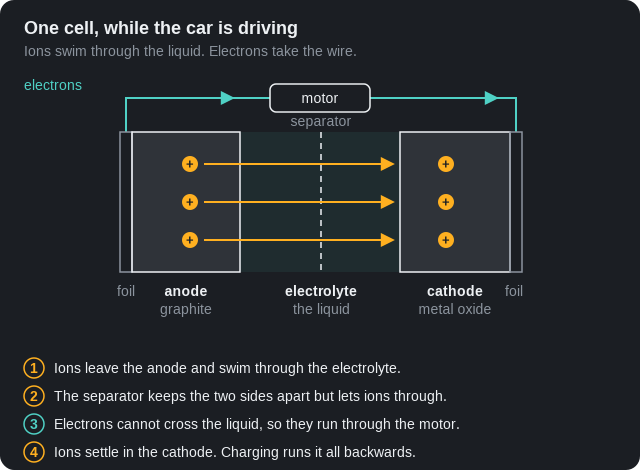
The ions are the part that surprises people. They do not turn into something else. They slip into the layers of each electrode and slip out again. The Nobel committee for the 2019 chemistry prize, given for this battery, says that is the reason it lasts: the ions flow back and forth without damaging reactions, so the battery “can be charged hundreds of times” before it fades (Royal Swedish Academy of Sciences). The same page tells the history in three steps. Stanley Whittingham built the first lithium battery in the 1970s. John Goodenough found in 1980 that a cobalt oxide cathode doubled the voltage to about four volts. Akira Yoshino made the first commercially viable cell, with a carbon anode instead of pure lithium, and a Japanese company started selling them in 1991.
One detail from that page matters later. Goodenough also replaced the cobalt oxide with iron phosphate, which the committee calls more environmentally friendly. That cathode is the “P” in the LFP cells further down.
A single flat sandwich is no use in a car, because it is too thin to hold much. So makers stack the four layers and roll them up, like a swiss roll, then slide the roll into a metal can:
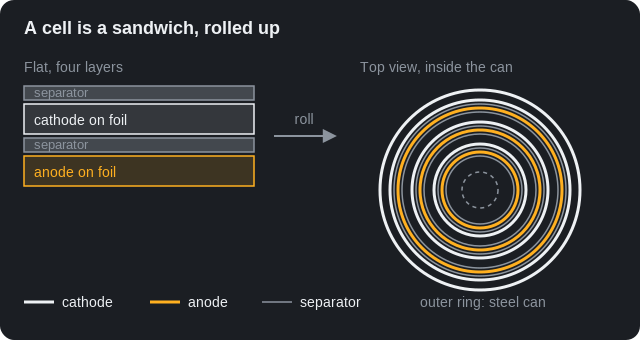
That roll is called a jelly roll. Every cylindrical cell Tesla has used is built this way, and the way the current gets out of the roll turns out to be the big design question. First, the can.
Three sizes, and why Tesla went big
The names are sizes in millimetres: diameter, then length. An 18650 is 18 x 65. A 2170 is 21 x 70. A 4680 is 46 x 80.
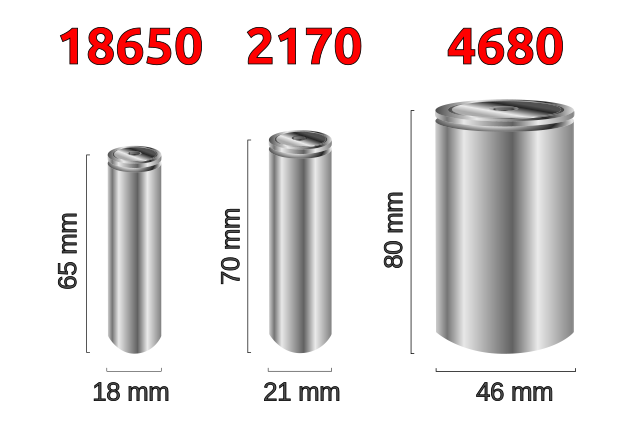
Image: “Tesla 4680 2170 18650 batteries.svg” by Jzh2074, CC BY-SA 4.0, via Wikimedia Commons. Cropped, with a white background added.

The 4680 looks only a little taller than the others. It is much fatter, and volume goes with the square of the width. I worked out the can volumes from those sizes, ignoring the wall:
| Cell | Size | Can volume | Tesla’s first public use |
|---|---|---|---|
| 18650 | 18 x 65 mm | about 16.5 cm³ | Early Tesla cars, from the 2008 Roadster |
| 2170 | 21 x 70 mm | about 24 cm³ | Gigafactory Nevada, announced 4 Jan 2017 |
| 4680 | 46 x 80 mm | about 133 cm³ | Battery Day, 22 Sep 2020 |
TechCrunch reported on 4 January 2017 that the Nevada Gigafactory had started making cells, first for Powerwall 2 and Powerpack 2, with cells for the Model 3 aimed at the second quarter. It said 2170 production for qualification began in December 2016 (TechCrunch). The IEA’s 2026 outlook notes the Roadster used cylindrical cells, and that Tesla’s long partnership with Panasonic is why cylindrical cells stay common in the US (IEA, Global EV Outlook 2026).
At Battery Day, Tesla’s slides showed the 4680 with three claims. Drew Baglino, who presented the cell, said the new cell gives “five times the energy with six times the power and enable 16% range increase, just form factor alone”, and a 14% cost per kWh reduction from the form factor (Battery Day transcript, Rev; Tesla’s deck). Another slide said bigger cylindrical cells cost less, and the next said the catch with big cells is supercharging.
Read the first claim against the table. Five times the energy in 5.5 times the volume is about the same energy per litre as before. IEEE Spectrum noted that the 4680 has nearly 5.5 times the volume of a 2170, and that Musk did not mention it (IEEE Spectrum). So the “five times” is mostly a bigger can. The gain Tesla was after sits in the cost and the parts count. IEEE reports a mock-up by Sandy Munro of a pack with “960 larger cells, versus 4,416 cells for the 2170 variety”, and every cell needs its own connections. A big cell cuts those.
How big did the cell turn out? Tesla’s 2023 Impact Report lists a Cybertruck pack of 1,344 cells and 123 kWh, which InsideEVs divided to get about 91.5 Wh a cell, and about 170 Wh/kg for the whole pack, at 721 kg (InsideEVs). Other outlets give a slightly different cell count, so treat the 91.5 as close, not exact.
The catch with big cells is the one Tesla’s own slide named. A fat roll has a long strip inside, and the current has to travel along it.
The tab problem
Picture the cathode or the anode as a long metal foil, coated with active material. In a classic cell, a small metal strip called a tab is welded to the foil and carries current to the cell’s terminal. The patent for Tesla’s tabless cell describes it this way: with a tab at the middle of the electrode, current travels up to half the length of the wound electrode, and with a tab at one end, all of it (US 11,749,842 B2). A long path is resistance, and resistance is heat. That heat is the supercharging problem.
Tesla’s fix is to have no tab. Baglino’s numbers were “50 millimeter versus 250 millimeter electrical path length”, and his slide called it a “5X reduction in electrical path”. The picture below is drawn at that 5 to 1 ratio:
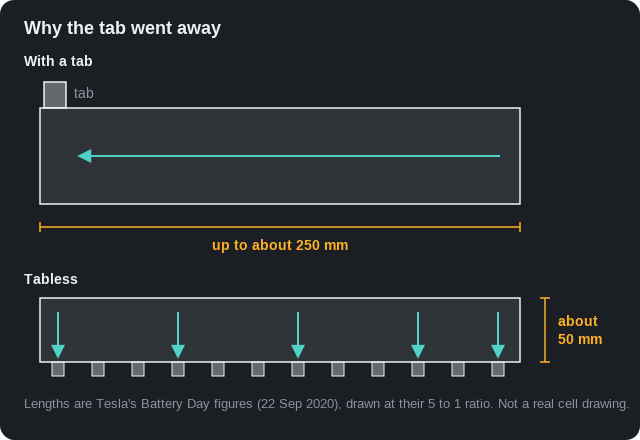
How can a rolled foil have no tab? The patent’s answer is the edge. One edge of the foil is left uncoated, and the roll is wound so that this edge sticks out of one end. Every turn of the roll then reaches the bottom of the can along its edge. The patent says the foil is typically 5% to 20% as tall as it is long, so the current travels a shorter way and the resistance of that electrode “can be reduced by 5 to 20 times.” The contact area effectively spans the whole diameter of the cell, which also helps carry heat out. The patent does not give temperatures.
Tesla filed the patent on 4 November 2019 (priority 5 November 2018) and was granted it on 5 September 2023. It carries no copyright notice, so here are its own drawings of the end of the cell:
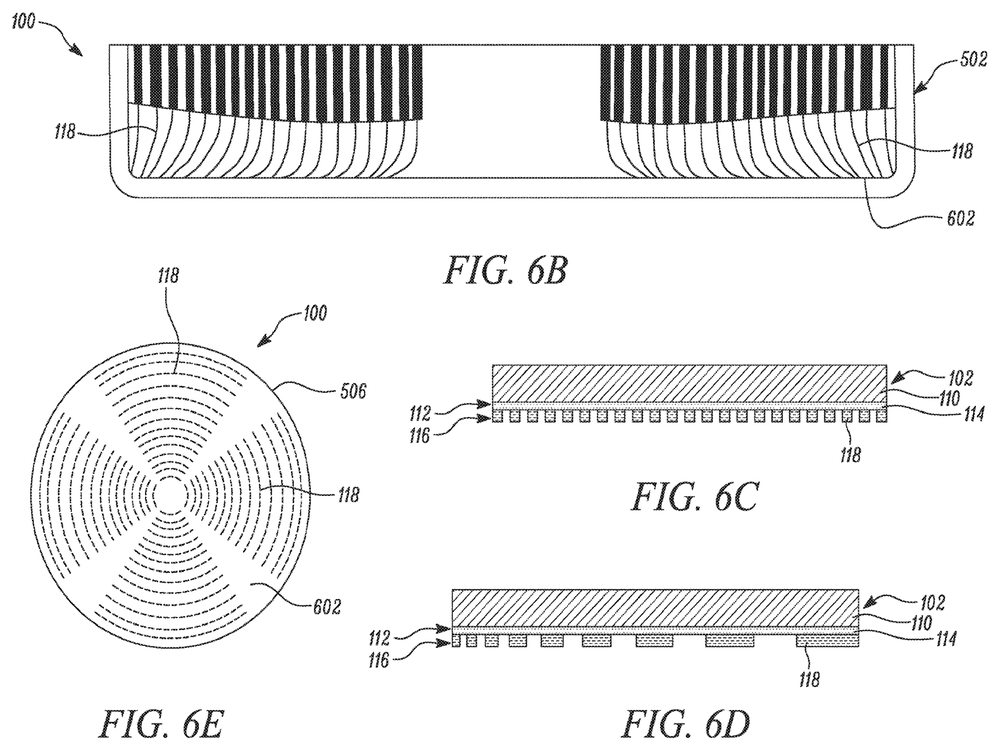
US patent 11,749,842, fig. 6B to 6E (cropped and rotated).
Two cautions. In this patent the tabless electrode is the anode, and the drawings still show a tab on the cathode. A patent also shows an idea, not the cell on the production line. IEEE Spectrum’s summary is the safe one: tabless cells simplify manufacturing, save space and cut ohmic resistance. I did not find a teardown that confirms the details inside a production 4680.
A big, tabless cell is a design. Making it fast and cheap is a different job, and it starts with how the coating is put on.
Dry electrode: skipping the oven
An electrode is foil plus a thin coat of powder. The usual way to coat it is wet. Mix the powder with a liquid solvent into a paste, spread the paste on the foil, dry it in a long oven and recover the solvent. Tesla’s slides called that four steps, and a dry process two.
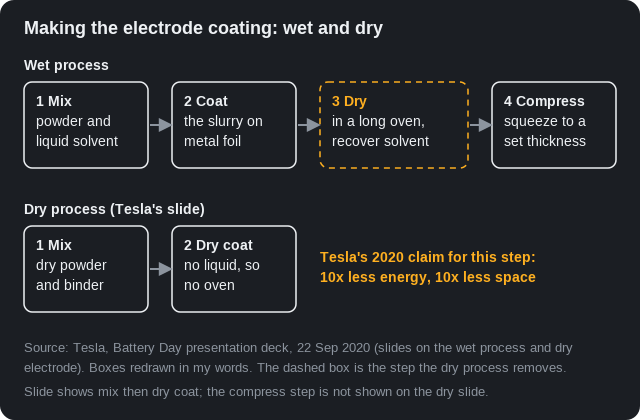
Tesla got the process by buying the California firm Maxwell Technologies in 2019. In March 2023 Reuters reported that Tesla has said the dry process has “the potential to dramatically reduce the size, cost, energy consumption and production cycle time” (Reuters via Kitco, 10 March 2023). Musk was blunt about it at Battery Day: “It’s not like dry coating electrode is actually easy.”
The milestones come from Tesla’s own updates:
- Q2 2024. Tesla said it had “entered validation of vehicle testing for our first prototype Cybertruck produced with in-house dry cathode 4680 cells”, “a major cost reduction milestone once ramped” (Electrek, 23 July 2024, quoting the update).
- Q4 2025. The deck says: “We now produce dry-electrode for 4680 cells with both anode and cathode made in Austin” (Tesla Q4 2025 deck).
Tesla gives no yield, speed or cost figure for the dry line. Outside analysts read the same period more darkly. Electrek reported that L&F, Tesla’s 4680 cathode partner, wrote its $2.9 billion supply deal with Tesla down by more than 99%, to $7,386, in December 2025, citing “change in supply quantity” (Electrek, 28 January 2026). Electrek reads that as a sign that 4680 is not ramping at scale. A write-down of a supply contract can have other causes, so I count it as a signal, not a measurement.
Both ideas change how the cell is built. What goes inside it is a separate choice.
Two chemistries: LFP and NMC
Cathodes come in families. NMC uses nickel, manganese and cobalt. LFP uses iron and phosphate, with no nickel or cobalt. The IEA compared them in its 2025 outlook: LFP packs are almost 30% cheaper per kWh. LFP pack energy density is about one-fifth lower by mass and about one-third lower by volume. On the other side, an LFP battery can reach 100% charge routinely without much wear, where NMC is typically held to about 80%. NMC does better in the cold (IEA, Global EV Outlook 2025). BloombergNEF’s survey of pack prices in December 2025 puts the average LFP pack at $81 per kWh and NMC at $128 (BloombergNEF, 9 December 2025).
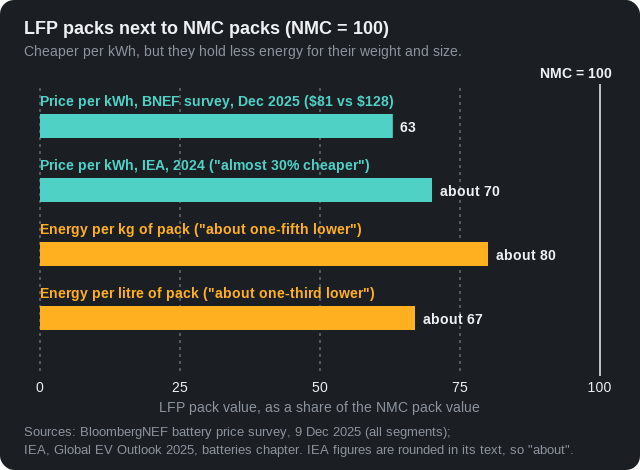
The two price bars differ because they measure different things: different years, different sets of packs. Both say LFP packs cost roughly 30 to 40% less per kWh. The market has noticed. The IEA says LFP made up nearly half of EV batteries deployed worldwide in 2024, and in its 2026 outlook, more than 55% in 2025 (IEA, Global EV Outlook 2026).
Which Tesla uses which? Tesla does not hand out one table by model. I could not open Tesla’s current spec pages while researching this, so here is what its own filings and outside reports say:
| Product | Chemistry or cell | Source |
|---|---|---|
| Standard range vehicles (Tesla names no models) | LFP | Tesla, Q3 2021 deck: “For standard range vehicles, we are shifting to Lithium Iron Phosphate (LFP) battery chemistry globally” |
| Cybertruck | 4680 cells, nickel-cobalt-manganese (NCM) cathode | Tesla’s 2023 Impact Report battery passport, as reported by InsideEVs |
| Some Model Y | 4680 cells, chemistry not stated | Tesla, Q4 2025 deck: “battery packs for certain Model Ys with our 4680 cells” |
| Powerwall and Megapack | LFP cells from Tesla’s Nevada plant, 7 GWh, “Early Ramp” | Tesla, Q2 2026 deck: “LFP cells in Nevada for our energy storage products” |
Look at the last row. Tesla’s own LFP plant is for storage first. The LFP cells in its cars come from other makers. The IEA says nearly all the LFP cells in cars sold in Europe or the US were made in China, that Tesla made up 85% of the LFP cars built in the US in 2024, and that it made almost half of those sold in the EU (IEA, 2025). The 2026 IEA outlook adds that Tesla still sources most of its EV batteries from Panasonic, LG Energy Solution and CATL, and that its in-house production is limited (IEA, 2026).
LFP’s weak spot in the cold has an engineering answer in Tesla’s decks. The Q4 2024 deck lists “Battery Heating at Superchargers, a feature that gets vehicles with LFP battery packs back on the road up to 4x faster” (Tesla Q4 2024 deck).
Whatever the chemistry, the cells still have to become a battery pack.
From cells to a floor
A pack is where a pile of cells becomes something a car can carry. There are three ways to build it.
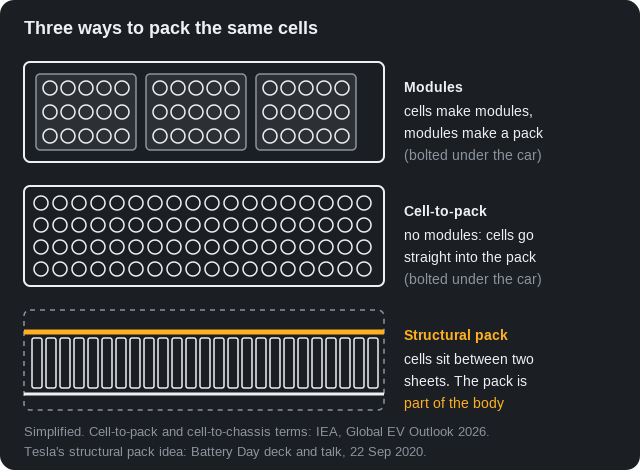
The IEA describes cell-to-pack and cell-to-chassis designs as ones that “eliminate the intermediate battery modules and increase overall energy density”, at a price: they make recycling harder (IEA, 2026). Tesla’s version, the third row, goes one step further. The pack is not just module-free, it is also load-bearing.
Tesla called it the structural battery at Battery Day. Musk explained that a filler “effectively glues the cells to the top and bottom sheet”, so the pack becomes one stiff box. His line for the benefit was: “Effectively the non cell portion of the battery has negative mass”, because the pack replaces floor structure the car would carry anyway. The slide reads “370 fewer parts”, “14% range increase opportunity” and “10% mass reduction”, for the body and the battery together. At the pack level Baglino gave “another 7% dollar per kilowatt hour reduction”. All of this was a target in 2020.
What was built? The 2022 teardown is the best look, and here is what it showed:
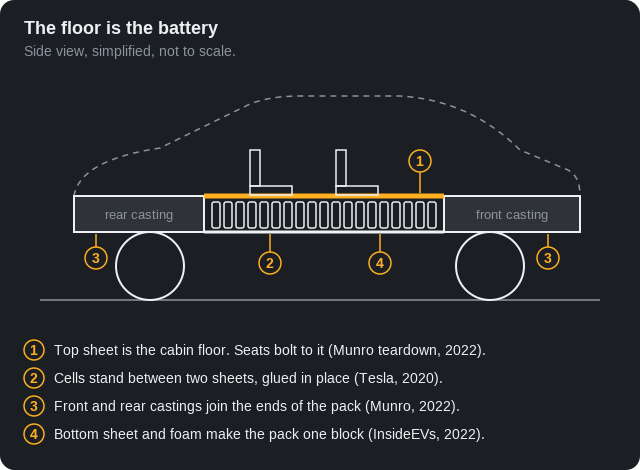
Munro Live found the seats, console and carpets and trims attached to the pack. The pack joined the body at the front and rear castings, the big one-piece parts from Part 2 of this series. The cells sat in a black plastic holder. Pink polyurethane foam covered the cooling channels and the rest, and set into what InsideEVs called “a single ultra-strong brick” (InsideEVs, 14 August 2022).
That brick has a price. Munro’s Cory Steuben said “the repairability of this is essentially zero”, because the cells are glued to each other and to the steel case (InsideEVs, 12 July 2022). Musk replied on Twitter: “Structural pack is the right overall architecture from a physics standpoint, but it is still far from optimized” (InsideEVs, 7 July 2022). That is Tesla’s CEO calling it right in principle and unfinished in practice.
The 4680 Model Y did not stay on sale. Electrek wrote in January 2026 that Tesla dropped the 4680 Model Y more than two years earlier, and called the Cybertruck the only vehicle using the cells. The Q4 2025 deck says Tesla has “begun to produce battery packs for certain Model Ys with our 4680 cells”. The deck does not say whether those packs are the 2022 structural design, and I found no source that does.
So how many 4680 cells has Tesla made, and how fast?
The 4680 ramp: a plan, a capacity table and a count
Three kinds of number get mixed together here, so I will keep them apart.
The plan. Tesla’s Battery Day deck has a slide called “The Plan”: 100 GWh in 2022 and 3 TWh by 2030. Musk added that the 100 GWh was “supplemental to what we buy from suppliers”. A GWh is a billion watt-hours; a Cybertruck pack is 123 kWh, so 100 GWh is enough for about 800,000 of them.
The capacity table. Tesla’s decks carry a table of installed annual capacity. Texas 4680 shows 40 GWh in the Q4 2025 and Q1 2026 decks, and “more than 40” in the Q2 2026 deck of July 2026, with Berlin listed as under construction (Q4 2025, Q1 2026, Q2 2026). The footnote in the Q4 2025 and Q2 2026 decks reads: “Installed capacity ≠ current production rate and there may be limitations discovered as production rates approach capacity.”
The count. Tesla does not publish 4680 output in GWh. It does post milestones, and one number in a deck:
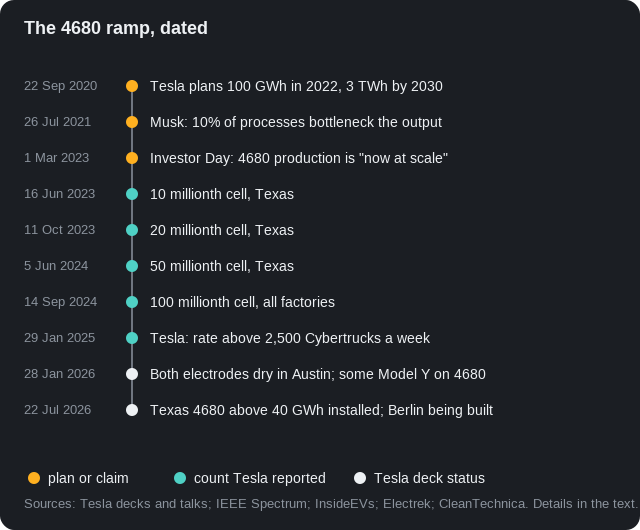
Where each line comes from: the plan is Tesla’s deck. The 2021 line is Musk on 26 July 2021, as reported by IEEE Spectrum: “the 10% of manufacturing processes that currently bottleneck production output”. The “now at scale” line is from the 2023 Investor Day, as listed by CleanTechnica. The cell counts come from InsideEVs and Teslarati, which reports Tesla’s own post on X. The weekly rate is the Q4 2024 deck: “Our in-house 4680 cell hit a production rate exceeding 2.5k Cybertrucks/week.”
Those two kinds of Tesla data can be turned into energy. Teslarati worked out that 50 million cells to 100 million took 101 days, which is about 495,000 cells a day. At 91.5 Wh a cell, that is about 45 MWh a day, or about 16.5 GWh a year at that pace. Tesla’s 2,500 Cybertrucks a week at 123 kWh each is 307.5 MWh a week, or about 16 GWh a year. These are my sums, and they rest on assumptions: the 50 millionth cell was counted at Giga Texas and the 100 millionth “across all our factories”, cell energy changed over time, and some cells went to other products. But the two methods land on the same place.
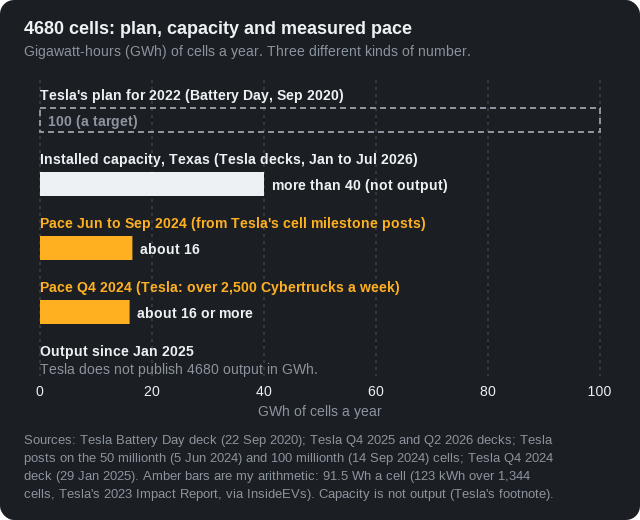
Read the chart for what it can say. In late 2024 the pace was around 16 GWh a year, a sixth of the 2020 plan for 2022. The 40 GWh of capacity in 2026 is more than twice that pace, and Tesla says capacity is not output. All 100 million cells together, if each held 91.5 Wh, add up to about 9 GWh: less than a quarter of one year at 40 GWh. I have no figure from Tesla for output after January 2025.
Outside analysis points the same way. The IEA’s 2026 outlook says Tesla’s in-house EV battery manufacturing is still limited, with the first large-scale production in 2023, “notably to supply its Cybertruck”. On cost, Musk told shareholders in June 2024 that Tesla expected “cost parity even with the much lower supplier cell price today by the end of the year”, and called it “a very difficult path” (CleanTechnica, 24 June 2024). I did not find a later Tesla statement that parity was reached.
Tesla’s own July 2026 deck puts the limit in a different place. It says “battery pack capacity” remains the limiting factor on ramping vehicle production globally. That covers all packs and all suppliers, not only 4680.
Questions people ask
What does 4680 mean? The cell is 46 mm across and 80 mm long. It is the same naming as 18650 and 2170. By can size it holds about 5.5 times the volume of a 2170.
Is a tabless cell the same thing as a dry electrode? No. Tabless is about how current leaves the roll. Dry is about how the powder coat is put on the foil. Tesla announced both in 2020 for the 4680 and they are separate changes. A cell could have one without the other.
Does Tesla use LFP in its cars? Tesla said in October 2021 that for standard range vehicles it was shifting to LFP chemistry globally. The cells in cars come mostly from other makers, per the IEA. Tesla’s own LFP plant in Nevada, in early ramp in its 2026 decks, is for energy storage products.
How many cells are in a Cybertruck? Tesla’s 2023 Impact Report, as read by InsideEVs, gives 1,344 cells and 123 kWh. I found no Tesla breakdown of the pack.
Can a structural pack be repaired? A 2022 Model Y pack was judged “essentially zero” repairable by Munro, because the cells are glued in. That was one design in one year. I did not find a Tesla repair procedure for a current pack.
Cheat sheet
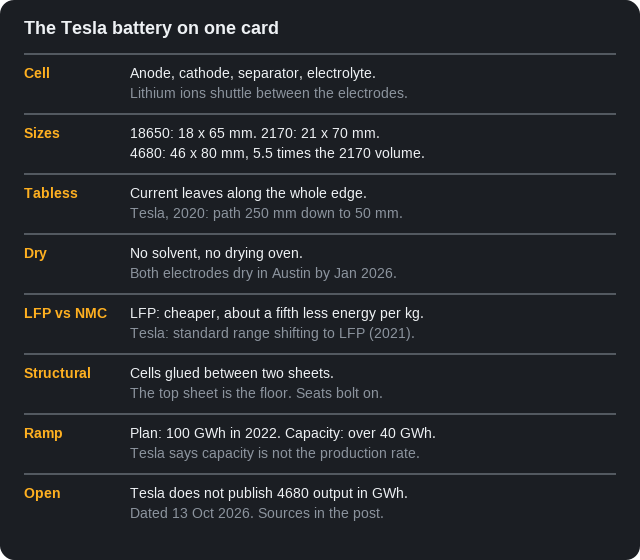
Next: the pack holds about 1,300 cells and 123 kWh in the Cybertruck, and it has to be watched, cooled and connected to everything else. A battery that big needs a nervous system. What carries the power and the signals around the car, how few wires can it get away with, and why did Tesla go to 48 volts?
Further reading
Tesla
- Battery Day 2020 presentation deck and the Rev transcript of the event
- Q3 2021 update, with the move to LFP for standard range
- Q4 2024 update, Q4 2025 update, Q1 2026 update and Q2 2026 update, as filed with the SEC
Patents
- US 11,749,842 B2, cell with a tabless electrode, Tesla, granted 5 September 2023
Government labs and public bodies
- Argonne National Laboratory, Science 101: batteries
- Royal Swedish Academy of Sciences, popular information on the 2019 Nobel Prize in Chemistry
- IEA, Global EV Outlook 2025, electric vehicle batteries and Global EV Outlook 2026
Outside analysis
- Is Elon Musk back in “production hell” with Tesla’s 4680 battery?, IEEE Spectrum, 2021, updated January 2024
- Lithium-ion battery pack prices fall to $108 per kilowatt-hour, BloombergNEF, 9 December 2025
- Tesla’s Gigafactory starts mass producing battery cells, TechCrunch, 4 January 2017
- Tesla 4680 battery’s secret sauce: dry electrode coating, Reuters via Kitco, 10 March 2023
- Tesla’s Cybertruck battery passport, InsideEVs, 1 July 2024
- Model Y 4680 structural pack removed with seats attached, Musk on the structural pack, teardown difficulty and the cells under the foam, InsideEVs, July and August 2022
- Tesla gives encouraging update on 4680 battery cells, Electrek, 23 July 2024
- Tesla puts 4680 battery cells back in Model Y, Electrek, 28 January 2026
- Tesla announces 100 millionth 4680 cell, Teslarati, 14 September 2024
- Elon Musk: Tesla’s 4680 batteries at cost parity by end of year and 20 news items from Tesla Investor Day, CleanTechnica
- Tesla 4680 2170 18650 batteries.svg, Wikimedia Commons, CC BY-SA 4.0

Backend engineer who builds high-volume systems that move money. More about Rafi