Part 5 of 12: Inside a Tesla Previous: The Battery Is the Floor: Cells, Chemistry and the Structural Pack Next: Eight Cameras, No Radar: How a Tesla Sees
All 12 parts
- Inside a Tesla: A Computer That Happens to Have Wheels
- One Casting Instead of 70 Parts: Tesla's Giga Press
- Building a Car in Pieces: Tesla's Unboxed Process
- The Battery Is the Floor: Cells, Chemistry and the Structural Pack
- Fewer Wires, One Valve: Tesla's Electrical and Thermal Design
- Eight Cameras, No Radar: How a Tesla Sees
- The Chip in the Glovebox: Tesla's FSD Computer (HW3, HW4, AI5)
- Tesla HydraNet and Bird's-Eye View: From Eight Cameras to One Map
- Tesla Occupancy Network: Seeing Things It Has No Name For
- From Hand-Written Rules to One Network: How FSD Plans
- The Data Engine: How Tesla Teaches the Car
- Robotaxi: A Car With Nobody in the Driver's Seat
Open the Cybertruck service manual at its electrical safety page and one rule stands out. Tesla writes that “disconnection or connection of live MV circuits is strictly prohibited.” MV is “Mid Voltage”, Tesla’s name for the truck’s low voltage bus. The same page says that bus has “rails that have nominal voltages from 5V to 48V” (Tesla service manual).
That is odd for a car. Many cars run their small electronics on a 12 V lead-acid battery, and nobody worries about unplugging a 12 V connector. Tesla’s own owner’s manual says the 48 V system has “an increased risk of personal injury, arcing, or component damage” if handled wrongly. So why take on that risk?
The answer is in the wires. The last part ended on the battery floor, which needs a nervous system to read it and to carry power around the car. That nervous system is copper, and a car has far more of it than you would guess. This part follows the copper, then the coolant pipes, because Tesla redrew both at the same time.
Part 5 of Inside a Tesla. I like the car and the tech, so I researched it to feed my own curiosity; not affiliated with Tesla, not investment advice.
Short version:
- A car’s wiring harness runs to kilometres. Musk said in 2019 that the Model S had about 3 km and the Model 3 about 1.5 km. For the Cybertruck, Tesla’s Pete Bannon said it has 155 wires where the Model 3 has 490, even though it has more things to wire. The tools are local controllers, a data loop and a 48 V supply.
- Four times the voltage means a quarter of the current. For the same share of power lost in the wire, that allows about 1/16 of the copper. This is Ohm’s law, not a Tesla claim, and real wire is never that thin.
- The Octovalve is one eight-port coolant valve. Turning one internal part joins the battery, drive units, radiator and chiller in different ways. Tesla’s patent shows ten modes.
Why a car has kilometres of wire
Every light, window motor, seat heater, sensor and switch needs a wire back to something that controls it. The controllers need power, and they need to talk to each other. The bundle that does all of this is the wiring harness.
Musk said that the Model S has about 3 km of harness, the Model 3 “only 1.5 kilometers”, and that Tesla hoped to reach “a mere 100 meters” in the Model Y (InsideEVs, 5 August 2019). The 100 m was a target. I found no source that says it was reached. Outside numbers are in the same range: a 2024 paper in the journal Sensors cites harnesses of up to 1.6 km and 60 kg (Park, Cui and Park, May 2024).
Harnesses are also hard to build with robots, because a round, floppy bundle is hard to grip. InsideEVs reported in 2019 that a Tesla patent application aimed to cut the jobs that robots handle badly, such as handling cables. So the goal is not only less copper. It is a harness that a machine can fit.
How do you shorten the wires, then? You stop grouping the electronics by what they do and start grouping them by where they are.
Zonal: wire by place, not by job
In an older layout, one controller handles one job, such as body electronics. A controller in the middle of the car then needs a long wire to every lamp and motor in its job, and those wires cross the car. A zonal layout puts a small controller in each region of the car. Each one talks to the devices near it, and the zones talk to each other over a network. The Sensors paper defines it as connecting controllers “according to their physical locations”, not by function.
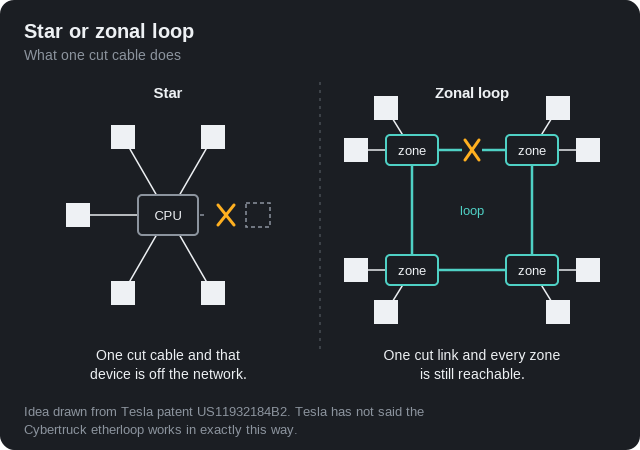
The paper simulated it. Against a layout with five function-based domains, six, eight and ten zones cut the harness length by about 43% to 64%, depending on how many controllers the car has. The paper also finds that network delay grows as zones are added. That is a simulation, not a measured car.
The loop in the picture comes from a Tesla patent, US 11,932,184 B2, with a priority date of 12 February 2018 and a grant date of 19 March 2024. It describes a processor and devices wired as two loops, with data going in a different direction on each. If one link breaks, every hub can still be reached the other way. Tesla has not said that this patent is what the Cybertruck uses, so treat it as the idea and not the build.
What Tesla has said about the truck is in the next section.
What Tesla said about the Cybertruck
Pete Bannon is Tesla’s director of low-voltage electronics and hardware engineering. Sandy Munro moderated a discussion with him and other Tesla engineers, including Lars Moravy. Assembly Magazine wrote it up on 26 April 2024 and does not give the date of the talk. The article says: “Instead of a central controller, the Cybertruck is equipped with local controllers.” The article describes the etherloop as an Ethernet loop that “connects all of the high-speed controllers together”, and quotes Bannon: “Between the etherloop and 48 volts, wiring mass is down significantly” (Assembly Magazine).
Then come the numbers, all from the same article and all Tesla’s own, not audited by anyone outside:
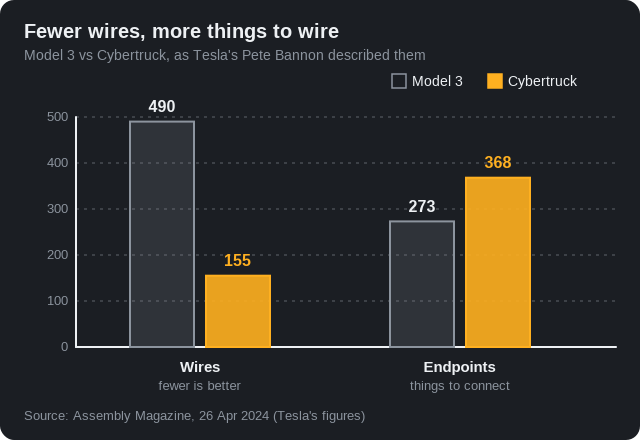
- 155 wires in the Cybertruck against 490 in the Model 3.
- 368 endpoints against 273. The article does not define an endpoint. I read it as a thing at the end of a wire: a lamp, motor, sensor or switch.
- The etherloop reduces the wiring needed by 68%, and “high-powered harness mass went down by 84 percent”.
Those figures do not all agree with each other. The article says the truck has “50 percent more end points” than the Model 3, but 368 against 273 is 35% more. I cannot tell which one is wrong, so both are shown. What matters is that wires fell by about two thirds while the number of things to wire went up.
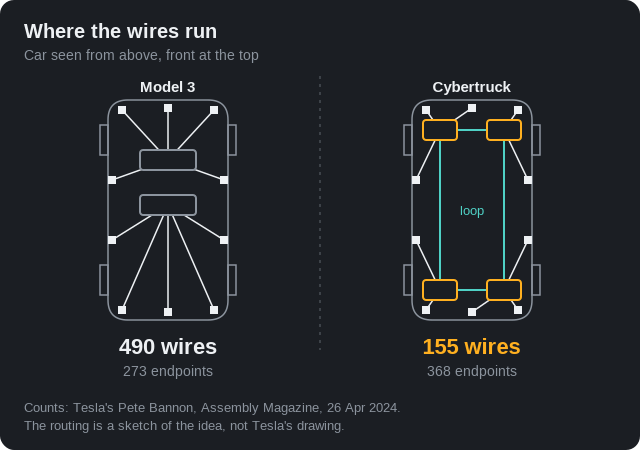
The routing in this sketch is mine, not Tesla’s. I did not find a Tesla document that shows the truck’s real wiring layout.
There is a second half to the story. The truck did not only change how the wires are arranged. It also changed what runs through them.
Why 48 V
The idea is in Ohm’s law. Power is voltage times current. Raise the voltage four times, from 12 V to 48 V, and the same load draws a quarter of the current. Heat lost in a wire grows with the square of the current. With a quarter of the current you can allow 16 times the resistance for the same lost share of power, and a wire with 16 times the resistance has about 1/16 of the copper.
Here is one load. Feed 1,000 W over 3 m of wire each way and lose 3% in the wire. At 12 V that is 83 A and needs about 24 mm² of copper. At 48 V it is 21 A and needs about 1.5 mm²:
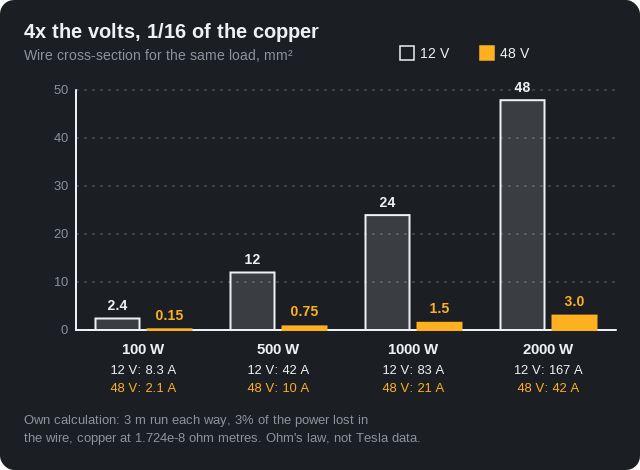
That is my own calculation, with copper at 1.724e-8 ohm metres (the standard annealed copper value). It is the best case. A real harness has a floor on wire size, because a very thin wire is too weak to crimp and pull. So the real saving is smaller than 1/16.
Tesla gave a bigger-sounding claim at its Investor Day in March 2023. CleanTechnica’s list of the event credits the 48 V architecture with “75% less copper use” (CleanTechnica, 6 March 2023). I could not find the slide, so I treat that as reported, not confirmed. The same list says no supplier was ready for 48 V parts, so Tesla had to design them from scratch. Musk gave the reason in his own words: “The entire supply chain, the entire design infrastructure is designed for 12 volts” (Motor1, 18 January 2024).
An outside expert is less sure the change pays off in an electric car. In the same Motor1 piece, Sam Abuelsamid of Guidehouse Insights said an EV “is already running at typically 400 volts and up, and all of your power is coming from the battery.” In other words, the big power is already high voltage. The 48 V system only covers the small stuff. Motor1 adds that 48 V is about the upper limit before stricter safety standards apply, and that such systems need stronger connectors to limit arcing.
What does the 48 V system run? Tesla’s owner’s manual says the 48 V battery powers “the windows, doors, touchscreen, and other low voltage vehicle systems” when the high voltage battery is unavailable. It “also provides a redundant source of power for critical systems (such as power steering)”. The manual adds that 48 V connectors are blue and 48 V wires are marked with blue tape (Tesla owner’s manual). InsideEVs read the rating from the manual: 4 Ah, which is 192 Wh at 48 V (InsideEVs, 16 January 2024). That is a small battery. It is a backup for the truck, not a second pack.
Not everything is 48 V. Bannon said the audio amplifiers run at 24 V, and the truck can be jump-started from a 12 V battery (Motor1, as above). The service manual’s “5V to 48V” rails say the same thing.
A backup for power steering is a useful clue. The truck has no steering shaft.
Steering without a shaft
Motor1 reports that the Cybertruck’s 48 V system enables steer-by-wire, meaning the wheel is not mechanically joined to the tyres. The owner’s manual does not say that. It is outside analysis, and the teardown fits it.
Sandy Munro’s team took a Cybertruck apart on video, and InsideEVs wrote it up on 26 April 2024 (InsideEVs). The steering column “stops where you would expect it to continue with a shaft that links to the steering rack.” It “just has electronics, servos and wires that enable it to have a variable ratio.” The rack “appears to be supplied by ZF” and “has two motors for redundancy”, so one motor can take over if the other fails. With the truck on, both the front and the rear steering racks work. With it off, no wheel turns when you turn the wheel.
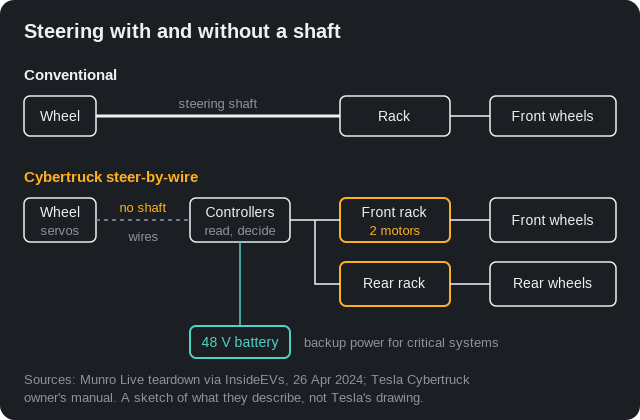
Is it the first? That depends on what you count. Motor1 notes that the Infiniti Q50 has steer-by-wire but keeps a mechanical column as a backup. InsideEVs calls the Cybertruck “one of the first passenger vehicles with no mechanical link between the steering wheel and the wheels”. I would use the second wording.
On the rules: the UN Regulation No. 79 on steering equipment says in its introduction that “it will now be possible to have steering systems in which there is not any positive mechanical connection between the steering control and the road wheels” (the consolidated text published in the EU’s Official Journal on 10 January 2025). I only checked that UN rule, not the US federal rules, so I am not saying how the truck was approved.
That finishes the electrical side. The cooling side has the unusual part.
One valve, many loops
An electric car has four things that make or need heat: the battery, the motor, the inverter and the cabin. In summer they all need cooling. In winter the cabin needs heat, and the patents below also warm the battery, for example to allow charging. A simple car gives each its own loop. Tesla made one valve that rearranges the loops.
First, what a heat pump is. It is an air conditioner that can run both ways. It moves heat from one place to another, instead of making it. Wikipedia’s definition of the coefficient of performance (COP) says that “usually, more heat is moved than the amount of work put in so the COP usually exceeds 1, especially in heat pumps” (Wikipedia). A plain electric heater has a COP of 1, since all it does is turn electricity into heat.
Design News described the Model Y’s Octovalve in October 2020 as “an eight-port, five-position rotary valve” for the glycol coolant. That is the magazine’s own wording. Cory Steuben, president of the teardown firm Munro and Associates, called the Model Y heat pump “the world’s best EV thermal management system” and said rivals’ systems “are not remotely close to the level of packaging” (Design News, 30 October 2020). That is an opinion from a firm that sells teardown reports, so weigh it so.
Tesla’s service manual gives the plain facts. The Octovalve bolts to a part called the supermanifold with four Torx T25 screws at 5 Nm. The coolant bottle has to come off first. One electrical connector drives it, and the service test “will vary speeds from 3500-6500 RPM (idle speed = ~1500 RPM) and actuate the valve between series and parallel” (Tesla service manual).
The inside is in a patent. US 11,932,078 B2, “Electric vehicle heat pump using enhanced valve unit”, names Prem Pinto and Daniel Hanks as inventors. It was filed on 30 March 2022, claims priority to 31 March 2021, and was granted on 19 March 2024. Figure 1 shows the parts:
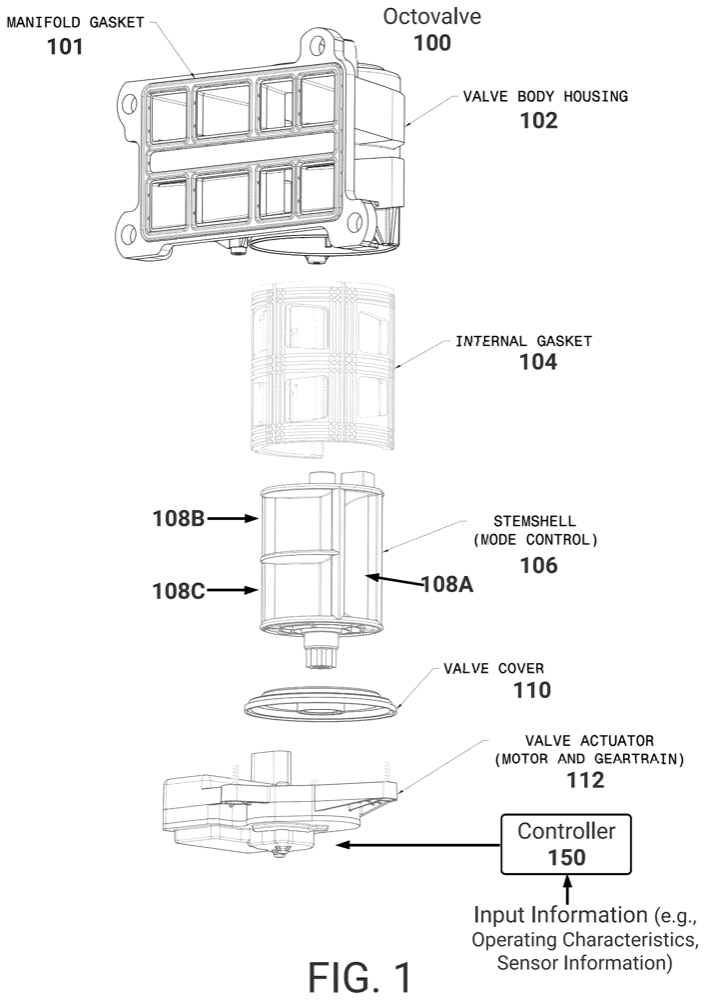
Figure: US patent 11,932,078, fig. 1
The valve body has eight ports, in two groups of four. Inside is a drum called the stemshell, with channels cut across it. An actuator, a motor and gear train, turns the stemshell about a vertical axis. Each turn lines the channels up with different ports and so joins different parts of the coolant system. A controller decides which. The patent’s port names are battery supply, battery return, chiller pump, chiller return, powertrain pump, radiator supply and radiator return.
Here are three of the modes the patent draws, reduced to four parts: battery, drive units, radiator and chiller.
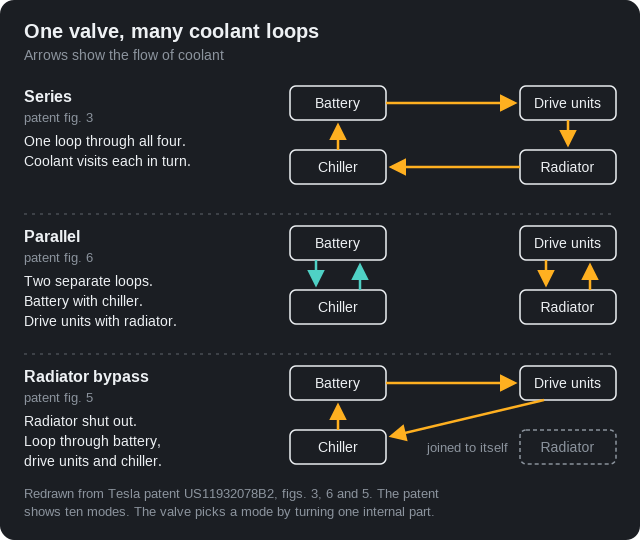
The patent draws ten coolant modes in figures 3 to 12. Several are reversed-flow versions of others. Design News calls the valve five-position. I could not tell from the text how the two counts map onto each other, so I do not claim to know.
Why does a car need so many? The earlier Tesla heat pump patent, US 2019/0070924, has an answer. Its priority date is 7 September 2017, it was published on 7 March 2019 and it was later granted as US 10,967,702 B2. InsideEVs, using analysis by an engineer, Keith Ritter, counts 15 modes in it: 12 for heating and 3 for cooling. The patent text says the cooling modes are for supercharging, for peak powertrain performance and for a quieter cabin cool-down. It also lists the sources of heat:
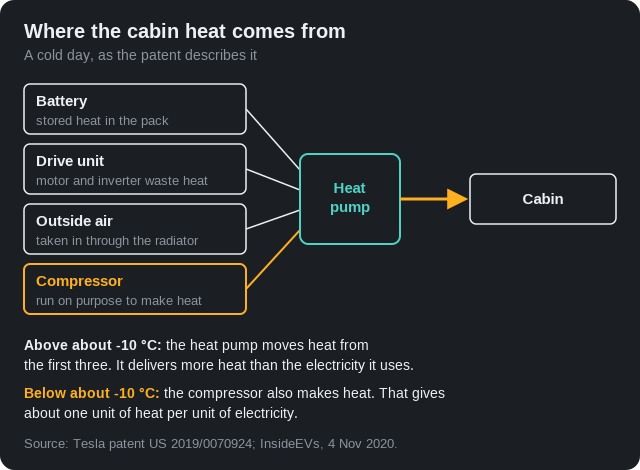
InsideEVs reads the patent as switching strategy at about -10 °C. Above it the radiator pulls heat from the outside air. Below it the system adds heat made by the compressor, whose efficiency then falls to about a COP of 1 (InsideEVs, 4 November 2020). The same analysis estimates the battery can store about 2.5 to 3 kWh of heat if the pack is allowed to cool to 10 °C. That is the analyst’s estimate, not a Tesla figure.
A patent says what Tesla may do. It does not prove what any one car does. InsideEVs itself says it cannot confirm which of the patent’s tricks the Model Y uses. The service manual proves the Octovalve exists and can run series and parallel. Everything beyond that is a reading of the patents.
Drive units, quickly
The drive unit is the motor, the inverter and the gearbox in one housing. The inverter turns the battery’s direct current into the three-phase current the motor needs. In Tesla’s Model Y service manual the rear inverter is bolted to the gear case with twelve bolts, and a three-phase cable links it to the motor (Tesla service manual, page revised 9 August 2026). Building them as one unit keeps the cable between motor and inverter short.
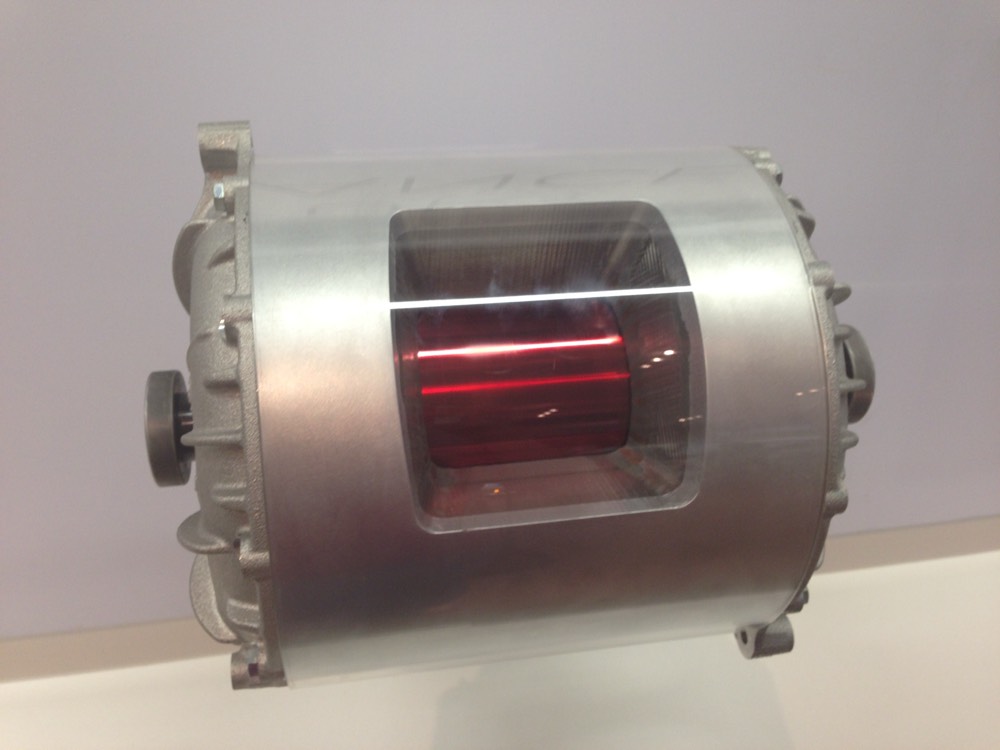
Photo: Alison Cassidy, CC BY-SA 3.0, via Wikimedia Commons, resized
At the Model S Plaid launch in June 2021, Musk said the new motor has a carbon fibre sleeve around the rotor, and that it was likely the first production electric motor with a carbon overwrapped rotor. The sleeve keeps the rotor’s copper under compression, which lets it spin faster without coming apart (CleanTechnica, 16 June 2021).
At Investor Day in March 2023, Colin Campbell, Tesla’s vice president of powertrain engineering, said: “We have designed our next drive unit to use a permanent magnet motor to not use any rare earth materials at all.” The talk also promised 75% less silicon carbide and a cost of $1,000 for the unit (TechCrunch, 1 March 2023). That was a plan. I could not find a source that shows it in a production car as of this post’s date.
Where the sources disagree or run out
- The 100 m harness. A target from 2019. No source I found shows it was met.
- 50% or 35% more endpoints. The Assembly Magazine article gives both, and they cannot both be right.
- 75% less copper. Reported from Investor Day. I did not find the slide. My own best case is 1/16 for the same lost share of power, and the real figure is smaller.
- “First” steer-by-wire. Depends on whether a backup shaft counts.
- Octovalve modes. Ten in the patent, five valve positions by Design News’ wording, and only the patent shows them. No Tesla document I found lists which modes a given car uses.
- Model Y wiring. I found numbers for the Cybertruck from Tesla, but no Tesla figure for the Model Y’s wire count.
Questions people ask
Is the Cybertruck 48 volt or 12 volt? Its low voltage battery is 48 V, Tesla’s owner’s manual says. The traction battery is much higher: InsideEVs gives 700 V. Some parts run lower, as the service manual shows rails from 5 V to 48 V, and the truck can be jump-started from a 12 V battery.
Why does Tesla use 48 V instead of 12 V? Tesla says the truck “is able to operate more efficiently”. The physics is that the same power needs a quarter of the current, so the wires can be thinner. Sam Abuelsamid of Guidehouse Insights argues the gain is smaller in an EV because its big loads are already high voltage. Motor1 also links the 48 V system to steer-by-wire.
What is the Tesla Octovalve? An eight-port rotary coolant valve. An actuator turns a drum inside it, and each position joins the battery, drive units, radiator and chiller loops in a different way. Design News calls it eight-port and five-position.
What is the etherloop? Assembly Magazine describes it as an Ethernet loop that connects the Cybertruck’s high-speed controllers. Tesla has not published more than that. A 2018 Tesla patent describes two data loops running in opposite directions for redundancy, but Tesla has not said that is the etherloop.
Does the Cybertruck have a steering shaft? A teardown reported by InsideEVs found a column with electronics, servos and wires but no shaft to the rack. The rack has two motors for redundancy, and there is rear steering as well.
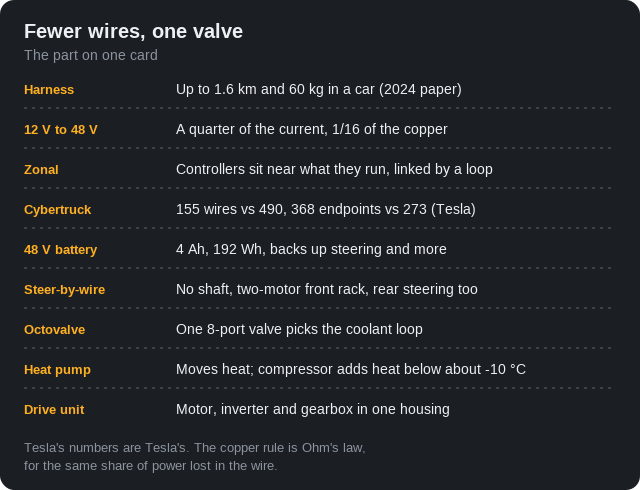
Cheat sheet
Next: the truck’s controllers now share a loop, and they have little to do until something feeds them the world. Tesla’s cars see it through cameras and no radar. Why did Tesla bet on cameras alone, and what can eight of them see that a radar could not?
Further reading
Tesla
- Cybertruck owner’s manual: Electric Vehicle Components
- Cybertruck service manual: Electrical Precautions
- Model Y service manual: Octovalve (Remove and Replace)
- Model Y service manual: Rear Drive Inverter (3DU)
Patents
- US 11,932,078 B2, electric vehicle heat pump using enhanced valve unit
- US 2019/0070924 A1, optimal source electric vehicle heat pump with extreme temperature heating capability
- US 11,932,184 B2, high-speed-wiring-system architecture
Regulators
- UN Regulation No. 79, steering equipment, EU Official Journal, 10 January 2025
Papers
- Analysis of E2E Delay and Wiring Harness in In-Vehicle Network with Zonal Architecture, Sensors, May 2024
Outside analysis
- Tesla’s New Cybertruck Features Modular Wiring, Assembly Magazine, 26 April 2024
- Why the Tesla Cybertruck uses 48 volts, Motor1, 18 January 2024
- The Tesla Cybertruck’s low voltage battery is rated at just 4 amp hours, InsideEVs, 16 January 2024
- Cybertruck teardown: steering by wire, InsideEVs, 26 April 2024
- More on Tesla’s innovative new wiring architecture, InsideEVs, 5 August 2019
- 20 news items from Tesla Investor Day, CleanTechnica, 6 March 2023
- Everything Elon Musk and execs shared and skipped at Tesla Investor Day, TechCrunch, 1 March 2023
- Secrets of the Tesla Model Y Octovalve, Design News, 30 October 2020
- Tesla Model Y heat pump system details, InsideEVs, 4 November 2020
- More details on Tesla’s innovative carbon-wrapped motor, CleanTechnica, 16 June 2021
- Coefficient of performance and International Annealed Copper Standard, Wikipedia

Backend engineer who builds high-volume systems that move money. More about Rafi