You tap your card for a coffee. The terminal beeps. A few seconds later your banking app shows “pending 4.00”. Two days later the word pending goes away. Nothing you could see happened in between.
At a petrol pump it is stranger. The app shows 100 pending, you pumped 43 worth of fuel, and a day later the line says 43. At a restaurant it goes the other way: the pending amount is the bill, and the final amount is the bill plus the tip.
All of this is one process with three stages, and the stages happen on different days. This post follows one EUR 4.00 coffee through them.
Short version:
- Four companies sit between your tap and the shop’s bank account: the merchant, the acquirer, the card network and the issuer.
- The tap only asks “may we take this?” and gets a yes. That is an authorisation. It puts a hold on your balance, and no money moves. The money moves one to three business days later, in settlement.
- Pending is a hold, not a charge. The shop sends the final amount later, so a tip, a fuel pump or a hotel stay can end up higher or lower.
Who is in the room
Five parties are involved. You are one of them. The other four have names that sound alike, so here they are in the order a tap travels:
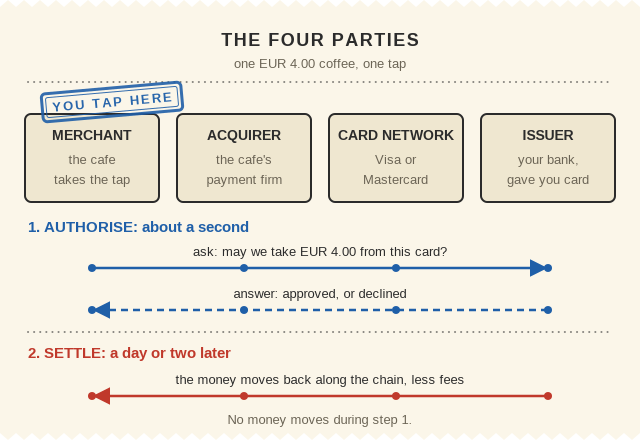
- Merchant: the shop that sells you the coffee.
- Acquirer: the merchant’s payment company. It “acquires” the shop’s card payments, so it receives them from the shop and pays the shop. Small shops often reach an acquirer through a payment provider, so the name on the terminal may not be a bank.
- Card network: Visa or Mastercard, for example. It carries messages between acquirers and issuers and sets the rules both sides follow.
- Issuer: the bank that gave you the card. It owns your account, so only it can say yes.
The EU’s card fee law, Regulation 2015/751, defines the issuer as the provider that gives the payer the card, and the acquirer as the provider that contracts with the payee to accept and process the payment. A few schemes have only three parties, because the network also acts as issuer or acquirer. The Regulation treats those separately.
It is a huge system. In the second half of 2024, people in the euro area made 44.3 billion card payments, worth EUR 1.7 trillion. That is about EUR 39 per payment, and about 750 million cards, or 2.1 per person (ECB). Two thirds of them were contactless taps (how a card with no battery answers a tap):
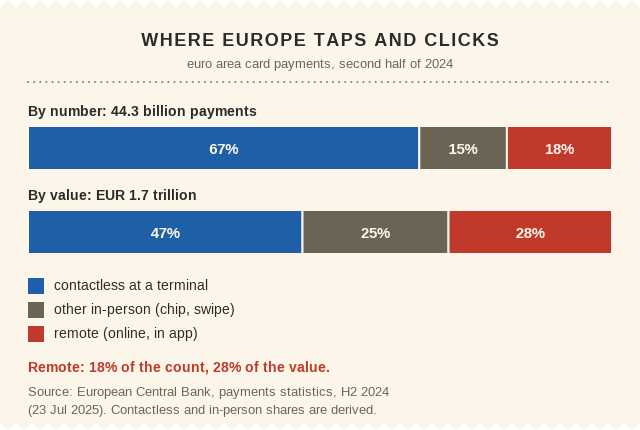
The ECB publishes the 18% and 28% remote shares, the 29.5 billion contactless count and its EUR 0.8 trillion value. I worked out the other-in-person slice from those. Online payments are fewer than in-person ones, but each one is larger on average.
Stage 1: authorisation, about a second
The terminal has no idea whether your account holds EUR 4.00. Only the issuer knows. So the terminal asks, and the question travels the whole chain:
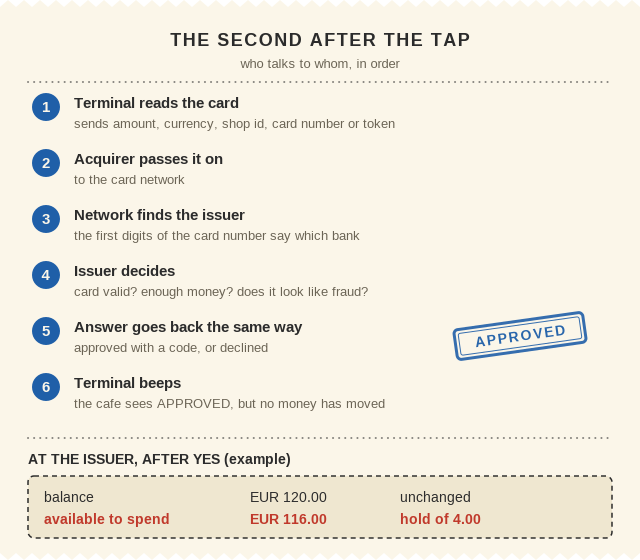
The messages between acquirers and issuers follow an international standard, ISO 8583. It defines the structure and format of messages that originate from payment cards. “A second or two” is a rule of thumb, not a published limit.
If the issuer says yes, it does not take the money. It puts a hold on it: your balance stays the same, but the amount you can spend goes down by EUR 4.00. That is why your app shows pending. Stripe’s explainer on authorisation holds says the same: only the issuer or the charging business can release a hold, and you cannot.
The yes also covers the shop. The Visa guide for restaurants mentions “authorization-related disputes”, which tells you an authorisation is the shop’s cover against that kind of dispute. So shops want one for every sale.
Stage 2 and 3: clearing and settlement, a day or two
Authorisation is a promise. Nothing has been paid. Two more steps follow, and they run in batches, not in real time.
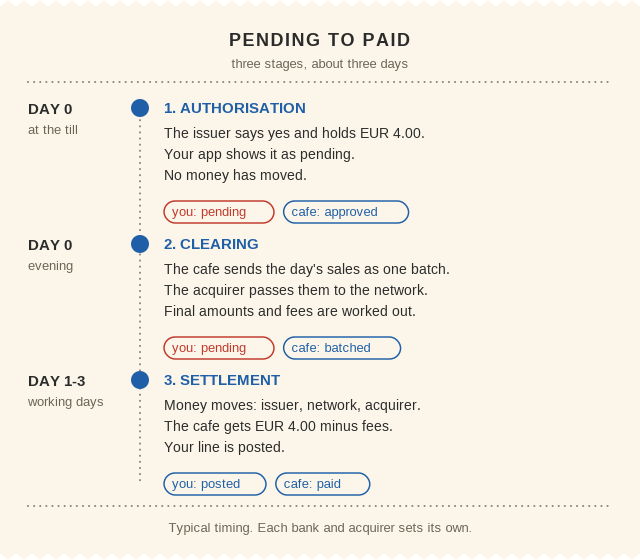
Clearing is the paperwork. The shop sends its day of authorised sales to its acquirer as one group. Overnight, the acquirer forwards them to the card networks. This is the moment the final amount is known, and the moment the fees are worked out.
Settlement is the money. The issuer pays through the network to the acquirer, and the acquirer pays the shop. Stripe’s guide says settlement “usually takes one to three business days”, and that the shop is credited with the gross amount minus interchange, acquiring fees and other charges. Weekends and bank holidays are not business days, so a Friday coffee can settle on Tuesday.
On some networks the authorisation and the clearing are two separate messages. The US Federal Reserve calls these dual-message networks, and they carried 71.4% of US debit card volume in 2023. They traditionally handled signature payments. Single-message networks, traditionally PIN payments, did the same job in one message (Fed report).
Here is why two messages matter. The authorisation and the clearing record can carry different amounts. This is a made-up, simplified pair for a restaurant bill. The field names are not real ISO 8583 fields:
{ "step": "authorisation", "amount": "100.00", "currency": "EUR", "merchant_category": "5812" }
{ "step": "clearing", "amount": "118.00", "currency": "EUR", "approval_code": "A1B2C3" }
Category 5812 is the merchant category code for eating places. The 18.00 difference is the tip, added after the card was read.
Who takes the fees
The shop never receives EUR 4.00. It receives EUR 4.00 minus a merchant service charge, the fee a shop pays its acquirer for card payments. It has three parts:
| Part | Goes to | What it is |
|---|---|---|
| Interchange fee | the issuer | A fee on every payment, paid between the two banks |
| Scheme fee | the card network | The network’s fee for carrying the messages and running the rules |
| Acquirer margin | the acquirer | What the acquirer keeps |
The Regulation defines the interchange fee as a fee paid for each transaction between the issuer and the acquirer. The three-part split of the merchant fee comes from the European Commission’s 2020 study of the Regulation. The Regulation also says an acquirer must show the shop each fee separately, unless the shop asks in writing for one blended price (Article 9).
What the law caps
In the EU, interchange on consumer cards is capped by law. Articles 3 and 4 of the Regulation set 0.2% of the payment value for consumer debit cards and 0.3% for consumer credit cards. They apply when both the issuer and the acquirer are in the EU, and not to company cards or to cards from three-party schemes (Article 1). The caps apply from 9 December 2015. Member states may set lower caps for their own domestic payments.
On the EUR 4.00 coffee, the cap works out like this:
| Card | Cap | Largest interchange on EUR 4.00 |
|---|---|---|
| Consumer debit | 0.2% | EUR 0.008 (0.8 cents) |
| Consumer credit | 0.3% | EUR 0.012 (1.2 cents) |
Scheme fees and the acquirer margin are not set by those two articles. They come from contracts.
What it looks like in the US
The US caps debit interchange for larger issuers under a rule called Regulation II. In the Federal Reserve’s 2023 data, the base cap was 21 cents plus 0.05% of the payment, plus a 1 cent fraud adjustment. Smaller issuers are exempt from it. The effect shows in the average fees:
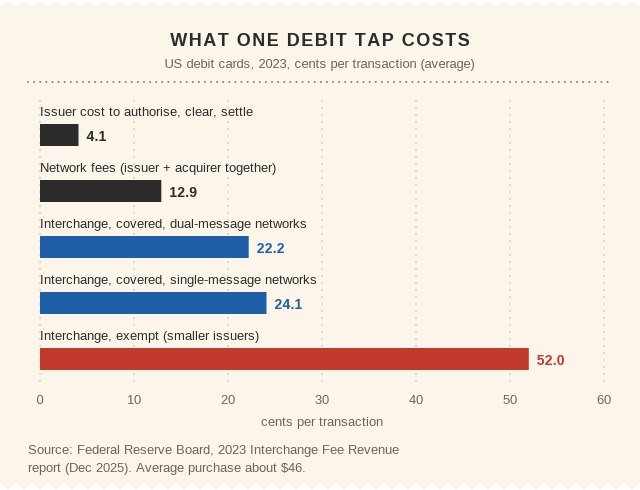
“Covered” means covered by the cap. US networks processed 100.7 billion debit and prepaid transactions worth $4.7 trillion in 2023, so the average one was about $46. The Fed also found that network fees were 0.28% of the transaction value on average.
Interchange is not only a payment for processing. The issuer also carries fraud and credit risk. For covered issuers, the Fed found that fraud losses were 17.6 basis points of the value. Merchants absorbed 49.9% of those losses, issuers 28.3% and cardholders 21.8%. That split is why the next stage matters to a shop.
Why a pending charge changes
Pending is a hold. The shop sends the real amount in the clearing step, and the issuer replaces the hold with it. The amount can change in either direction:
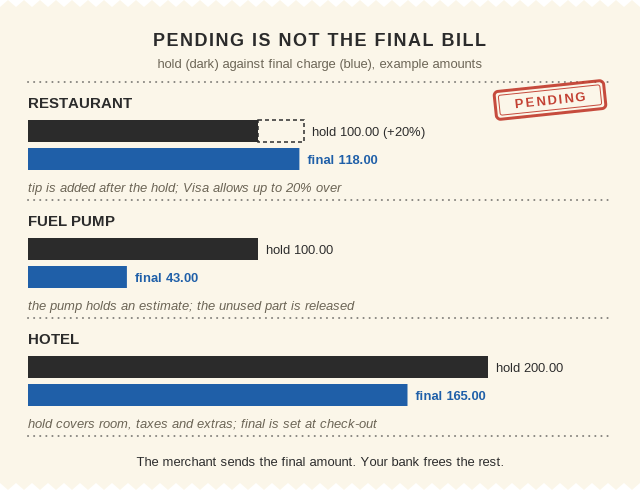
- Restaurants. Visa’s guide for restaurants says the common US practice is to authorise the bill and add the tip afterwards. Restaurants, bars and fast food (merchant categories 5812, 5813 and 5814) may add up to 20% to the authorised amount with no liability for authorisation-related disputes. If the tip goes over 20%, Visa recommends a new authorisation. Visa also says merchants must not add an estimated tip to the authorisation. That guide is US guidance from 2019, so other regions and networks may differ.
- Fuel. Stripe says pay-at-the-pump payments “typically start with a preset authorisation amount”. The pump does not know how much you will pump. The final charge reflects the fuel dispensed, and the unused part is released.
- Hotels. Hotels “commonly place authorisation holds at check-in to cover the room, taxes and potential incidentals”. The final charge is set at check-out.
The amounts in the picture are made up to show the shape. Real holds depend on the shop, the network and the bank.
When it breaks
A hold that does not go away. If a shop neither collects the money nor releases the hold within some window, the issuer releases it by itself. Stripe says holds “typically last a few days to a week or so”, and hotel holds can last a few weeks. A hold from a failed or cancelled attempt can sit next to the real charge for a while, so it looks like a double charge. It is two authorisations, and one of them falls away.
A hold that falls away too early. If the shop waits too long to collect, the hold is gone. The shop then has to ask again, and the answer can now be no. That is one reason shops collect quickly.
A tip that is too big. Past the 20% allowance, the shop no longer has the “no liability for authorisation-related disputes” cover. That is why Visa recommends a new authorisation for the extra amount.
Showing “pending” is the bank’s choice. The card networks have authorisations and clearing records. What your app calls pending, and when the line turns into a posted one, is the bank’s own screen. Two banks can show the same payment differently.
Refunds and chargebacks
Both give you money back. They start in different places.
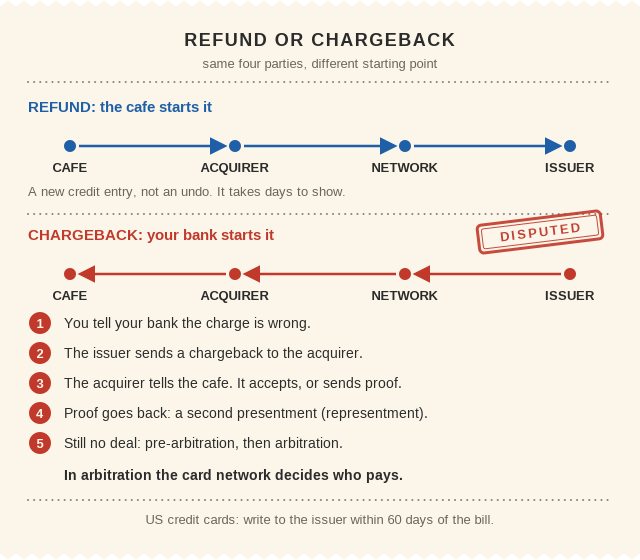
A refund is the shop’s choice. The shop sends a credit back through the same chain. It is a new entry, not an undo of the old one, and it takes days to show up for the same reasons the payment did. If the shop cancels before clearing, the hold simply falls away.
A chargeback is your bank’s move. Mastercard’s dispute documentation describes the steps. The issuer sends a first chargeback. The acquirer can accept it, or answer with a second presentment (also called representment), if it thinks the chargeback did not meet the rules or it can address the dispute reason. If the issuer still disagrees, it files a case, and in arbitration the network decides who is responsible.
For US credit cards, a federal law adds deadlines. The FTC says a written dispute has to reach the issuer within 60 days of the first bill with the error. The issuer must acknowledge it in 30 days and resolve it in 90. The same page says federal law limits your responsibility for unauthorised charges to $50 (FTC). Other countries and networks have their own limits.
If you build on top of this
A payment is several events, not one row. An authorisation, a capture, a refund and a dispute each arrive separately and can arrive twice. Keep one entry per event. Keep money as integers in minor units, as in How to Store Money in a Database Without Losing Cents. Post the entries in a ledger that has to balance, as in Double-Entry Ledger in Postgres. When the provider’s settlement report comes in, match it to your ledger, as in Payment Reconciliation in SQL. A retry of a charge request must not take the money twice, which is what Idempotency Keys Explained is about.
Questions people ask
Why is my card payment still pending? Pending is a hold that the issuer placed after saying yes. It stays until the shop sends the final amount and the issuer posts it, usually within a few days. If the shop never collects, the issuer releases the hold on its own.
How long does a card payment take to settle? For the shop, usually one to three business days after the sale, according to Stripe. Your bank decides when your line stops being pending, and that can be sooner or later than the shop’s payout.
Does the shop get the full amount? No. It gets the amount minus the merchant service charge: interchange, the network’s scheme fee and the acquirer’s margin. In the EU, the interchange part on consumer cards is capped at 0.2% for debit and 0.3% for credit.
What is the difference between a refund and a chargeback? A refund starts with the shop, which sends the money back. A chargeback starts with your bank, after you dispute the charge, and the shop gets a chance to answer with proof. A refund usually ends the matter. A chargeback can end in the shop winning.
Can a shop charge more than the hold? Sometimes. Restaurants may add up to 20% for the tip without a new authorisation under Visa’s guidance. Beyond that, Visa recommends asking again. Fuel and hotel final amounts depend on what you used.
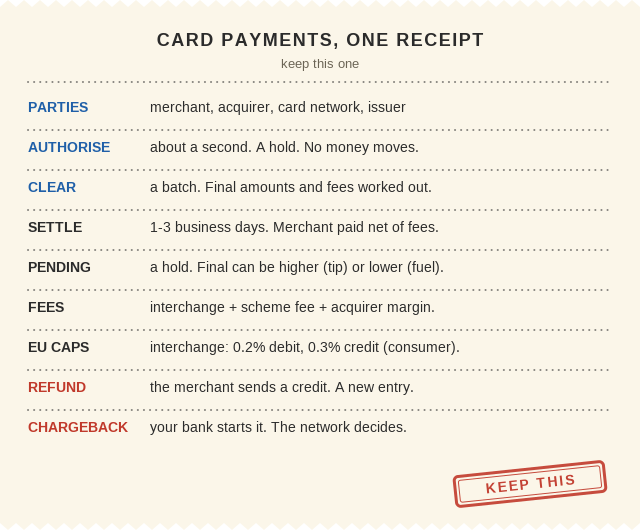
Cheat sheet
Further reading
- Regulation (EU) 2015/751 on interchange fees for card-based payment transactions, EUR-Lex
- ECB payments statistics, second half of 2024
- Federal Reserve: 2023 interchange fee revenue, covered issuer costs and fraud losses (report published December 2025)
- Visa: EMV payment acceptance for restaurant merchants (tips and gratuities)
- Mastercard: dispute resolution cycle
- FTC: using credit cards and disputing charges
- ISO 8583:2023, financial transaction card originated messages
- Stripe: authorisation holds explained and how payment settlement works
- How to Store Money in a Database Without Losing Cents
- Double-Entry Ledger in Postgres: Enforce the Rules in the Database
- Payment Reconciliation in SQL: Match Your Ledger to the Bank
- Idempotency Keys Explained: How to Make API Retries Safe

Backend engineer who builds high-volume systems that move money. More about Rafi