Part 1 of 12: Inside a Tesla Next: One Casting Instead of 70 Parts: Tesla's Giga Press
All 12 parts
- Inside a Tesla: A Computer That Happens to Have Wheels
- One Casting Instead of 70 Parts: Tesla's Giga Press
- Building a Car in Pieces: Tesla's Unboxed Process
- The Battery Is the Floor: Cells, Chemistry and the Structural Pack
- Fewer Wires, One Valve: Tesla's Electrical and Thermal Design
- Eight Cameras, No Radar: How a Tesla Sees
- The Chip in the Glovebox: Tesla's FSD Computer (HW3, HW4, AI5)
- Tesla HydraNet and Bird's-Eye View: From Eight Cameras to One Map
- Tesla Occupancy Network: Seeing Things It Has No Name For
- From Hand-Written Rules to One Network: How FSD Plans
- The Data Engine: How Tesla Teaches the Car
- Robotaxi: A Car With Nobody in the Driver's Seat
On 12 December 2023, Tesla sent a recall report to US regulators. It covered 2,031,220 cars: Model S, X, 3 and Y built up to 7 December 2023 with a driver-assist feature called Autosteer. The report says the fix is “an over-the-air software remedy”, at no cost to customers, expected to start reaching cars “on or shortly after December 12, 2023”, as software version 2023.44.30 (NHTSA report 23V-838).
The fix did not need a workshop. It was a software release sent to the car. What the recall was about is a story for later in this series. What matters here is the delivery. A car you can patch from a server is not built like a car from 1995.
So what is inside one? I took the 2025 Model Y as the example and went looking for the parts of the story that Tesla and outsiders have actually written down.
Part 1 of Inside a Tesla. I like the car and the tech, so I researched it to feed my own curiosity; not affiliated with Tesla, not investment advice.
Short version:
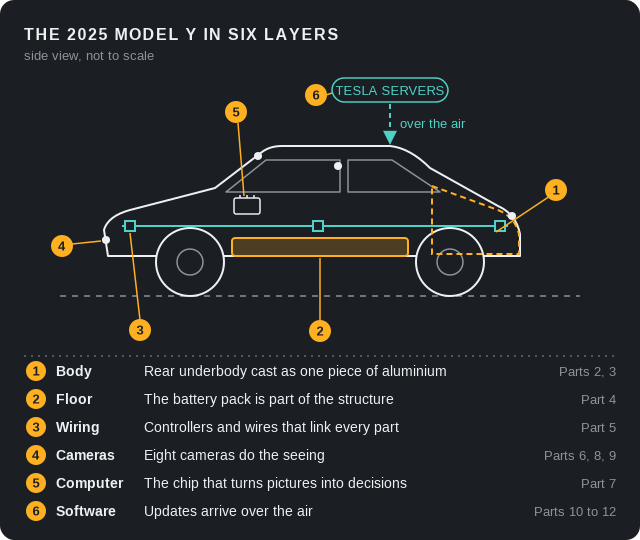
- A 2025 Model Y is six layers: a cast aluminium rear body, a battery that is part of the structure, wiring and controllers, cameras, a computer, and software that Tesla can change after the sale.
- Tesla publishes a lot (decks, patents, repair manuals), but its headline numbers are claims. Every claim in this series is labelled: Tesla says, regulator, or outside analysis.
- On 1 October 2026 Tesla still builds the Model 3, Model Y and Cybertruck. The Model S and X lines are gone, and the Cybercab has started production. Parts 2 to 5 cover how the car is made. Parts 6 to 12 cover how it sees and decides.
Why I am writing this
Tesla leaves a long public trail: patents, a service manual that anyone can open, quarterly updates filed with the US stock regulator, and long talks with slides. A curious person can read all of it. That is what I did, and this series is the result.
Three rules keep it honest.
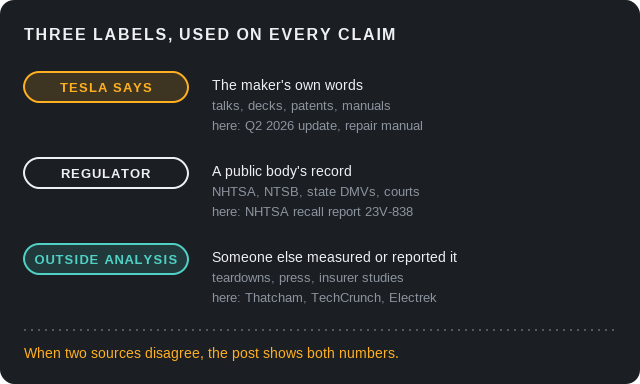
The series is about technology only. It does not cover the company’s owners, share price or politics. Numbers that change over time carry their date. And everything in this part is as of 1 October 2026: I use nothing published after that day.
The car as a map
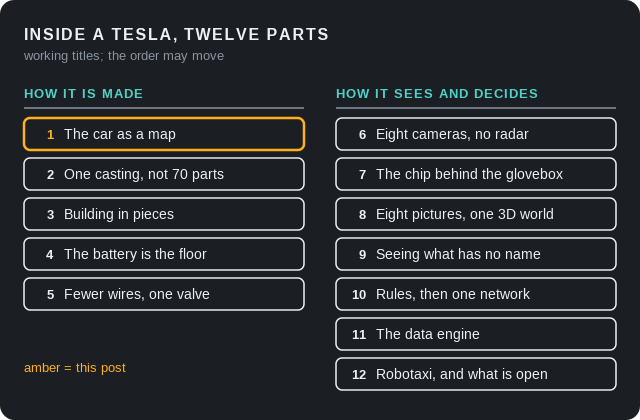
Here is the whole car in one picture. The next six sections follow the numbers.
The car itself changed in January 2025. Electrek’s write-up of the refreshed Model Y, shown in China on 9 January 2025, lists a light bar across the nose, acoustic glass, a rear-seat screen, a new front bumper camera, and no gear stalk.
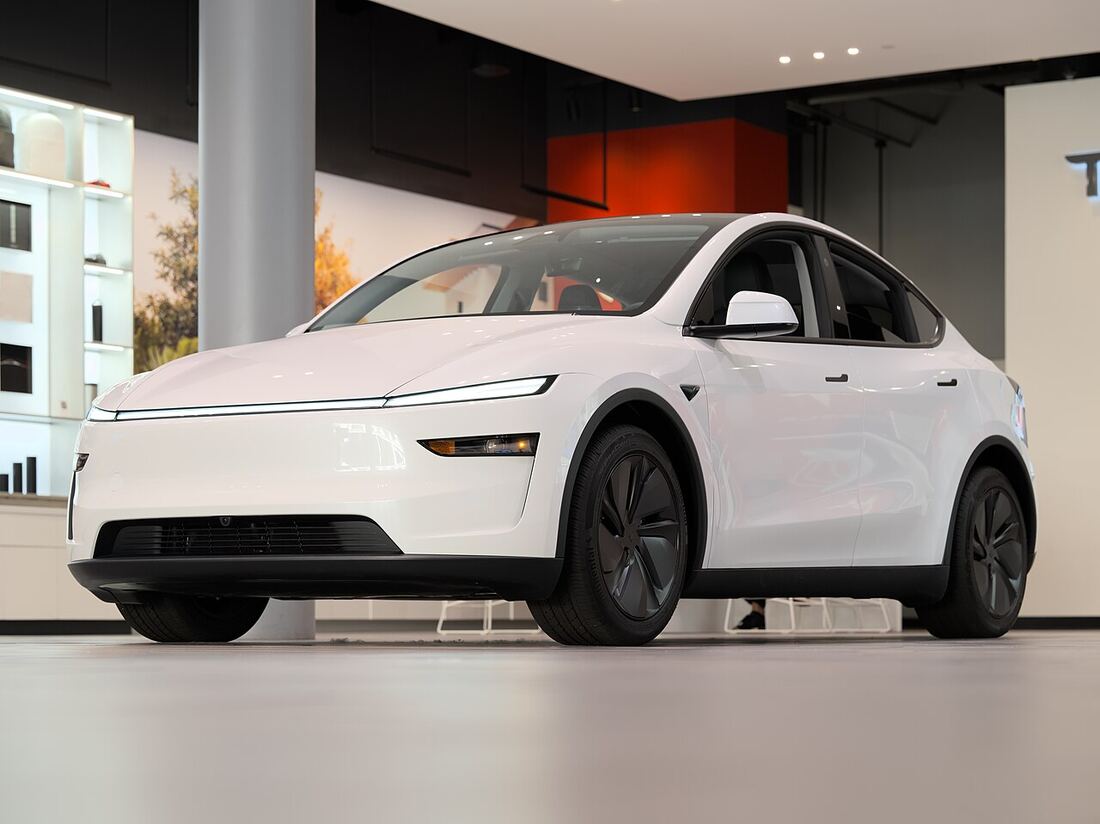
Photo: Dllu, CC BY-SA 4.0, via Wikimedia Commons, taken 3 March 2025. Resized.
1. Body: the rear is one casting
Most cars are stamped from sheet steel, then welded. Tesla instead pours molten aluminium into a die under huge pressure. The machine is an IDRA “Giga Press”, described by SAE’s Automotive Engineering in June 2020 as about 64 feet long and 17 feet tall. The same article reports that the Model Y’s rear underbody casting stands in for around 70 stampings, extrusions and castings of the Model 3’s rear structure (SAE, 1 June 2020). The 70 is SAE’s reporting, not a Tesla statement. Musk, quoted there, called the old structure “a patchwork quilt” and said the new casting “has no CNC machining - it doesn’t even have datums.” Those two lines are Tesla’s claim, made through Musk.
Outside data repeats the 70 and adds a catch about repairs. Thatcham Research, a UK vehicle research centre, ran a two-year study of the Model Y rear casting, reported on 18 September 2025. The report on it says the casting folds about 70 components into one. At 15 km/h the casting took no structural damage. At 25 km/h it cracked and needed full replacement. Even so, Thatcham found the casting cheaper to fix. A partial replacement cost £2,167 less than the Model 3’s multi-part steel rear, and a full replacement cost £519 less than the traditional repair, with the replacement casting itself priced at £716. The catch: welding repairs must be done at Tesla-approved sites, and the full report is open to Thatcham members only.
Tesla’s own repair manual explains why. It splits the casting into colour zones (Model Y collision repair manual). In a green zone, a weld repair up to 50 mm is allowed. In a yellow zone, up to 30 mm, or up to 50 mm with a bonded reinforcement plate. In a red zone: “Welding is not allowed.” Heat is never allowed to straighten the metal. Part 2 explains why the alloy matters here. A Tesla patent, WO2021150604A1, describes an aluminium alloy meant to work “as-cast and without further processing”, with a yield strength of at least about 130 MPa. I did not find Tesla saying which alloy the cars use.
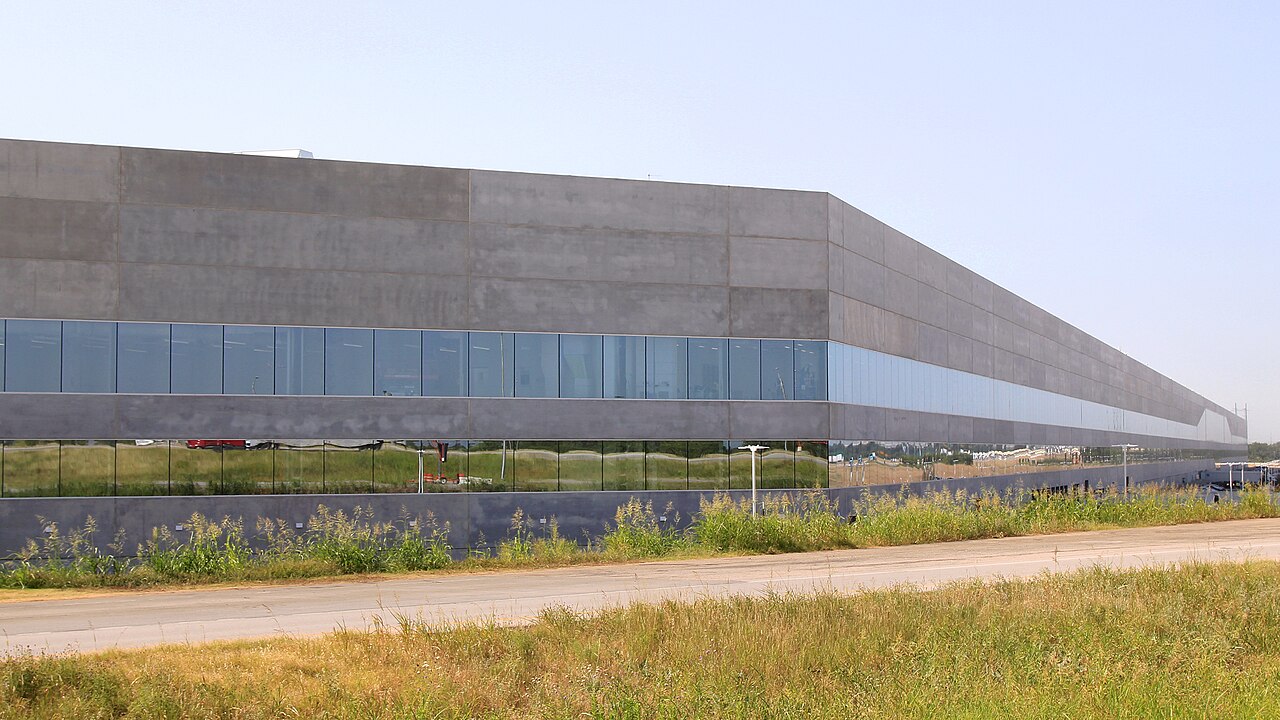
Photo: Larry D. Moore, CC BY 4.0, via Wikimedia Commons, June 2022. Resized. Building 1 of Giga Texas; Tesla’s Q2 2026 update lists Model Y production in Texas.
2. Floor: the battery is part of the structure
Normally a battery pack is a box bolted under the car. Tesla’s pitch is that the pack is part of the body. At its Battery Day event on 22 September 2020, Musk said the battery would be “an energy device and as structure”, with a filler that is “a structural adhesive, as well as flame-retardant” and “effectively glues the cells to the top and bottom sheet”. His summary of the gain: “10% mass reduction in the body of the car, 14% range increase, 370 fewer parts” (transcript, Rev). Those were 2020 targets, not results. Tesla also gave “five times the energy with six times the power” for its new 4680 cell, and a 16% range gain “just form factor alone”.
What came true? Tesla’s January 2026 update says it now produces dry electrode for 4680 cells, anode and cathode, in Austin and has “begun to produce battery packs for certain Model Ys with our 4680 cells” (Q4 2025 update). Read the words: certain Model Ys, not all. The April 2026 update lists Texas 4680 capacity at 40 GWh, and warns that production rates depend on “equipment uptime, component supply, downtime related to factory upgrades” (Q1 2026 update). So 40 GWh is what the plant can do, not what it did. Part 4 digs into the numbers.
3. Wiring: fewer wires, smarter controllers
A car carries power and data to every corner. In an old design, hundreds of wires run to one place. Tesla has been pushing controllers out into the car and linking the fast ones with a network it calls the etherloop. Pete Bannon, Tesla’s director of low-voltage electronics and hardware engineering, told Assembly magazine that the Cybertruck has 155 wires against 490 in a Model 3, even though it has more endpoints (368 against 273) (Assembly, 26 April 2024). That is a Tesla engineer’s claim about a different vehicle. I could not find Tesla giving a wire count for the Model Y, so I will not guess one. Part 5 covers the Cybertruck’s 48-volt system, the heat-pump valve and what is known about the Model Y.
4. Cameras: the car sees with eight
Tesla stopped fitting radar to North American Model 3 and Model Y cars in May 2021. Tesla’s FAQ at the time said: “Transitioning them to Tesla Vision first allows us to analyze a large volume of real-world data in a short amount of time” (TechCrunch, 25 May 2021). From October 2022 it stopped fitting the 12 ultrasonic parking sensors to the Model 3 and Y, replacing their job with what it called a “vision-based occupancy network” (TechCrunch, 4 October 2022). Electrek’s list of changes in the 2025 car does not mention either one coming back.
The 2025 car adds a camera in the front bumper. Tesla said it “provides a wider field of view for automatic assisted driving and advanced Smart Summon”, and Drive Tesla Canada counted “a total of 8 on-board cameras” once it was added (Drive Tesla Canada, 11 January 2025). That is the same total as on earlier cars, which NotATeslaApp also describes as having eight surround cameras (NotATeslaApp). So adding a camera in front means the layout changed somewhere else. I could not confirm where. Tesla’s own pages would not load for my research tool, so the count and the layout change are outside reporting, not Tesla’s word. Part 6 takes the cameras one by one.
5. Computer: the chip behind the pictures
Eight video streams need something to chew on. At Tesla’s Autonomy Day on 22 April 2019, the company showed its own computer for the job. TechCrunch reported two identical compute units on one board, made by Samsung on a 14 nm process in Texas (TechCrunch, 22 April 2019). The headline claim was 144 TOPS (trillions of operations per second). A chip-design blog at Cadence says the figure includes the second, redundant unit, so about half is available for driving (Cadence).
The power numbers look like a conflict but fit together. TechCrunch wrote that the whole computer “runs on about 100 watts”. Cadence lists “Power less than 100W” as the design goal, and says the main chip logic “runs at 72W” and the neural network accelerator at 15 W, “so they made their 100W goal”. Cadence does not say whether the 72 W covers one chip or both. Part 7 looks at that.
The 2025 Model Y has the newer generation, called AI4 or HW4. Tesla does not, as far as I found, publish its speed. NotATeslaApp puts it near 500 TOPS, with about 5 megapixel cameras, and does not credit that to Tesla. The next chip is AI5. In January 2026 Tesla said it was “targeting a 50x improvement in performance for AI5 relative to AI4”, with production planned for 2027 (Q4 2025 update). In April it said it had “completed the final chip design” of AI5 (Q1 2026 update). By Tesla’s own plan, then, AI5 is not in the cars on sale today. That last step is my reading of its dates, not a Tesla statement.
6. Software: the car you buy is not the car you keep
The screen in the middle of the dash is the car’s face. The photo below shows no gauge cluster behind the wheel; speed and settings live on that one screen.
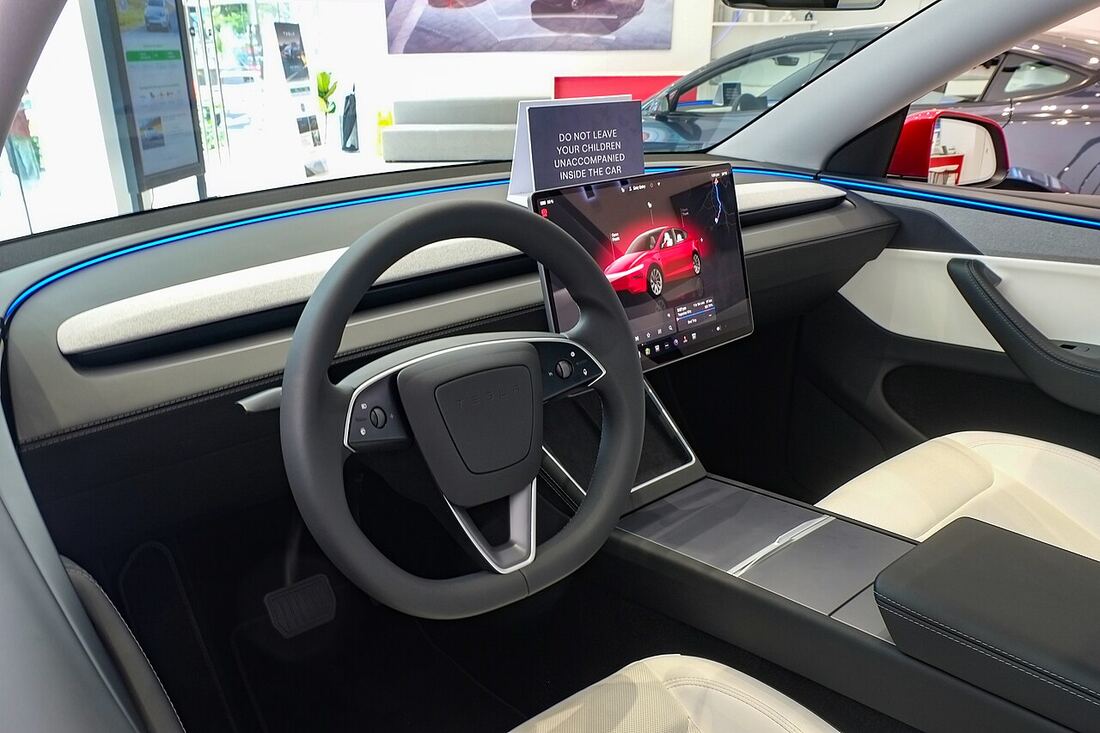
Photo: Ethan Llamas, CC BY-SA 4.0, via Wikimedia Commons, taken 29 March 2025 in a Tesla store in Bonifacio Global City. Resized.
Back to the recall. The same NHTSA report says cars in production got the fix from midday on 7 December 2023, so new cars came off the line already patched. Cars already sold got it over the air. The software change added alerts and checks around Autosteer. NBC Bay Area’s report adds that the remaining cars would get it “at a later date” (NBC Bay Area, 13 December 2023).
Driver-assist software is also a product. Tesla’s Q2 2026 update says active subscriptions to FSD (Supervised) stood at 1.48 million in the second quarter, counting upfront payments and monthly plans and leaving out free trials (Q2 2026 update). Tesla’s own footnote on the feature reads: “Active driver supervision required; does not make the vehicle autonomous” (Q4 2025 update). That is the starting point for Parts 10 to 12.
How many cars is that?
All of this is built at scale. Tesla’s Q2 2026 update lists Model 3 production in California and Shanghai, and Model Y production in California, Shanghai, Berlin and Texas. It does not split the numbers by model, so here are all models together:
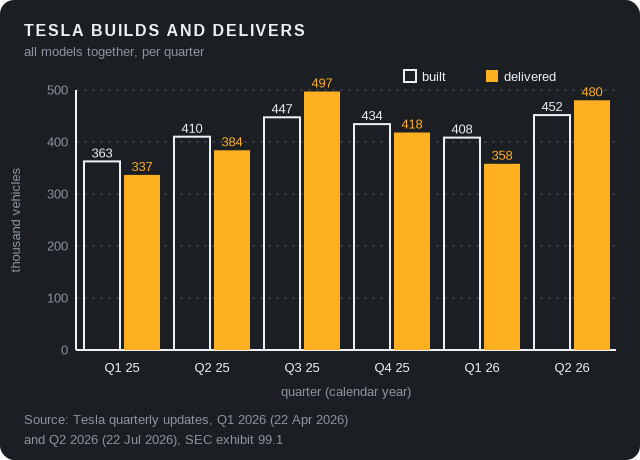
Adding the four 2025 quarters gives 1,654,667 cars built and 1,636,129 delivered. That sum is my arithmetic from Tesla’s tables. Deliveries beat production in Q3 2025 and Q2 2026, and fell short in the other four quarters.
The lowest bar for cars built is Q1 2025. Tesla’s April 2025 update ties that quarter to the new Model Y: “switchover of production lines for the New Model Y resulted in several weeks of lost production”. It also says the Shanghai Model Y factory “fully ramped production in six weeks, our quickest ramp of any vehicle ever”, and that this approach “will result in achieving less cost reduction than previously expected” (Q1 2025 update). Both halves are Tesla’s words: a quick ramp, and a smaller saving than planned.
What Tesla builds on 1 October 2026
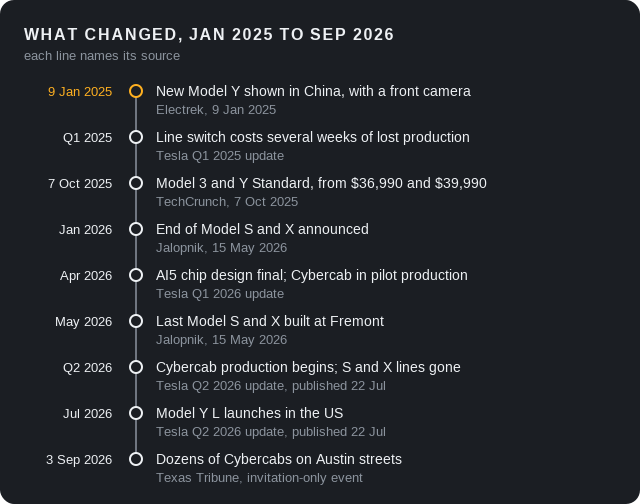
The lineup moved a lot in the 21 months before this post’s date.
| Product | State on 1 Oct 2026 | Source |
|---|---|---|
| Model 3 | In production in California and Shanghai. A Standard version from Oct 2025 | Tesla Q2 2026 update; TechCrunch |
| Model Y | In production at four factories. Standard (Oct 2025), Model Y L in the US (Jul 2026) | Tesla Q2 2026 update; TechCrunch |
| Model S and X | Ended. Tesla says the Fremont lines are decommissioned | Tesla Q2 2026 update; Jalopnik |
| Cybertruck | In production in Texas; installed capacity above 125,000 a year | Tesla Q2 2026 update |
| Cybercab | Production began at Giga Texas; dozens of cars on Austin streets from 3 Sep 2026, at an invitation-only event | Tesla Q2 2026 update; Texas Tribune |
| Semi | Commissioning in Nevada; “on track for production this year” | Tesla Q2 2026 update |
| Roadster | Design development | Tesla Q2 2026 update |
| Optimus (a robot, not a car) | First production lines being installed | Tesla Q2 2026 update |
Two cautions. “Installed capacity” is what a factory can do, not what it does. And the Model S and X story has two dates: Jalopnik says Musk announced the end on a January call, and that the last cars were built the weekend before 15 May 2026 (Jalopnik). The Model Y Standard started at $39,990 in the US, with a 321-mile estimate and a long list of cuts, among them no light bar, no glass roof and no rear-seat screen (TechCrunch, 7 October 2025). On 3 September 2026 “dozens” of Cybercabs went onto Austin streets at an invitation-only launch event. The cars have no steering wheel or brake pedals. The article gives no date for rides open to the public (Texas Tribune, 3 September 2026).
Where the series goes
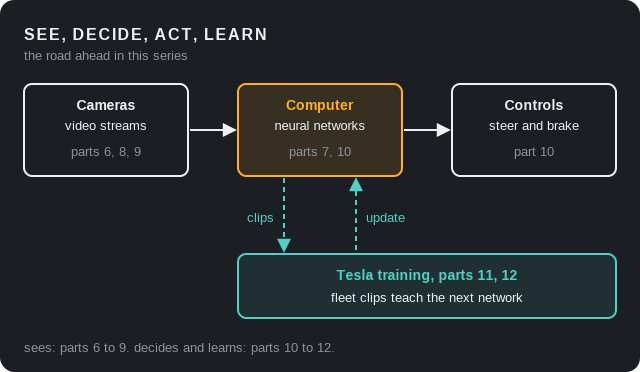
Here is the plan for the twelve parts. The first half is how the car is made. The second half is how it sees and decides.
The second half follows a loop. Cameras feed a computer. The computer runs neural networks (programs that learn from examples) and drives the controls. Separately, clips from the cars go back to Tesla, which trains the next version and sends it to the cars over the air.
Where the numbers do not agree
I said I would show both sides. Here are the places in this part where the sources pull apart:
| Topic | Tesla says | Other data |
|---|---|---|
| Rear casting | Musk (quoted by SAE, 2020): “a patchwork quilt” replaced by one casting; the 70 parts figure is SAE’s reporting | Thatcham repeats about 70, and finds the casting cracks at 25 km/h and needs full replacement |
| Repair cost | A repair manual with colour zones | Thatcham: partial replacement £2,167 less than the Model 3’s steel rear, full replacement £519 less than traditional repair, but welding only at Tesla-approved sites |
| “370 fewer parts” | Musk, Battery Day 2020, in the structural battery section | I found no breakdown, so I use 70 for one casting only |
| 4680 cells | 2020: five times the energy, six times the power | 2026: packs for “certain Model Ys”; capacity is not output |
| Chip power | 144 TOPS claim, 2019 | About half usable (Cadence). Power: under 100 W goal, 72 W for the chip logic |
| Camera count | Not confirmed by Tesla’s own page, which I could not open | Drive Tesla Canada counts 8 on the 2025 car, the same as earlier cars, so the layout changed |
Questions people ask
How many cameras does a 2025 Tesla Model Y have? Drive Tesla Canada counted eight on-board cameras after the front bumper camera was added in January 2025. That is the same total as earlier cars, so the layout moved elsewhere. Tesla’s own pages would not load for my tool, so this is outside reporting. Part 6 goes through where each one sits.
What is a Giga Press? It is an IDRA die-casting machine that injects molten aluminium into a mould to make a very large part in one shot. SAE reported in 2020 that Tesla’s rear casting replaces about 70 parts. Part 2 covers it.
Does a Tesla get updates over the air? Yes. In NHTSA recall 23V-838 (2,031,220 cars, December 2023), Tesla said a software remedy would reach certain affected cars from 12 December 2023 and the rest at a later date, at no cost to owners.
Is a Tesla self-driving? Tesla’s own footnote says the supervised feature requires active driver supervision and “does not make the vehicle autonomous”. Tesla has also put Cybercabs, which have no steering wheel or brake pedals, on Austin streets. Part 12 covers what that is and is not.
Is the Model S still made? No. The Fremont lines were decommissioned, according to Tesla’s Q2 2026 update. Jalopnik reports the last cars were built in May 2026.
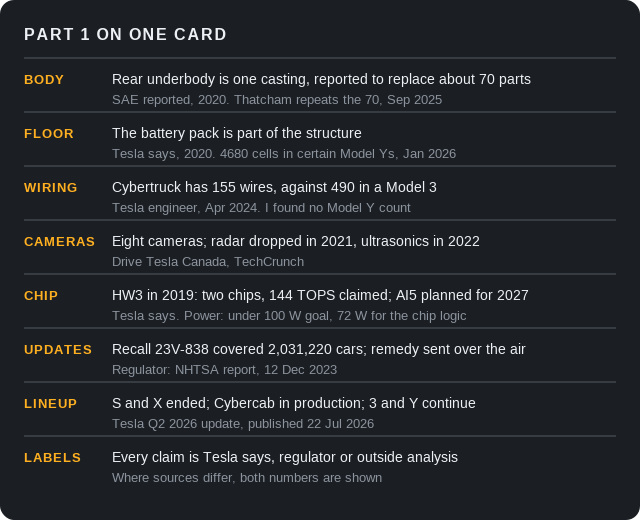
Cheat sheet
Next: the back of this car is one piece of aluminium that replaced about 70. How do you pour a part that big without it warping, and what do you do when a crash cracks it? Part 2 starts at the Giga Press.
Further reading
Tesla
- Q2 2026 update (SEC exhibit 99.1, webcast 22 July 2026)
- Q1 2026 update (webcast 22 April 2026)
- Q4 2025 update (webcast 28 January 2026)
- Q1 2025 update (webcast 22 April 2025)
- Model Y collision repair: cast rear underbody guidelines
- Battery Day 2020 transcript (a third-party transcript of Tesla’s event)
Patents
Regulators
Outside analysis
- SAE Automotive Engineering: Tesla casts a new strategy for lightweight structures
- Repairer Driven News on the Thatcham Research study
- Electrek: the refreshed Model Y
- Drive Tesla Canada: front camera on the new Model Y
- TechCrunch: radar removed from Model 3 and Y
- TechCrunch: ultrasonic sensors removed
- TechCrunch: the Autonomy Day chip
- Cadence: the Tesla FSD chip
- NotATeslaApp: how Tesla’s FSD hardware changed
- Assembly magazine: Cybertruck modular wiring
- TechCrunch: Model 3 and Y Standard
- Jalopnik: the last Model S and X
- Texas Tribune: Cybercabs in Austin
- NBC Bay Area (CNBC): the recall software fix

Backend engineer who builds high-volume systems that move money. More about Rafi